How to use a Cardiologist Email List for targeted healthcare marketing
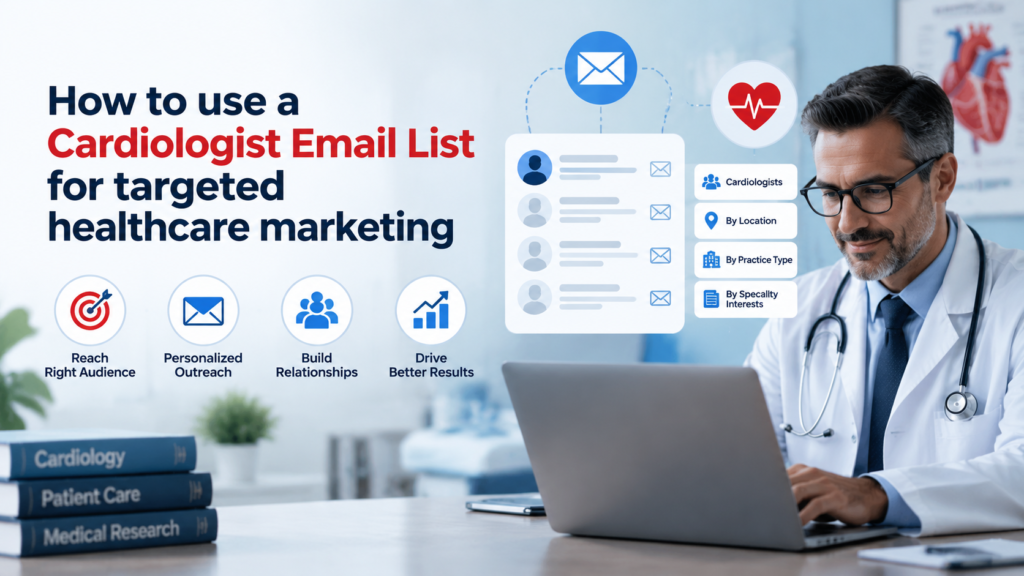
A Cardiologist Email List becomes useful when the campaign begins with a defined professional audience and a clear reason for contacting that audience. Cardiology covers several clinical areas, practice settings, hospital relationships, and purchasing situations, so sending the same message to every cardiologist usually wastes a large part of the list. A medical device manufacturer, healthcare software company, pharmaceutical business, recruitment firm, or education provider may all want to reach cardiologists, yet each company needs a different segment and campaign path. The quality of the result depends on matching the right cardiologist records with the right subject, evidence, offer, and follow-up process.
The scale of cardiovascular care explains why marketers often treat cardiology as a major healthcare audience. The American Heart Association’s 2026 cardiovascular statistics update reported 915,973 U.S. deaths attributed to cardiovascular disease in 2023 and estimated that 130.6 million U.S. adults had some form of cardiovascular disease based on 2021 to 2023 data. Those figures describe the size of the clinical burden, while the CDC heart disease statistics also show substantial use of physician services connected with chronic ischemic heart disease. Marketing teams still need to move from those broad numbers to specific professional groups before campaign planning becomes useful.The IInfotanks Cardiologist Email List is designed for companies that want professional cardiologist contact data that can be filtered around factors such as geography, specialty information, affiliation, and other available business fields. The current IInfotanks page lists 45,407 U.S. cardiologist records, including 31,497 email records, along with international coverage. Those figures should be checked again before publication because database counts can change as records are updated.The following sections explain how to turn a cardiologist contact database into a focused healthcare marketing program. The emphasis stays on audience selection, campaign planning, message relevance, account structure, content use, list maintenance, measurement, and compliance review. Each part addresses a different job in the campaign so the article doesn’t repeat the same segmentation advice under different headings.
Start by Deciding Exactly Which Cardiologists Should Receive the Campaign
The first campaign decision should define who has a professional reason to care about the offer. A broad label such as “cardiologists in the U.S.” gives the marketing team very little direction because it doesn’t explain which physicians use the relevant product, influence the buying decision, attend the event, qualify for the research program, or match the recruitment requirement. A useful audience definition combines the offer with the professional context in which that offer matters.
For example, a company selling equipment used in interventional procedures may begin with interventional cardiologists rather than the entire cardiology specialty. A company promoting ambulatory rhythm monitoring may care more about electrophysiology-related roles. A healthcare software provider selling to multi-location cardiology groups may need a wider physician audience, but the campaign may still need practice-setting and organization filters before any email is sent.
Write the target definition before importing records into an email platform. The definition should identify the relevant cardiology focus, geography, organization type, practice context, and any professional field that changes the likelihood of campaign fit. Some campaigns may need only 2 of those dimensions, while others may require more detailed filtering because the product has a narrow clinical application.
A simple campaign statement can keep the team focused: “This campaign is for interventional cardiologists affiliated with hospitals inside our current California sales territories who may evaluate catheterization-related equipment.” That sentence gives the data team a selection rule, gives the writer a real audience, and gives sales a clear idea of who should enter follow-up.
Know Which Fields Matter Before Buying or Exporting Data
A cardiologist database can contain many professional fields, but the campaign should request the fields that support a real decision. Extra columns don’t improve a campaign unless someone can explain how each field changes segmentation, messaging, sales routing, account grouping, or reporting. The data specification should therefore come after the campaign goal has been defined.
The broader physician email database from IInfotanks describes fields and filtering options across physicians, including specialty, geography, practice information, NPI-related details, and organization data. A cardiology campaign can use the same general logic while narrowing the audience to cardiovascular professionals who fit the use case.
| Data field | Campaign decision it supports | Example use |
| Cardiology specialty or subspecialty | Determines clinical relevance | Separate interventional cardiologists from general cardiologists |
| Practice setting | Helps shape the buying context | Change the message for independent practices and hospital-employed physicians |
| Hospital or organization affiliation | Supports account grouping | Connect physicians who work within the same health system |
| Geography | Controls market coverage | Build state, metro, territory, or regional campaigns |
| NPI | Supports provider identity checks | Match U.S. physician records before campaign assignment |
| Professional credentials | Helps confirm audience fit | Exclude records that don’t meet campaign requirements |
| Organization information | Adds commercial context | Separate independent practices from larger systems |
| Record-update information | Helps with list review | Identify older records that should be checked before sending |
A company selling a highly specialized product may place subspecialty at the top of the specification. A recruitment business may care more about location, credentials, current organization, and practice context. A conference organizer may need specialty plus geography, while a hospital software provider may need physician records grouped under organization-level accounts.
The useful question is simple: what decision will this field help us make? Keep fields that have a clear answer and remove fields that add complexity without changing the campaign.
Segment Cardiologists by Clinical Focus Before Writing the Message
Clinical focus often provides the strongest first segmentation layer because it connects the recipient with the actual subject of the campaign. Cardiology includes general cardiology, interventional cardiology, electrophysiology, heart failure, preventive cardiology, pediatric cardiology, imaging-related work, and other areas that can involve different procedures and technology requirements. A campaign becomes easier to write once the audience is narrowed to the specialists most closely connected with the offer.
A company promoting catheter-based technology, for example, can begin with an interventional cardiologist contact database rather than placing the same product message in front of every cardiologist. The email can then discuss the setting, professional use, evidence, or technical information that matters to that specific audience. The landing page and follow-up materials should follow the same audience logic.
The table below shows how the campaign focus may change across different cardiology groups.
| Cardiologist segment | Possible campaign subject | Information likely to matter | Suitable next step |
| General cardiology | Broad cardiovascular services or practice technology | Everyday clinical or practice relevance | Review product or service information |
| Interventional cardiology | Cath lab products or procedure-related equipment | Procedure application and technical evidence | Request technical material |
| Electrophysiology | Rhythm monitoring or EP technology | Arrhythmia use case and workflow fit | View clinical or technical resource |
| Heart failure specialists | Monitoring or disease-management programs | Program relevance and supporting evidence | Review clinical information |
| Pediatric cardiology | Pediatric cardiovascular products or education | Age-specific professional relevance | Access pediatric-focused material |
| Academic cardiology | Research programs or scientific education | Study evidence and research relevance | Review research material |
The content should change enough that each segment receives a message written for its work. Adding “interventional cardiologist” to the first sentence while keeping every other part of the email unchanged gives little practical value. The evidence, CTA, landing page, and follow-up questions should also reflect the segment where the product or campaign genuinely differs.
Practice Setting Changes the Buying Process
A cardiologist’s workplace can affect who evaluates a product, who approves a purchase, and how long the decision may take. Independent practices, hospital-owned groups, academic centers, and large health systems often have different approval structures. A marketing team that understands those differences can build a more realistic follow-up path before leads reach sales.
The AMA physician ownership analysis reported that 30.7% of cardiologists were in private practice in 2024. The broader AMA analysis also documented continued movement of physicians toward practices owned by hospitals and other organizations. That shift matters for healthcare marketing because a physician may influence clinical evaluation while another department controls contracting, procurement, IT review, or budget approval.
Independent cardiology practices
Independent cardiology groups may have a shorter path between clinical interest and business evaluation. A physician partner or practice administrator can sometimes have direct influence over software, equipment, staffing, or service decisions. Campaign content can therefore include practical information about implementation, practice use, training requirements, and the next commercial step where those subjects fit the offer.
The email should still respect the physician’s role. Technical detail belongs in supporting material when it would overload the initial message. The first contact should establish relevance, explain why the product or resource belongs in the physician’s professional context, and provide a clear route to deeper information.
Hospital-employed cardiologists
Hospital-employed cardiologists often work inside a wider purchasing structure. Clinical interest may need to be followed by review from procurement, information technology, operations, security, finance, or another function depending on the product. The marketing team should map that likely path so the cardiologist isn’t expected to carry a message that belongs with another stakeholder.
A useful account plan can assign different content to different roles. The cardiologist can receive clinical evidence and use-case information, while another contact receives implementation, system, commercial, or organizational details that relate to that person’s responsibilities.
Academic medical centers
Academic cardiologists may combine clinical responsibilities with research, teaching, or committee work. Campaigns aimed at this audience often need stronger evidence and clearer scientific context, especially when the subject involves research tools, specialist education, clinical technology, or study participation. Claims should be tied closely to verifiable sources and approved product information.
The goal is to respect the recipient’s professional setting rather than assuming every cardiologist follows the same purchasing path.
Geography Should Shape Campaign Strategy
Geographic filters have more value when they affect the offer, sales coverage, event relevance, or service availability. Selecting a state simply because the database can filter by state gives the marketing team a location boundary without a business reason. A stronger campaign connects location with something that changes the recipient’s experience or the company’s ability to support the account.
The CDC’s analysis of rural heart disease prevalence reported higher heart disease prevalence among adults aged 45 and older in nonmetropolitan areas than in the metropolitan categories examined using 2024 National Health Interview Survey data. Population-level findings should stay at the market-planning level. They don’t establish anything about the needs of an individual physician or organization.
Healthcare marketers can use geography in several practical ways:
- Align records with active sales territories. Start with areas where the company already has representatives, distribution, onboarding support, or service capacity. A qualified cardiologist response has less commercial value if the company can’t support the account in that market.
- Build campaigns around local events. Conferences, dinners, workshops, training sessions, and regional webinars can be promoted to cardiologists within a relevant travel area. The location filter should match the event rather than follow an arbitrary state boundary.
- Separate regional performance. Measure qualified responses, registrations, inquiries, and later sales outcomes by territory. Regional differences can reveal audience-quality issues or market conditions that disappear inside national reporting.
- Reflect local availability. Products, services, research programs, or recruitment opportunities may be available only in certain markets. The email should state relevant geographic limits clearly so recipients aren’t sent to an offer they can’t use.
Location becomes valuable once it changes who should receive the campaign or what the recipient can do next.
Build the Campaign Around a Real Healthcare Use Case
A cardiologist campaign should begin with the professional use case rather than the product category. “Healthcare software for cardiologists” is still broad. “Scheduling software for multi-location cardiology practices” gives the campaign team a clearer audience and a clearer business problem to discuss.
The same principle applies to medical devices. A device used in a defined procedure should be promoted to professionals connected with that procedure, subject to the product’s approved use and the company’s review requirements. Educational campaigns should start with the subject being taught, while recruitment campaigns should begin with the role requirements and market.
Health technology deserves particular care because physician interest can depend on workflow, evidence, system fit, privacy, and implementation requirements. The AMA physician AI survey reported that 66% of surveyed physicians used health AI in 2024, compared with 38% in 2023. The survey also found that physicians considered areas such as data privacy and EHR integration when evaluating health AI.
Those findings provide category context. A company still needs evidence for its own product and shouldn’t borrow broad industry statistics as proof of specific performance.
A useful campaign brief should describe the professional situation in plain language. State what the cardiologist is likely doing, where the product or resource enters that work, what information supports the claim being made, and what action makes sense after the email. This keeps the campaign focused on the recipient’s context.
Medical Device Campaigns Need Clinical Relevance Before Promotion
Medical device marketing to cardiologists works best when the audience is selected around the product’s professional application. Devices used in electrophysiology, interventional cardiology, imaging, monitoring, or another cardiovascular area may require different specialty filters. Sending the same device message across the full cardiology category can create poor audience fit even when every email address is valid.The first email should explain why the information is relevant to the physician’s area of work. Technical specifications, clinical evidence, approved indications, training information, product documentation, and implementation material can then support evaluation based on what the company is permitted to communicate.
The content team should also separate educational material from promotional claims. A study can explain a clinical issue or category finding without proving that a specific product performs better. Product-specific statements need their own support and required review.
Medical device teams can improve campaign planning by creating separate content paths for physicians who request technical material, physicians who register for education, and accounts that need commercial follow-up. Each action signals a different level of interest and should lead to a different next step.
Pharmaceutical Outreach Requires Careful Evidence Use
Pharmaceutical communication needs a tighter review process because claims about treatment, safety, efficacy, indication, or comparative performance can carry regulatory implications. The audience should be professionally relevant to the therapeutic area, while campaign content should follow the organization’s approved materials and review requirements.A 2025 academic detailing systematic review examined 118 studies involving educational outreach aimed at changing prescribing behavior. Among the 36 studies assessed as having the lowest risk of bias, half produced significant improvement across all measured prescribing outcomes, while the median absolute change in targeted medication use was 4.0% in the intended direction.That research concerns educational outreach rather than ordinary commercial email. It still illustrates why evidence-based professional communication deserves more attention than repetitive promotional messages.Pharmaceutical marketers should keep each campaign tied to approved professional information. Medical, legal, regulatory, privacy, and other internal reviewers should examine the required claims before distribution. Marketing copy should never expand a research finding beyond what the study itself supports.A Cardiologist Email List can help identify a relevant professional audience, but audience selection doesn’t replace the review requirements attached to the content.
Healthcare Software Campaigns Should Explain the Workflow
Software marketing often fails when it describes the product category without showing where the software fits inside the cardiology practice. A cardiologist doesn’t need another email claiming that a platform improves healthcare operations. The physician needs enough context to understand which task the software affects and whether that task belongs to their work.
A campaign promoting remote cardiac monitoring software, for example, should define the monitoring workflow it supports. A scheduling product should explain the practice setting it is intended for. A documentation tool should state where it enters the physician or staff workflow and which systems or processes are involved.The email can then direct the recipient to a fuller resource. Technical documentation may cover integration and system requirements, while another page can address implementation or clinical use. Different stakeholders can receive different parts of the information once the account shows interest.The healthcare email marketing guide from IInfotanks covers broader email campaign practices that can be adapted when planning healthcare outreach. The cardiology campaign still needs its own audience logic because the professional context determines which message deserves to reach which physician.
Write the First Email for a Busy Clinical Reader
Cardiologists work inside communication-heavy environments, so the first email needs to establish relevance quickly. A long company introduction makes the recipient search for the reason the message arrived. Put the professional connection near the beginning and move supporting detail lower in the email or into the linked resource.Research on clinical communication load provides useful context. A JAMA physician notification study examined 276,207 EHR notifications received by physicians across 3 large practices. Specialists at the multispecialty site received a mean of 29.1 EHR notifications per day, while primary care physicians in the study received more. EHR notifications differ from marketing email, but the research shows that clinicians already manage substantial information flow.
A useful first message should therefore answer the recipient’s immediate questions in a sensible order. Explain why the message concerns their professional area, what is being shared, why the information may matter, and where the recipient can find further detail.For example, a weak opening might spend a paragraph describing the company’s history before mentioning ambulatory rhythm monitoring. A stronger version would begin with the monitoring subject and the intended electrophysiology audience, then move to supporting information.
Keep the CTA proportional to the recipient’s likely level of interest. A cold recipient may be more willing to review technical information than commit to a sales meeting immediately. The campaign can move toward a commercial discussion after genuine engagement appears.
Build Follow-up Emails Around Different Information Needs
A follow-up sequence should add useful information rather than repeat the first email with different wording. Each message needs its own reason to exist, and the sequence should stop once the campaign has made the relevant information available or the recipient signals disinterest.A 4-stage structure can work as a planning model, although the exact sequence should reflect campaign purpose, audience behavior, applicable law, and company policy.
Stage 1: establish professional relevance
The first message explains why the cardiologist is receiving the email. It identifies the professional topic and gives enough information for the recipient to judge whether the subject belongs in their work.The message should avoid dense product explanation. Give the reader a clear route to more detail if the subject is relevant.
Stage 2: provide supporting evidence
The next message can introduce the strongest approved evidence connected with the campaign. This may include a peer-reviewed study, technical resource, product documentation, research summary, or educational material.
The evidence should support the exact point being made. Avoid using a general industry statistic as proof of a product-specific outcome.
Stage 3: answer an evaluation question
The next message can focus on a practical question that often appears during consideration. A software buyer may care about integration. A medical device evaluator may want technical information. An event prospect may need agenda details.
Answering 1 concrete question gives the message a clear purpose.
Stage 4: offer an appropriate next action
The final stage can invite the recipient to request information, review a resource, register, reply with a question, or identify another contact when appropriate.
The campaign should also make opt-out handling easy and permanent according to applicable requirements. Response data from the sequence should feed back into future audience decisions.
Use the List to Distribute Cardiology Content More Precisely
Content marketing becomes more useful when distribution is planned around cardiology segments. A research summary about arrhythmia management should reach a different audience from a practice-management guide aimed at independent cardiology groups. One asset may be valuable for several audiences, but the reason for sending it can still change.
Research summaries work well when the study directly relates to the recipient’s professional area. The email should provide enough context to explain why the paper matters, while the full resource can carry methodology, findings, limitations, and interpretation. Marketing teams should avoid overstating conclusions or removing study limitations that materially affect the finding.Technical guides fit products that require detailed review. A first email can introduce the subject and point toward specifications, implementation requirements, compatibility information, or approved documentation. This keeps the initial message readable while still giving interested cardiologists access to depth.Webinars and specialist education need precise audience selection. Registration numbers can look strong while producing little commercial value if most registrants fall outside the intended specialty. Measure the professional quality of the audience alongside total registration.Original research, benchmark reports, and specialty surveys can also support outreach when the methodology is sound and the subject is useful to the recipient. Keep promotional statements separate from research findings so readers can distinguish evidence from marketing.
Turn Cardiologist Contacts into Account-level Campaigns
Many healthcare purchases involve several people inside the same organization. A cardiologist may identify a need or evaluate the clinical case, while another stakeholder handles implementation, technology review, contracting, or budget. Grouping records by hospital, health system, or practice can therefore give the campaign more commercial context.
A hospital administrator email database can support account planning when administrators genuinely participate in the decision. The administrative message should be written for that role rather than copied from the cardiologist campaign.Consider a cardiology software purchase inside a large health system. The cardiologist may care about clinical usability and the effect on daily work. A technical reviewer may care about system requirements and security review. An administrative contact may need information connected with implementation planning or financial approval.Account-level campaigns should connect those contacts around the same business need while keeping the content appropriate for each role. This approach also helps sales teams see whether several relevant people inside one organization are engaging with the campaign.The account view becomes especially useful for products that require a longer decision process. Instead of treating every cardiologist reply as an isolated lead, the company can examine the wider organization and identify the next professional contact required for evaluation.
Cardiologist Data Can Support Event Promotion
Events give marketers a clear reason to segment by specialty and geography. A national cardiology webinar can use subspecialty as the main filter, while a regional workshop may need both specialty and location. A small in-person program may require an even narrower market because travel distance affects attendance.Start with the agenda before building the audience. Each session should have a defined professional subject, and the invite list should contain cardiologists who have a reasonable connection with that subject. A general cardiology conference can support a wider group than an electrophysiology workshop.The invitation should state the educational subject early. Agenda details, speaker information, timing, format, and registration requirements can follow in the body or linked event page. Avoid vague event promotion that forces the physician to open several pages before understanding what will be discussed.Event reporting should also go beyond registration totals. Measure whether the right cardiologists registered, attended, engaged with follow-up material, and entered any later stage relevant to the campaign. A small audience of highly relevant specialists can carry more value than a large group with weak fit.
Research Outreach Needs Criteria Before Contact Selection
Research organizations can use professional cardiologist data to identify potential investigators, survey participants, advisory participants, or professional audiences for research communication. The campaign must begin with criteria defined by the research team rather than criteria invented by marketing.For investigator-related outreach, the study team may care about specialty, research background, institutional setting, geographic location, or other qualifications. Those requirements should determine which professional records are reviewed.
Marketing data can’t establish clinical trial eligibility or replace formal study procedures. It can help locate potential professional contacts after the correct research criteria have been defined.
The message should also distinguish research participation from ordinary promotion. Explain the purpose of the outreach, the type of participation being requested, and the next approved step.Organizations working in regulated research environments should route the campaign through the required research, legal, privacy, ethics, and institutional review processes before contacting professionals.
Recruitment Teams Need a Different Segmentation Model
Recruitment campaigns use the same professional database differently because the offer is a career opportunity. Clinical product use becomes less important, while specialty, location, credentials, organization type, career context, and practice setting become more useful.
A recruiter looking for an interventional cardiologist in Texas should begin with that exact professional requirement. Sending the vacancy to general cardiologists across the country creates avoidable noise and can damage future engagement.
The first message should make the role understandable without forcing the physician through several follow-ups. State the required specialty, market, employment setting, and enough role information for the recipient to judge basic fit.
Recruitment response data can also improve the database. A physician who reports a new employer, different location, or changed professional focus gives the team information that may affect future campaigns.
Suppression rules remain important. A cardiologist who clearly declines recruitment outreach should be handled according to the organization’s communication policy and applicable requirements.
Keep Cardiologist Records Current Between Campaigns
Professional data changes continuously because physicians move organizations, hospital systems reorganize, email addresses become inactive, and specialty information may be recorded inconsistently across sources. A database that performed well last year can still need review before a new campaign.
NPI can support U.S. provider identity checks because CMS assigns covered healthcare providers a unique 10-digit identifier. The identifier itself doesn’t contain specialty or geographic meaning, so additional current fields remain necessary for campaign segmentation.
Companies working with incomplete healthcare records can use an NPI data appending service to add or match provider identity information where appropriate. The resulting data should still be reviewed according to the company’s own campaign standards.
A pre-send review can cover the following areas:
- Remove known invalid addresses and suppressed contacts. A record that has already hard bounced or opted out shouldn’t return to an active commercial campaign because someone uploaded an older file.
- Check organization affiliation where it affects the message. A physician who moved from a private practice into a health system may need a different campaign path even if the email remains active.
- Review specialty information. Confirm that the professional category used for segmentation still matches the campaign requirement, especially for narrow subspecialty outreach.
- Deduplicate records before assignment. Duplicate records can produce repeated messages and distort campaign reporting. Establish 1 canonical record before launching.
- Keep update dates visible. Knowing when a field was last checked helps marketing teams decide which segments deserve extra review before reuse.
List maintenance should continue after sending. Bounces, replies, referrals, opt-outs, employer changes, and wrong-person responses all provide information that can improve the next campaign.
Measure List Quality Separately from Campaign Quality
A campaign can fail for several different reasons, so reporting should separate problems in the data from problems in the message. Combining everything into a single engagement score makes it harder to know what should change.
A high hard-bounce rate points toward contact validity. A high rate of “wrong person” replies may indicate a segmentation or affiliation problem. Low qualified response from a clean audience may indicate weak message relevance, a poor offer, or a CTA that asks too much too early.
Use a measurement framework that assigns each metric to the part of the campaign it can actually diagnose.
| Measurement area | Useful metric | What the result can reveal |
| Contact validity | Hard bounce rate | Whether email records remain active |
| Audience accuracy | Wrong-person responses | Whether segmentation rules are working |
| Professional relevance | Qualified reply rate | Whether the subject matches recipient needs |
| Content interest | Resource visits or downloads | Whether the promoted material has value |
| Event fit | Qualified registrations | Whether the audience matches the agenda |
| Commercial interest | Relevant inquiries | Whether recipients are moving toward evaluation |
| Account activity | Engagement across one organization | Whether several stakeholders are showing interest |
| Database freshness | Employer or role corrections | Whether records need updating |
Open rates should be interpreted carefully because privacy features and automated systems can make opens a weak measure of human attention. Qualified actions usually provide stronger evidence.
The campaign team should define its main outcome before sending. A webinar may focus on registrations from the correct cardiology segment. A software campaign may focus on qualified information requests. A recruitment campaign may focus on replies from cardiologists who match the role.
Segment-level reporting gives the team the most useful learning. If one subspecialty responds differently from another, examine the offer and content. If a single territory generates many wrong-contact replies, inspect the underlying data for that region.
Protect Compliance and Approval Standards
Professional cardiologist contact data still needs responsible use. Commercial email rules, privacy requirements, healthcare regulations, company policies, and product-specific review requirements can all affect a campaign.
For U.S. commercial email, the FTC CAN-SPAM compliance guidance explains requirements around sender information, subject lines, postal information, and opt-out handling. The user requested external links to research and statistics, so this legal guidance should be human-reviewed before publication if the final editorial policy restricts outside links strictly to studies and statistical sources.
Healthcare marketers also need to distinguish professional contact information from patient information. A cardiologist business email database should be treated as professional outreach data. Patient medical records, protected health information, claims information, and clinical histories belong to a different category and carry different legal responsibilities.
Medical device, pharmaceutical, research, and other regulated healthcare campaigns may require review beyond general commercial-email rules. Product claims, therapeutic statements, research invitations, and comparative statements should go through the company’s required human approval process before launch.
Maintain a campaign record showing where the data came from, why the segment was selected, which suppression rules were applied, what claims were used, what evidence supports them, and who approved the material. That record gives legal, compliance, marketing, and sales teams a clear reference if questions appear later.
Which Cardiologist Marketing Approach Fits your Use Case?
The right use of a Cardiologist Email List depends on the offer and the decision process around that offer. The list should be shaped around the professional situation rather than treated as one fixed audience.
Medical device companies should begin with the cardiology area connected with the product’s professional use. Procedure-specific equipment may require interventional cardiologists or electrophysiologists, while broader cardiovascular products may support a wider group. Clinical relevance should determine the audience before geography or account size is added.
Healthcare software companies should combine specialty with practice setting and organization context. Products that require IT involvement, hospital approval, or system-level implementation benefit from account-level planning because the cardiologist may be one participant in a larger decision.
Pharmaceutical companies should keep therapeutic relevance and approved communication at the center of audience selection. Evidence and required review should shape the campaign before commercial follow-up begins.
Medical education and event teams should work backward from the subject. The agenda determines which cardiologists are relevant, while location and event format can narrow the audience further.
Recruitment firms should shift the criteria toward specialty, location, credentials, and employment context. A recruitment email has a different purpose from a product campaign, so the message and follow-up path should change accordingly.
Research organizations should begin with study-defined professional criteria. Contact data can support discovery and communication after those requirements are established.
IInfotanks’ healthcare professional email lists cover cardiologists along with other physician and healthcare professional groups. That wider coverage can help when a campaign needs related specialists or organization-level contacts around the same healthcare account.
A Cardiologist Email List Works Best as Part of a Repeatable Process
The strongest campaign process begins before the first email is written. Define the audience, choose the fields that support that definition, review the professional data, prepare the message around the actual use case, and decide how responses will be measured. Each step gives the next team member clearer information.The first campaign should also produce data for the second. Bounces show contact issues. Wrong-person replies show audience problems. Qualified engagement shows which segments deserve more attention. Employer corrections and referrals improve account knowledge.Over time, this process creates a more useful cardiology marketing database because the company is learning from actual campaign outcomes. The email list becomes part of the campaign system rather than a static spreadsheet that is uploaded repeatedly without review.That distinction matters for healthcare marketing. Cardiologists have narrow professional interests and limited time. A campaign earns attention by being relevant enough that the recipient can immediately understand why the message reached them.
Reach the Cardiologists Who Fit your Campaign with IInfotanks
IInfotanks provides cardiologist contact data for healthcare companies that need to build professional audiences around factors such as geography, cardiology focus, affiliation, and available business information. The current cardiologist page includes U.S. and international coverage and provides an option to request sample data before a wider purchase.
Before requesting a list, define the exact audience your campaign requires. Share the target geography, cardiology segment, organization criteria, required fields, and intended business use so the data can be reviewed against a real campaign specification.
Ask for sample records that reflect those same criteria. Check the sample against your own data standards, sending policy, sales coverage, and compliance requirements before activating the full campaign.A clear audience request gives both the data team and the marketing team a better starting point. It also reduces the chance that campaign writers will be asked to create one generic message for cardiologists whose professional contexts differ substantially.
If your next campaign requires cardiologist contacts, review the current IInfotanks Cardiologist Email List page and request a sample built around the professional segment you intend to reach.
Frequently Asked Questions
What is a Cardiologist Email List?
A Cardiologist Email List is a professional contact database containing cardiologists and related business information that can support permitted healthcare marketing, recruitment, event promotion, research outreach, and other professional communication. Available fields may include professional email, cardiology focus, geography, organization affiliation, credentials, NPI-related information, and other business data depending on the provider and selected package.The useful part of the list is the ability to define a specific professional audience. A general cardiology event may support a broad physician segment, while a campaign involving electrophysiology technology should begin with cardiologists whose work connects with that subject.Campaign teams should review the source, fields, update process, suppression practices, and intended use before activating the data. A large record count alone doesn’t establish whether the list fits a particular campaign.
How should a Cardiologist Email List be segmented?
Start with the factor most closely connected to the offer. Clinical subspecialty is often the strongest first filter for devices, specialist education, or therapeutic communication, while practice setting and organization affiliation can matter more for software and account-level purchases.Geography should be added when it affects sales coverage, service availability, recruitment location, event attendance, or another real campaign condition. Organization information can then help the team group physicians into accounts where several stakeholders may participate in the decision.Every filter should change something meaningful in the campaign. A filter that doesn’t affect the message, CTA, account path, eligibility, or reporting may add complexity without improving audience fit.
How often should cardiologist contact data be reviewed?
Review important fields before each meaningful campaign, especially when the audience hasn’t been used recently. Professional records can change because physicians move organizations, practices merge, health systems reorganize, and email addresses become inactive.
Your own campaign data should become part of the maintenance process. Hard bounces, employer corrections, opt-outs, referrals, and wrong-person replies can all indicate that a record needs attention.There isn’t 1 review schedule that guarantees accuracy for every field. Ask the data provider how current records are maintained and keep your own record of campaign corrections so known problems don’t return during later sends.
Can a Cardiologist Email List be used for medical device marketing?
A cardiologist database can support medical device marketing when the professional audience fits the product and the campaign follows applicable legal, regulatory, privacy, and internal review requirements. Products connected with specific procedures should usually begin with the cardiology group most closely associated with that professional use.The email should explain why the product information is relevant to the recipient’s work. Technical documentation, study evidence, approved product information, and educational material can support deeper evaluation after the first contact.Claims about performance, safety, indication, clinical benefit, or comparative results should receive the required human review before the campaign is sent. Audience selection can’t compensate for unsupported product claims.
Can healthcare software companies use cardiologist email data?
Healthcare software companies can use cardiologist contact data to identify physicians and organizations that may have a professional reason to evaluate the software. The campaign should define the workflow or business task the product addresses before selecting records.
Practice setting matters because a cardiologist in an independent group may follow a different purchase process from a hospital-employed physician. Organization affiliation can also help the marketing team identify accounts where technical, administrative, or procurement stakeholders may need separate information.The campaign should explain where the software fits into the cardiology workflow and provide appropriate technical detail when the recipient moves deeper into evaluation. General software claims usually create weaker campaigns than clear workflow-specific communication.
What metrics matter most in cardiologist email marketing?
The best metric depends on the purpose of the campaign. A webinar campaign may focus on qualified registrations from the intended cardiology segment, while a product campaign may care more about information requests or relevant commercial inquiries.
Data-quality metrics should be tracked separately. Hard bounces, wrong-person replies, changed employers, and duplicate records tell the team about the database rather than the strength of the offer.
Compare results across meaningful segments. Differences between subspecialties, practice settings, organizations, or territories can show where the audience definition or campaign content needs adjustment.
Is it legal to send marketing emails to cardiologists?
The legal answer depends on the recipient’s location, the source of the data, the type of message, the sender’s relationship with the recipient, and the laws that apply. U.S. commercial email may fall under CAN-SPAM requirements, while other countries and regions can have different rules.Healthcare organizations may also need internal review for privacy, promotional claims, research communication, pharmaceutical content, medical device information, and other regulated subjects. Those requirements can go beyond ordinary email marketing rules.
Legal and compliance teams should review the final campaign where required. Marketing teams should also maintain suppression records and honor applicable opt-out requirements so contacts who shouldn’t receive future commercial messages aren’t returned to active lists.