How SEO Experts audit content for AI search visibility
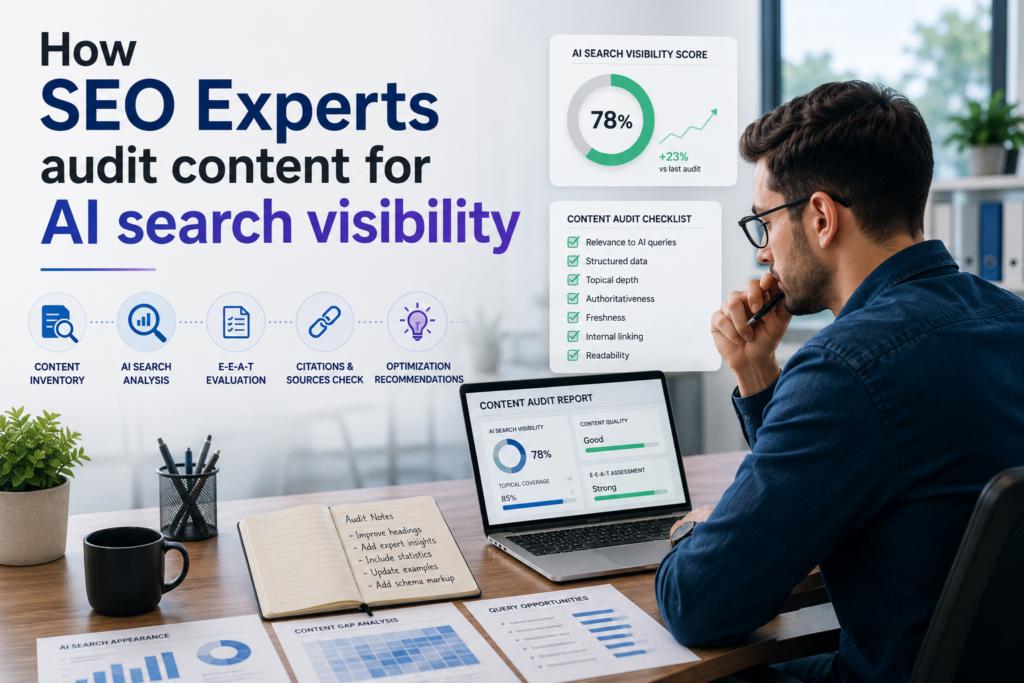
A page can rank in standard search results and still have little presence inside AI-generated answers. That creates a measurement gap for content teams because rankings, clicks, and impressions no longer describe every place where a buyer can encounter a company. ChatGPT Search, Google AI Overviews, Microsoft Copilot, Perplexity, and other answer systems can mention a business, cite a page, or use another source while answering a question that already brings organic search traffic to the site. An AI visibility audit helps a team identify where those appearances happen, which pages AI systems cite, and where important content remains absent.
The audit needs to work at page level because a site-wide observation rarely tells a team what to fix. Checking whether an AI tool knows a company name gives one signal, while checking whether a priority article or service page appears as a cited source gives the team something specific to investigate. SEO Experts conducting the audit should connect crawler access with index status, query coverage, citation activity, page quality, and business intent. A blocked URL needs technical work. An accessible page that fails to answer an important question needs a content fix.
Platform reporting now gives teams more evidence than manual prompt testing alone. Google provides generative AI reporting for eligible Search Console properties, while Bing Webmaster Tools reports citation activity at page and query level. OpenAI and Perplexity also publish crawler guidance that helps site owners check whether their pages can be accessed for search experiences. These sources don’t reveal every decision made inside an AI system, but they provide enough information to build a repeatable audit process.
What an AI Visibility Audit Should Actually Reveal
AI visibility covers several events, and each one should remain separate in reporting. A brand mention shows that the company appeared in an answer. A citation shows that a specific page was visibly referenced as a source. An impression inside a generative search feature records exposure on that platform. A referral session shows that someone continued from an AI answer to the website. Combining these signals into one score can hide the exact point that needs attention.
A useful audit should show which important URLs receive citations, the topics associated with those citations, and the important questions where the site remains absent. It should also show whether cited pages support the business purpose assigned to them. A tutorial may receive frequent citations because it answers an informational question, while a service page may matter when prospects begin comparing providers. Citation count alone doesn’t establish which page deserves the most work.
Business importance therefore needs to sit beside citation evidence. The team should record the role of the page, audience intent, known search demand, and the action a qualified visitor is expected to take. These fields define what the audit needs to reveal. Later sections can then focus on causes and fixes without redefining the measurement framework.
Build a Baseline Before Testing AI Answers
Random prompt testing produces findings that are difficult to compare. Build a baseline first so every test has a page, query, intent, and business purpose attached to it. The baseline should be clear enough for another person to repeat during the next audit without changing the rules halfway through the process.
- Choose the pages that matter. Start with service pages, high-traffic educational content, high-converting organic landing pages, newly published articles, and pages that recently changed. Record each URL with its topic, intended audience, organic search role, publication date, and conversion purpose.
- Create query groups around audience intent. Include informational questions, research questions, comparison queries, and local or commercial searches where they make sense. Keep branded queries in their own group because a person searching a company name already knows the brand. Unbranded questions give a clearer view of whether the content enters the research process earlier.
- Capture the current search position. Record organic impressions, clicks, index status, landing-page traffic, known AI referrals, and any AI citation information already available. This starting point gives later movement context.
- Set the evidence fields before testing. Decide whether each query record will include a brand mention, source citation, cited URL, competing source, platform, test date, and referral activity. Keep the same fields during later reviews so the comparison remains usable.
A fixed baseline also stops teams from changing the page set whenever an interesting result appears. Additional pages can still be investigated, but they should be marked as added observations instead of being mixed into the original test group.
Check Whether AI Search Systems Can Reach the Content
Content changes won’t solve an access problem. Start the technical audit by confirming that every priority URL can be crawled, indexed where required, rendered correctly, and associated with the version of the page the business wants search systems to use. Google’s guidance for AI features in Search says pages used as supporting links in AI Overviews or AI Mode must be indexed and eligible to appear in Google Search with a snippet. Google also states that these features don’t require a separate technical specification or special AI schema.
Use the following checks as an acceptance gate before changing the copy:
● The URL returns a normal successful response.
● Googlebot and other intended search crawlers can reach the page.
● The page doesn’t carry an unintended noindex directive.
● The canonical points to the preferred URL.
● The main information appears in rendered text.
● Internal links give crawlers a route to the page.
● Important URLs appear in the correct sitemap where the site uses one.
● Duplicate versions are handled so the intended page owns the subject.
ChatGPT Search needs a crawler-specific check. OpenAI’s publisher guidance for ChatGPT Search says publishers who want page content available for summaries and snippets should allow OAI-SearchBot. OpenAI separates that crawler from GPTBot, which relates to potential model training. An audit can reach the wrong conclusion when it treats the GPTBot setting as the only control that matters for ChatGPT Search.
Record technical eligibility as pass, fail, or needs investigation for every priority page. Once a URL fails this gate, assign the technical task before rewriting the page. That order keeps editorial work focused on pages that search systems can actually reach.
Measure the AI Exposure the Site Already Has
First-party platform reporting should come before manual prompt testing when that reporting is available. Platform data covers more activity than a marketer can recreate manually, and it provides observations across time instead of one generated response. Manual testing can then investigate gaps that the platform reports don’t explain.
Google Search Console
Google announced dedicated generative AI performance reports in Search Console in June 2026. The generative AI performance reporting announcement describes separate reporting for AI Overviews, AI Mode, and generative features in Discover. Google says these insights were rolled out to all websites worldwide on August 31, 2026. Compare pages receiving generative impressions with the priority URLs selected during the baseline.
A page with steady organic exposure and little generative exposure deserves investigation, but the report alone doesn’t explain why that difference exists. Check whether the page covers questions commonly handled by generative search, confirm technical eligibility, and inspect whether the answer is easy to find on the page. Pages gaining generative impressions should also be documented before routine editing changes the material that may already be working.
Bing Webmaster Tools
Bing provides a more direct view of citation activity. Its AI Performance report shows cited pages, total citations, page-level activity, grounding queries, time trends, Topics, Intents, Citation Share, and comparison views. Bing describes grounding queries as grouped phrases associated with retrieved content rather than complete user prompts. Its documentation also states that citation metrics don’t represent ranking, authority, traffic, or page importance.
Use this report to find URLs receiving repeated citations and the subjects connected with them. Then compare those results with important pages receiving little activity. Several uncited pages covering the same subject can point to weak page ownership or duplicated coverage, while an informational page that earns citations beside an absent commercial page may show that different intents need clearer ownership.
Test Real Buyer Questions Across AI Search Systems
Manual testing becomes useful when the protocol stays fixed. SEO Experts should use the same query wording, record the date and platform, note whether web search was active, capture cited URLs, and repeat high-priority tests later. AI-generated answers can change between sessions, so one missing citation should remain an observation rather than becoming the verdict on a page.
Build the query set around the buyer’s research process. Early questions may ask what a problem means or how a process works. Later searches may compare approaches, check implementation requirements, look for a provider, or ask for location-specific options. Run the same important queries across systems the audience is likely to use and record the source set each platform returns.
Perplexity needs 2 access checks before a missing result is treated as a content problem. Its robots.txt guidance distinguishes PerplexityBot from Perplexity-User. PerplexityBot is the search crawler and follows robots.txt, so blocking it can affect crawler-based discovery. Perplexity-User is used for user-requested page visits and generally ignores robots.txt. A PerplexityBot block therefore isn’t proof that Perplexity can never retrieve the page. Check both access paths before assigning a content fix.
Repeat high-value questions after enough time has passed to create another observation point. Stable citation presence across repeated checks carries more weight than one isolated appearance. Repeated absence also deserves more attention because the pattern has survived across multiple tests.
Inspect Whether Each Page Contains Information Worth Citing
A technically accessible page still needs useful material. The audit should check whether each priority URL answers its main question clearly, supports factual statements, gives readers something beyond a generic summary, and stays accurate as the subject changes. Google’s people-first content guidance asks publishers to consider original information, research, clear sourcing, authorship, first-hand knowledge, and whether a page genuinely helps its intended audience.
Use the following page review as a working scorecard.
Page purpose: State the job of the page in one sentence. Several pages around closely related subjects can blur ownership, so decide which URL should own the main topic before adding more material elsewhere. The page title, opening, headings, and internal links should support that purpose.
Answer placement: Put the useful answer near the question or heading that introduces it. Readers shouldn’t have to move through a long opening before reaching the information promised by the section. The explanation can still cover the reason, applicable conditions, and practical consequence once the direct answer is clear.
Evidence quality: Trace important statistics, dates, policies, and product claims to an original source where possible. Replace unsupported figures and broad claims with material that can be checked. When a statement comes from company experience, explain the setting in which that observation was made.
Original contribution: Look for experience, process detail, decision criteria, examples, or first-party knowledge that other pages don’t simply repeat. Google’s guidance for generative AI Search encourages publishers to add distinct information and genuine first-hand knowledge. Rewriting common material gives a retrieval system little reason to treat the page as a distinct source.
Factual freshness: Review dated screenshots, platform instructions, prices, product names, regulations, interface steps, and research references. Update the section that changed. Stable parts of the page can remain intact when the evidence still holds.
Section independence: Make each subsection understandable when a reader lands on it directly. Descriptive headings and self-contained explanations help readers identify what a passage covers. Definitions should sit close to the terms they explain.
Entity consistency: Use the same names for the company, services, products, locations, authors, and recurring concepts across important pages. Conflicting labels can make related content harder to understand as one connected body of information.
Internal page relationships: Supporting articles should link toward the page that owns the core subject, while the main page can send readers to deeper explanations where useful. Anchor text should explain the relationship between the 2 pages instead of adding unrelated cross-links.
Find the Subjects Where Competing Sources Receive the Citation
Competitor analysis should identify missing information on your own page. When another source receives a citation for an important query, inspect the question it answers, the evidence it provides, and the information your expected page doesn’t yet cover. The goal is to find the missing subject or evidence gap, then decide whether it belongs on the existing URL.
| Audit finding | What to inspect on your page | Likely content task |
| Competitor cited for a question your page doesn’t answer | Topic ownership and missing query coverage | Add the missing subject to the correct page |
| Competitor gives checkable proof while your page uses broad claims | Source support and factual detail | Add primary sources or supported first-party evidence |
| Competitor answers commercial intent while your page stays educational | Search intent and page purpose | Revise or create the correct decision-stage page |
| Competitor page is current while yours contains dated instructions | Time-sensitive material | Refresh the affected information |
Repeat the comparison across several meaningful questions before deciding that a pattern exists. One response may cite a source because of the exact query wording, while another phrasing can return a different set. A repeated pattern gives the team a stronger basis for deciding what information deserves attention.
Keep one gap note for each repeated loss. Record what the cited source explains, what your page already covers, what is missing, and whether that missing material belongs on the current URL. This keeps competitor research tied to reader intent instead of turning it into a contest over page length.
Audit Local and Business Information as a Separate Visibility Layer
Location-based AI answers can depend on business information that changes more often than ordinary editorial content. Local SEO Services should therefore review business names, addresses, phone details, opening information, service areas, location-page claims, and applicable business profiles as part of the audit. Google’s Search Essentials also recommends making content easy to find, using the language people search with, and maintaining the technical conditions required for Google to access a page.
Local discovery lane
Compare information on the website with the company’s owned business profiles and other controlled listings. A location page should describe the actual service area and provide information that belongs to that location. Repeating the same generic city paragraph across many URLs can leave each page with little individual purpose.
Review location claims together rather than correcting one page in isolation. When several pages share the same address, service-area wording, or contact information, a change to the official business record may need to be reflected across all of them.
Business identity lane
Review the company’s official name, service labels, product names, author information, and core description across important pages. Stable terminology helps readers and search systems understand when different pages refer to the same service or business unit.
When the audit finds conflicting information, use the accurate company record as the source of truth and update affected pages together. Document the change so a later audit doesn’t mistake corrected identity data for a new content strategy.
Who Owns Each Finding After the Audit
AI search still depends on much of the technical and editorial work used for organic discovery. The audit should route crawl access, index status, page ownership, internal linking, search intent, source quality, and measurement findings to the teams already responsible for those areas. Google’s AI-feature guidance sends site owners back to normal Search eligibility and established SEO practices, so the ownership model can sit inside an existing SEO review rather than becoming a separate process.
Technical ownership
The SEO team should own crawler blocks, indexation problems, canonical errors, duplicate URLs, rendering failures, and weak internal discovery. Findings from the AI audit can enter the same backlog used for ordinary search issues, which keeps technical ownership clear.
AI search ownership
Citation monitoring, crawler-specific rules, retrieval-query analysis, and page-level AI reporting also need an assigned owner. These tasks can sit beside standard organic reporting so page changes remain connected with both search eligibility and observed citation activity.
Editorial ownership
Writers and editors should handle unsupported claims, dated material, missing explanations, weak page purpose, duplicated subject coverage, and poor internal context. The SEO team can identify where the problem appears, while the content owner decides how much of the page needs to change.
That split helps prevent unnecessary full-page rewrites. A missing explanation, outdated source, or weak passage may be the only part that needs editing. Keeping unaffected material in place also makes later performance changes easier to interpret.
Commercial ownership
Marketing or demand teams should examine what happens after an AI-referred visitor arrives. A page can receive citations and still fail to guide a qualified visitor toward a useful next action. That issue belongs after the visibility diagnosis because citation activity and post-click performance measure different parts of the journey.
Keep the source of the visit separate from the website action that follows. This gives teams a clearer picture of whether the problem sits with discovery, page relevance, or the path after arrival.
Decide Which Pages Deserve Attention First
Every uncited page doesn’t need immediate work. Priority should depend on business importance, confidence in the finding, and the amount of work required. The purpose of this step is to rank the backlog after the audit has already identified the underlying issue.
Critical priority: Use this for important pages with confirmed access, indexing, canonical, or rendering failures. These issues can prevent the page from being available in the first place, so they move ahead of editorial work.
High priority: Use this for commercially important or high-demand pages that stay absent across repeated checks while relevant sources continue to receive citations. These pages deserve review soon because the finding is repeated and the business value is clear.
Medium priority: Use this for pages that already receive some visibility but miss related questions that clearly belong within their existing purpose. The required work is usually limited to specific sections.
Low priority: Use this for pages with little demand, limited business value, or a weak role in the site’s content map. The team can leave the page unchanged, combine it with a stronger owner, or retire it under the site’s normal content policy.
This priority stage shouldn’t repeat the full diagnosis. The audit has already established what is wrong. Prioritization simply decides which confirmed findings enter the work queue first.
Match Each Finding With the Right Page Fix
The best audit result maps a confirmed finding to a specific repair. Broad rewrites change too many variables at once and make later measurement harder to interpret. Assign the smallest fix that addresses the evidence.
Crawler or index problem: Correct the access condition and recheck the URL before changing the copy.
Missing subject coverage: Add the question or explanation to the page that already owns that topic.
Weak factual support: Replace unsupported statements with original sources or clearly identified company evidence.
Outdated material: Refresh the affected instructions, references, dates, screenshots, or product information while leaving stable sections alone.
Duplicate page ownership: Choose the URL that should own the subject and adjust internal links, retained material, or redirects through the site’s normal SEO process.
Thin editorial value: Add useful research, company experience, or process detail where evidence supports it. The content marketing services page covers research, blog writing, existing-content updates, keyword work, internal links, and performance tracking, which are relevant when a weak page needs a focused editorial repair.
Scaled low-value publishing: Review the publishing process before creating more pages around minor query variations. Google’s spam policies cover scaled content created mainly to manipulate rankings when the pages add little for users.
The repair log should record what changed and why. That record becomes important during later reviews because it separates a deliberate response to an audit finding from unrelated publishing changes.
Measure What Changes After the Page Is Updated
Every update needs a before state, a change record, and a later observation. SEO Experts should record the publication date, affected URLs, sections changed, technical repairs, and the same exposure measures captured during the baseline. This makes later comparison possible without claiming that one edit caused every movement that followed.
Track these measures where the platform or analytics setup provides them:
● Google generative AI impressions for eligible Search Console properties
● Bing total citations and cited pages
● Grounding-query coverage associated with the page
● Citation Share where that view is available
● Repeat manual citation presence for the fixed query set
● AI referral sessions and landing pages
● Qualified website actions from AI-referred visits
● Standard organic performance for the same page
Traffic needs separate measurement because a citation doesn’t guarantee a visit. OpenAI says ChatGPT referral URLs can carry utm_source=chatgpt.com, which analytics tools can use to identify inbound traffic. Google’s Analytics documentation explains how UTM parameters identify campaign and referral sources. The tracked parameter is mentioned here only as the referral value being measured. It isn’t added to any outbound link in this article.
Commercial follow-through can then be reviewed without turning citation counts into lead claims. The lead generation services page covers processes used to attract and identify potential customers. AI-referred landing pages can be measured inside an existing lead process while the source of the visit and the later conversion remain separate fields.
Bing’s documentation also gives teams a reason to interpret changes carefully. Citation trends can move because of user demand, content changes, model changes, freshness, or broader changes across the web. A rise after a page update creates a correlation worth tracking. It doesn’t prove that the edit alone caused the increase.
AI Visibility Audit Mistakes That Distort the Findings
A sound audit can still lead to poor decisions when observations are recorded loosely. The common mistakes usually come from treating one signal as stronger evidence than it actually provides.
One prompt becomes the verdict: A single response doesn’t cite the page, so the team immediately rewrites it. Repeat the query before treating absence as a persistent pattern.
A brand mention is counted as a page citation: The company appears in an answer, but no cited URL is recorded. Keep mentions and page citations as separate fields.
A technical gate is skipped: The team rewrites a page before checking whether crawlers or search indexes can reach it. Run the access check first.
Competitor structure becomes the writing brief: A cited article is copied heading by heading, which leaves little room for original company knowledge. Use competitor citations to identify missing information instead.
Several fixes happen at once: Technical settings, headings, links, sources, and large sections of copy change together. Smaller recorded changes make later observations easier to interpret.
A site-wide score hides page differences: One combined number can mask which signal actually moved. Keep page-level observations visible so the team can connect a change with the affected URL.
These mistakes are useful as a final audit check because each one tests whether the process stayed tied to evidence. They don’t need to repeat the earlier diagnostic framework in full.
Frequently Asked Questions
What is an AI visibility audit?
An AI visibility audit reviews how individual website pages appear across AI-generated search and answer experiences. It checks whether important URLs can be accessed, whether they appear as cited sources, which topics are associated with those citations, and where important pages remain absent. The audit also records referral activity when that information is available. Page-level reporting matters because it gives the team a specific URL and issue to investigate instead of a vague site-wide visibility score.
How do you check whether your content appears in AI search?
Start with first-party reporting when the platform and property provide it. Then run a fixed set of manual questions across the AI search systems your audience is likely to use. Record the platform, query, date, brand mention, cited URL, other cited sources, and page intent for every test. Repeat important questions later using the same wording. A pattern across several observations gives a stronger basis for a page decision than one generated response.
Can Google Search Console measure AI visibility?
Google introduced dedicated generative AI performance reporting in Search Console in June 2026. Google says the dedicated insights were rolled out to all websites worldwide on August 31, 2026. The reporting includes dedicated impression views for AI Overviews, AI Mode, and generative features in Discover. Teams can compare those views with the priority URLs selected for the audit.
How do you check citations in Bing Copilot?
Bing Webmaster Tools’ AI Performance report provides citation information across supported Microsoft AI experiences. It can show cited pages, citation volume, grounding queries, time trends, Topics, Intents, and Citation Share. Bing describes the reporting as aggregated information and states that citations don’t represent rankings, traffic, authority, or a page’s position in one individual answer. Use the report to identify repeated page and topic patterns rather than treating citation count as a quality score.
How can you tell whether ChatGPT can access your website?
Check robots.txt for rules affecting OAI-SearchBot. OpenAI identifies OAI-SearchBot as the crawler publishers should allow when they want content to be available for ChatGPT Search summaries and snippets. Keep that crawler separate from GPTBot during the audit because the 2 serve different purposes. After the crawler review, test relevant questions and check analytics for identifiable ChatGPT referrals so access and observed search behavior are both documented.
Does traditional SEO affect AI search visibility?
Yes. Google’s guidance says a page used as a supporting link in AI Overviews or AI Mode must be indexed and eligible for a Search snippet. Crawl access, internal links, textual page content, page experience, source quality, and accurate structured information therefore remain relevant. These conditions don’t guarantee that an AI system will cite a page, but they affect whether the content is available and understandable when the system retrieves sources.
Why does one page get cited while another page does not?
Several conditions can create that difference. One page may answer the question more directly, provide stronger factual support, contain newer information, or have fewer technical barriers. Start by confirming crawl and index eligibility, then compare the missing page with the exact question being answered. Once the gap is clear, change the section connected with that finding. Useful sections that already serve their purpose can remain untouched.
Do you need special schema for AI search visibility?
Google says there is no special Schema.org markup required specifically for AI Overviews or AI Mode. Structured data should still match visible information on the page where it is used, and normal Search requirements continue to apply. Schema can help describe page information accurately, but it doesn’t replace useful content or solve an access problem. Treat structured data as one part of accurate page representation rather than a shortcut to AI citations.
How often should an AI visibility audit be repeated?
Set the review cycle according to page importance and how quickly the underlying subject changes. High-priority commercial pages should be checked again after material updates, while fast-changing subjects may need review when platform rules or factual details change. Stable educational pages can follow a slower schedule unless citation data, generative impressions, organic performance, or AI referral activity gives the team a reason to investigate sooner. Keep the query set and evidence fields consistent across each review.
Can Local SEO Services support AI visibility for location-based searches?
Local SEO Services can help keep the business information used for location-based discovery accurate across location pages, service areas, owned profiles, and other controlled listings. The audit should compare those sources with the website and correct conflicting information when it appears. Results still depend on the platform, query, eligibility, and source selection. Measure the work through observed search behavior and citation activity instead of assuming that accurate local information guarantees an AI citation.