



What Is Semantic SEO And Why Google Rewards It Now
A page can rank for searches it barely mentions word for word. Another page can place its primary keyword in the title, introduction, headings, and body copy, yet still struggle to reach page 1. The difference often comes from meaning. Google tries to understand the question behind a search, what the page actually covers, and whether the information helps the searcher complete the task that brought them there.
Google has moved in this direction for years. TheGoogle Knowledge Graph introduced a model based on real-world entities and the relationships between them. Later language systems improved Google’s ability to interpret context. Search now deals with longer questions, conversational language, follow-up searches, and situations where several pieces of information may be needed before a useful answer can be produced.
Semantic SEO applies that shift to content planning. Keyword research still tells you how people describe a subject, but the work continues with search intent, entities, page scope, supporting questions, and internal relationships. The same thinking also sits behind modernAI SEO services, where pages need clear subject boundaries and information that search systems can interpret without depending on repeated exact-match phrases.
Google doesn’t publish a ranking factor called semantic SEO. The value comes from what a good semantic SEO strategy produces: focused pages, useful subject coverage, clear relationships, reliable evidence, and an information structure that helps readers move from one question to the next. The goal is to make the page genuinely useful for the search intent it targets.
TL;DR
Semantic SEO is the practice of creating and organising content around the meaning behind a search. It starts with the reader’s task, identifies the concepts required for the answer, explains how those concepts connect, and separates supporting questions when they deserve their own pages.
Google can understand context beyond exact keyword matches. Its newer AI search experiences can also retrieve information across related parts of a question. That makes clear subject coverage more useful than publishing several pages that repeat the same answer with slightly different keywords.
A practical semantic SEO program should:
- Define the reader’s outcome before creating the outline.
- Group keyword variations that require the same answer.
- Identify entities that materially affect the subject.
- Explain relationships between those entities clearly.
- Create separate pages when the reader’s task changes.
- Connect supporting pages with descriptive internal links.
- Add original evidence or first-hand knowledge where available.
- Measure performance across relevant query groups.
Semantic SEO therefore changes the way content teams move from keyword research to page planning. A keyword remains useful evidence. Search intent decides what the page needs to do.
1. What semantic SEO actually means
Semantic SEO means planning a page around what a search means and what the reader needs to understand. Consider the query “best CRM for consulting firms.” A keyword-focused brief may collect several versions of that phrase and distribute them across the copy. A semantic brief asks what actually affects the decision. Team size may change pricing. Existing email software may affect integration requirements. Reporting needs may narrow the shortlist. Migration effort matters when a firm already has years of client records.
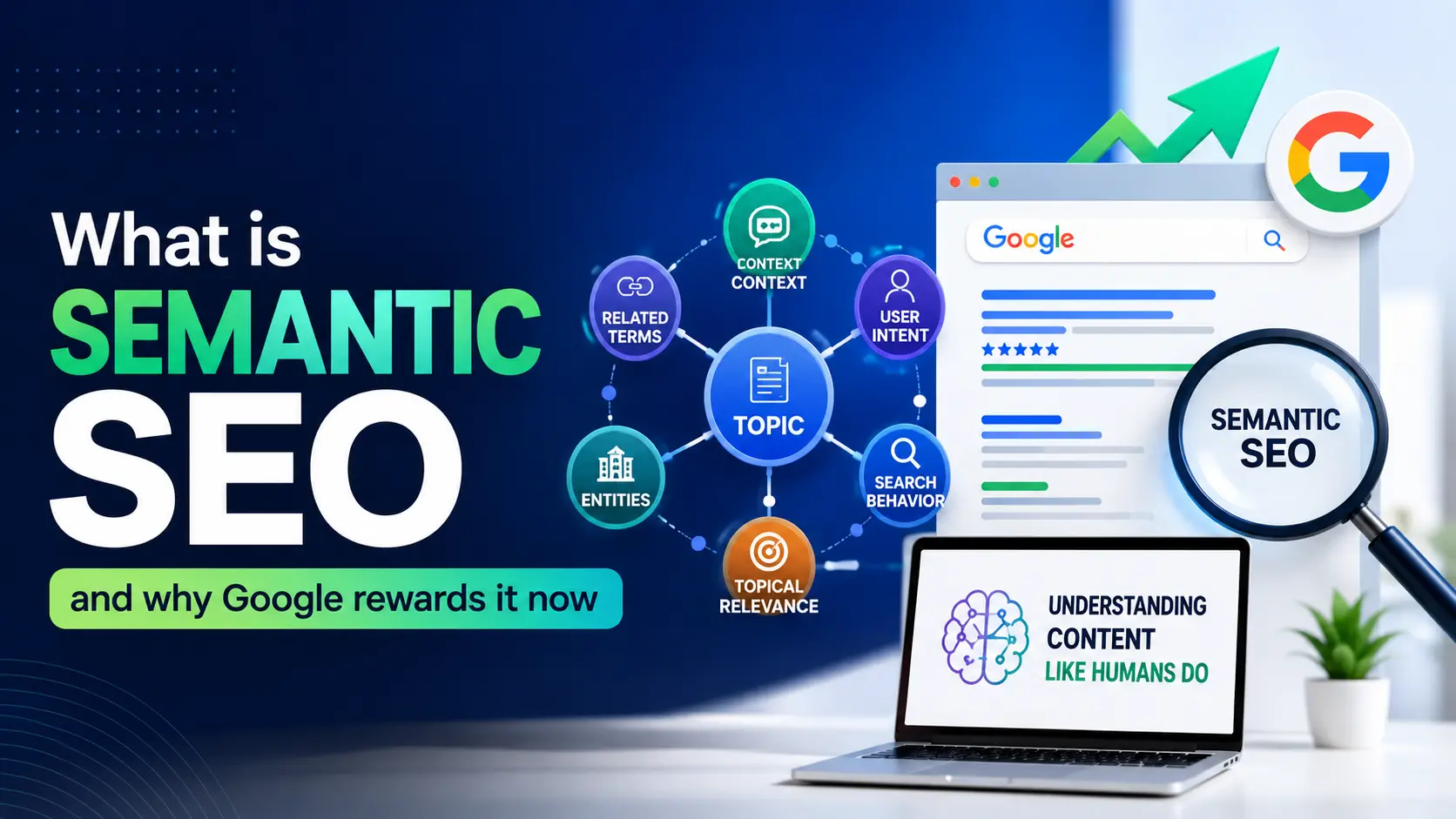
Entity SEO adds structure to that answer. An entity is an identifiable thing or recognised concept, such as a company, product, person, location, service, platform, or metric. Attributes describe those entities, while relationships explain how they connect. A pricing plan belongs to a product. An integration connects 2 systems. A reporting feature supports a business task. Those relationships give the subject meaning rather than leaving the page as a collection of related terms.
The risk appears when teams turn entity research into another keyword quota. A content tool may return dozens of related phrases, but inserting all of them doesn’t make the explanation stronger. A term belongs when it helps answer the question, removes ambiguity, or supports a decision. A page about mortgage closing costs should explain common charges, who receives them, when they’re paid, and why the amount varies. It doesn’t need every concept associated with mortgages.
2. Why Google rewards semantic SEO now
- Context understanding: Google’s language systems can interpret words according to the language around them.Google’s explanation of BERT describes how context can change the meaning of a query, especially with conversational searches where small words affect intent. This gives Search more information than a basic keyword-matching model would have available.
- Query fan-out: Google’s currentgenerative AI search guidance explains that AI search can explore related parts of a question. A search about accounting software for a 20-person agency may require information about pricing, recurring billing, payment connections, reporting, and migration. Teams planning pages for these searches can also review IInfotanks’ guide onstructuring content for AI Overviews.
- Meaning-based relevance: Modern Search can connect pages with queries even when the wording doesn’t match exactly. That reduces the need to build separate pages for “semantic SEO meaning,” “semantic SEO definition,” and “what is semantic SEO” when all 3 searches require the same core answer. Clear page purpose matters more than finding another place to repeat a phrase.
- Useful information: Semantic SEO can help content teams identify what a reader needs beyond a definition. A strong page may need examples, comparisons, exceptions, evidence, or implementation detail. These additions should resolve genuine information gaps. More words have little value when they repeat information the reader already understood 3 sections earlier.
3. Semantic SEO versus keyword-first SEO
Keyword research remains important because it reveals demand and shows how people describe a subject. Google’sSearch Essentials still recommends using words people would use to find your content. Semantic SEO changes how those findings turn into pages rather than removing keyword research from the process.
| Planning area | Keyword-first model | Semantic SEO model | Publishing decision |
|---|---|---|---|
| Page target | Starts with 1 main phrase | Starts with 1 reader task | Define the outcome first |
| Keyword variations | Often mapped separately | Grouped by shared intent | Keep them together when the answer stays similar |
| Related terms | Added from term lists | Used where explanation requires them | Remove terms that add no useful context |
| Outline | Often follows ranking headings | Built around questions and gaps | Include sections that help complete the task |
| Internal links | Added after drafting | Planned around subject relationships | Link when another page gives useful depth |
| Page length | Often follows competitor averages | Follows information needs | Stop when more copy adds little value |
| Measurement | Watches the main keyword | Reviews wider query coverage | Measure the page’s search footprint |
Take “semantic SEO,” “semantic SEO definition,” and “semantic SEO meaning.” The wording changes, but the reader usually expects the same basic explanation. Publishing separate URLs can create unnecessary overlap.
Now compare “semantic SEO tools” with “semantic SEO audit.” Tool research requires information about products and capabilities. An audit query asks for an evaluation process. Those searches can justify separate pages because the job changes.
This distinction also helps teams understand the relationship between traditional SEO and newer search practices. IInfotanks’ breakdown oftraditional SEO vs AI SEO vs GEO gives a separate view of how page rankings, AI visibility, and generated-answer citations fit into the same search program.
4. The building blocks of semantic content
Search intent defines the page’s job
Search intent describes what the reader wants to accomplish. Before outlining a page, write 1 sentence describing the outcome. For this article, the outcome could be: “A marketer should understand semantic SEO, why it matters to Google now, and how to apply it to content planning.” That sentence gives every proposed section a scope test.
A detailed comparison of semantic SEO software may be related to the wider subject, but it doesn’t necessarily help this page complete its primary job. Moving that material to another page keeps the main article focused while giving the deeper question enough room.
Entities define what the answer depends on
Once the intent is clear, identify the entities that materially affect the answer. A page about heat-pump running costs may need electricity price, insulation, system efficiency, outside temperature, thermostat settings, and backup heating.
Each concept belongs because it can change the answer or the reader’s interpretation. An unrelated heating term adds vocabulary without adding useful information.
Relationships turn concepts into explanation
An entity list becomes useful when the page explains how the concepts connect. Electricity price affects operating cost. Insulation changes heat loss. Outside temperature can affect system performance. Backup resistance heating may increase electricity use.
Those relationships teach the reader how the subject works. They also provide clearer context than a paragraph built mainly to contain related phrases.
Page boundaries protect the main intent
Every subject connects to another subject, so semantic content needs a stopping rule. Include the information required to complete the primary reader task. Move deeper questions into supporting pages when they deserve separate treatment.
This keeps semantic depth from becoming uncontrolled expansion. The page can cover the subject thoroughly without trying to contain every possible adjacent question.
5. How topic structure supports semantic SEO
Semantic SEO often works across a group of pages rather than a single article. A broad guide can establish the main subject, while supporting pages address separate reader needs in more detail. A semantic SEO topic area might include entity research, keyword clustering, internal-link audits, structured data, AI search SEO, and content performance analysis. A plannedcontent marketing program can help organise these pages around audience questions rather than publication volume.
The main risk is confusing subject depth with page count. A keyword database can return hundreds of related phrases, but those phrases don’t automatically deserve hundreds of URLs. The better test is whether a new page answers a distinct question and has enough useful material to justify a separate destination. Several close variants can remain on 1 page when the reader expects the same answer.
Internal links then make those relationships usable. Google’slink best-practice guidance says descriptive anchor text helps people and Google understand linked pages. It also recommends linking important pages from other relevant pages on the site. A link such as “semantic SEO audit checklist” gives more context than a generic “read more” anchor.
6. How to implement semantic SEO step by step
The implementation process works best when every stage answers a clear planning question. Teams can apply the same sequence to a new page or use it to review an existing article.
1. Define the page outcome
- State exactly what the reader should understand after finishing the complete page.
- Keep the outcome narrow enough to control the scope of each section.
- Use that outcome to decide whether each proposed topic belongs on-page.
- Remove sections that don’t directly support the primary search intent.
2. Collect search evidence
- Research the primary keyword and meaningful variations before creating the outline.
- Review current search results to identify dominant intent and common page types.
- Check Search Console for queries already generating impressions for related pages.
- Add customer questions and expert input that keyword databases may miss.
This research can sit inside a widerSEO services process where technical health, keyword research, content work, and authority activity are reviewed together.
3. Group queries by shared intent
- Combine queries when readers expect essentially the same answer from each search.
- Separate queries when the reader’s task or required information changes materially.
- Review automated keyword clusters manually before assigning terms to individual URLs.
- Avoid separate pages for wording changes that leave the underlying intent unchanged.
4. Map the necessary entities
- Identify the central entity that defines the primary subject of the page.
- Add related entities only when they materially affect the reader’s understanding.
- Record useful attributes and relationships that explain how each entity connects.
- Remove related terms that increase vocabulary without improving the actual explanation.
5. Find the information gap
- Review ranking pages and identify questions they leave partially or poorly answered.
- Check for outdated claims, weak examples, missing exceptions, and unsupported statements.
- Find decisions readers still need help making after reviewing competing results.
- Add depth where new information closes a meaningful gap for the reader.
6. Build the outline around decisions
- Give every major section 1 clear purpose before drafting its supporting copy.
- Start each section with the answer readers need before adding deeper explanation.
- Use headings that reflect genuine questions, decisions, or important subject areas.
- Remove headings created mainly to place another variation of the target keyword.
7. Add evidence and useful examples
- Support factual claims with reliable sources that readers can independently check.
- Add first-hand examples where direct experience improves understanding of the subject.
- Use realistic examples to show how recommendations work under normal conditions.
- Remove unsupported statistics, invented cases, or claims that can’t be verified.
Teams working across classic and generated search can compare this process with IInfotanks’ guide toAI SEO in 2026, which covers source support, direct answers, internal links, and AI search measurement.
8. Review scope before publishing
- Check whether every section still supports the page’s original search intent.
- Move deeper questions to supporting pages when they need separate detailed treatment.
- Confirm internal links connect readers with useful information beyond the current page.
- Remove repeated explanations that increase length without helping the reader progress.
The final review matters because semantic research can expand a page quickly. The goal is enough context to solve the main task while giving separate questions their own clear destinations.
7. Where structured data fits into semantic SEO
Structured data gives Google explicit information about supported elements on a page. Google’sstructured data documentation describes it as a standard format used to provide information about a page and classify its content. It can also make qualifying pages eligible for supported search appearances.
The implementation order matters. Clear visible content comes first. Structured data should describe information the page actually contains. Adding markup doesn’t repair weak page scope, missing evidence, or a confusing explanation. The page still needs a clear subject that readers can understand without examining its source code.
The same principle applies when teams work onGEO services. Schema, entity consistency, page architecture, and content structure can help systems interpret information, but markup should support the underlying page rather than carry the entire meaning by itself.
8. How to audit existing content for semantic gaps
A semantic SEO audit should identify the actual problem before a team rewrites the page. Some articles have missing concepts. Others suffer from overlapping intent, outdated facts, weak evidence, poor internal connections, or sections that would work better as separate pages.
Review these areas:
- Page purpose: Can the page’s job be explained in 1 sentence?
- Opening answer: Does useful information appear early?
- Intent coverage: Does every major section support the stated outcome?
- Entity coverage: Are the concepts required for the answer present?
- Relationships: Does the page explain how those concepts connect?
- Evidence: Are important factual claims supported?
- Freshness: Have prices, rules, products, or facts changed?
- Internal links: Can readers reach deeper material where needed?
- Overlap: Does another URL answer essentially the same question?
- Completion: Would the reader need another search for the same task?
Google’speople-first content guidance asks whether content provides original information, whether it adds useful value, and whether people leave feeling they learned enough to achieve their goal. Those questions give a semantic content audit a stronger final test than a proprietary score from a third-party writing tool.
Match the response to the failure. A good page missing 2 important concepts may need a focused edit. Two pages answering the same intent may need consolidation. A traffic decline following a broader search change may require a wider diagnosis. IInfotanks’Google core update recovery roadmap covers page overlap, entity clarity, internal linking, and intent changes as part of that review.
9. How to measure semantic SEO performance
A single keyword position gives a narrow view of semantic performance. A strong page may gain visibility across several relevant searches because Google finds it useful in more situations. Supporting pages may also gain their own query coverage as the site develops clearer topic relationships.
| Metric | What to review | What the result can indicate |
|---|---|---|
| Relevant query breadth | Useful queries producing impressions | Wider relevance across the topic |
| Search impressions | Visibility for the page and related URLs | More opportunities to appear |
| Organic clicks | Visits from relevant queries | Searchers are choosing the result |
| Supporting-page visibility | Performance across connected pages | Topic structure is gaining coverage |
| Conversion activity | Leads, trials, purchases, or another action | Search visibility supports business outcomes |
| AI search signals | Mentions, citations, referrals, or available search reporting | Content appears in newer discovery paths |
Interpret those figures together. A rise in impressions with weak clicks may mean the page is appearing for broader searches but doesn’t yet match the expected result format. Wider query coverage with relevant conversions can be useful even when one high-volume keyword moves only slightly.
IInfotanks’ analysis ofAI search statistics in 2026 gives additional context for measuring citations, clicks, referral traffic, and commercial results as AI-led discovery becomes part of search reporting.
10. Common semantic SEO mistakes and the practical response
Creating separate pages for minor keyword variations
The risk is internal overlap. Several URLs can end up answering almost the same question, which also creates more pages to review and maintain.
Response: Group searches by the answer they require. Create another page when the reader’s task genuinely changes.
Treating entities as a vocabulary quota
The risk is forced copy. Writers begin inserting terms because a tool requests them, even when those terms don’t improve the explanation.
Response: Include an entity when its attributes or relationships help the reader understand the subject.
Copying every heading from ranking pages
The risk is sameness. The article becomes another summary of information searchers can already find elsewhere.
Response: Identify missing evidence, outdated claims, weak examples, or decisions that competing pages leave unresolved.
Chasing competitor word counts
The risk is padding. A longer article can repeat the same point several ways without improving the answer.
Response: Let the searcher’s task determine the required depth and stop once additional copy stops helping.
Building oversized content clusters
The risk is page multiplication. Large keyword exports can turn into dozens of URLs with weak differences in purpose.
Response: Approve a new page when the question has a distinct intent and enough useful information to stand alone.
Ignoring real human language
The risk is writing pages around keyword-tool vocabulary while missing the way readers actually describe the problem. User discussions, customer questions, and first-hand observations can reveal distinctions that a keyword list misses.
IInfotanks’ analysis ofwhy Google surfaces Reddit results so prominently examines how real discussions, current language, and first-hand context can affect the type of material appearing in search.
11. What semantic SEO means for AI Overviews and AI Mode
Google’sAI features guidance says the standard SEO practices remain relevant for AI Overviews and AI Mode. Google also says there are no additional technical requirements for appearing in those experiences. Pages still need to be accessible to Search and eligible to appear with a snippet.
This matters because query fan-out can break a complex search into related information needs. Someone asking which project management platform suits a 12-person remote design agency may need information about pricing, approvals, guest access, integrations, and team limits. A comparison article can answer one part while a pricing page or implementation guide handles another.
Semantic SEO gives those pages clearer jobs. Each URL can focus on a distinct question, while internal links connect the wider subject. Google can then retrieve useful material without the publisher trying to place every possible query variation onto one enormous page.
What semantic SEO means for your content strategy
Semantic SEO changes the unit of content planning. A keyword remains a useful research input, but each page is built around the task represented by that keyword. The writer decides what the reader needs to understand, which entities affect the answer, how those concepts connect, and where another question needs its own page.
The main implementation risk is overproduction. Large keyword lists can create overlapping pages. Entity research can become forced vocabulary. Topic maps can turn into publishing quotas. The safer approach gives every page 1 clear purpose and uses supporting pages only where the searcher’s task changes.
Search performance also needs a business endpoint. Organic visibility can feed enquiries throughB2B lead generation services, while teams receiving steady traffic can useconversion rate optimization services to study whether visitors move from information to meaningful action.
Semantic SEO works when the site becomes easier to understand for the reader first. Clear intent, useful relationships, focused pages, reliable evidence, and sensible internal connections give search systems stronger material to work with at the same time.
12. Frequently asked questions about semantic SEO
1. What is semantic SEO in simple terms?
Semantic SEO means creating content around the meaning of a search. Keyword research shows how people phrase the question, while semantic planning identifies what they need to understand. The page then explains the concepts and relationships required to complete that task instead of repeating close keyword variations throughout the copy.
2. Why does Google reward semantic SEO?
Google’s systems try to find information that fits the meaning and intent of a search. Semantic SEO supports that process by giving a page clear subject boundaries, relevant concepts, and enough context to answer the question. Google doesn’t publish a separate semantic SEO ranking factor or a public semantic score.
3. Is semantic SEO the same as entity SEO?
Entity SEO forms part of semantic SEO. It focuses on identifiable things or concepts and their attributes or relationships. Semantic SEO covers the wider page-planning problem, including search intent, keyword grouping, content scope, internal links, supporting pages, evidence, and the structure used to explain the subject.
4. Are keywords still important for semantic search?
Yes. Keywords reveal the language people use and can identify differences in search intent. Semantic SEO changes how those phrases are mapped. Several keyword variations can share 1 page when the reader expects the same answer, while similar-looking searches may require separate pages when the task changes.
5. What is an entity in semantic SEO?
An entity is a distinct thing or recognised concept related to the subject. Examples include a person, company, product, service, platform, place, or metric. An entity becomes useful when the page explains why it matters to the question and how it connects with the other information.
6. Does structured data improve semantic SEO?
Structured data can give Google explicit information about supported page elements and can help qualifying pages become eligible for certain search appearances. It should accurately represent visible content. The page still needs clear writing, useful information, and a defined purpose before the markup can support it.
7. Does semantic SEO help with AI Overviews?
It can support the type of content Google’s AI search features retrieve. Complex searches can involve several related information needs, so clear page purpose and connected supporting content become useful. The same technical and content foundations still apply to standard search and Google’s AI search experiences.
8. How many pages should a semantic content cluster contain?
There is no fixed number. Create another page when the reader’s task differs enough from existing content and the subject contains enough useful information to support a separate destination. A smaller set of focused pages can be easier to understand and maintain than dozens of overlapping articles.
9. How long should semantic SEO content be?
The page should be long enough to complete its intended task without padding. A short definition may need far less space than an implementation guide or detailed comparison. Search intent and information depth give a better length guide than simply matching the longest competitor on page 1.
10. How do you measure semantic SEO performance?
Review relevant query breadth, search impressions, organic clicks, supporting-page visibility, and meaningful business actions. Search Console can show how query coverage changes, while analytics can show what readers do after arriving. Judge the topic across useful searches rather than relying on 1 ranking or proprietary semantic score.