
HR Decision Makers Email List: CHROs, HR Directors, and Benefits Leaders
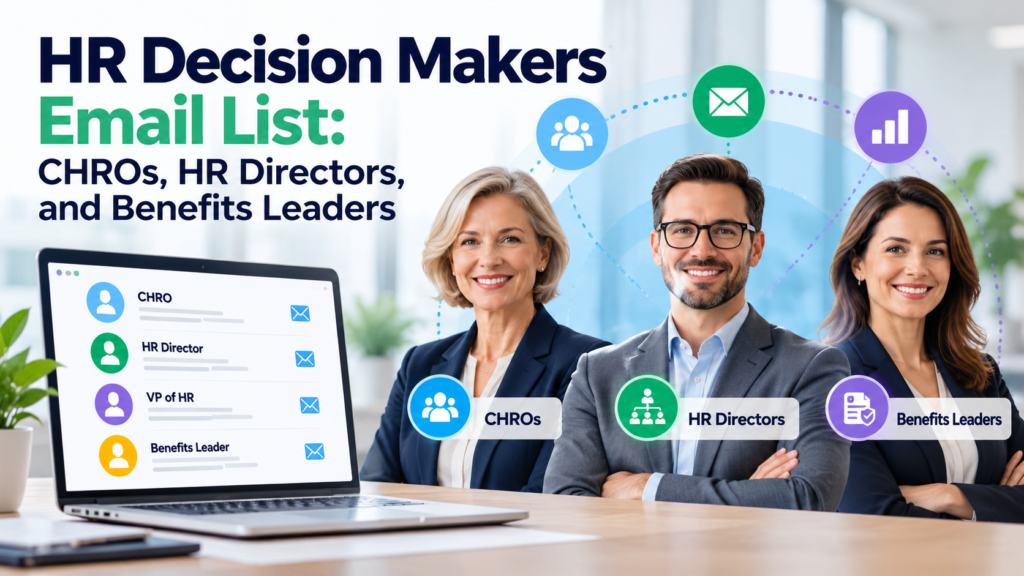
An HR decision makers email list can put a workforce software company in touch with the people who assess HR technology, approve changes to employee programs, or influence the next benefits contract. Yet a list that says “HR leaders” on the label may contain recruiters, payroll clerks, former employees, and executives who have no reason to review the offer. Job title alone tells only part of the story.
The useful question is who owns the problem you’re trying to solve. An HR executives email list should make that question easier to answer. A chief human resources officer may sponsor a companywide HR system change, while a benefits director may lead a health plan review. An HR director at a smaller business might handle both. A sound contact list makes those differences visible and gives teams a defensible basis for deciding whom to contact.
TL;DR
An HR decision makers email list should be grouped by the recipient’s actual responsibility, not by seniority alone. CHROs often sponsor broad people decisions, HR directors manage day-to-day systems and policies, and benefits leaders assess insurance and employee benefit programs. Check job-title accuracy, company fit, source records, and recent email checks before importing contacts. Purchased business addresses aren’t automatic permission to email. Apply the rules for each recipient’s location, explain the relevance of your message, provide a working opt-out, and remove people who object.
What an HR Decision Makers Email List Actually Contains
A business contact file commonly includes a person’s name, work email, job title, employer, and basic company details. A good HR decision makers email list goes further by showing the HR function that person leads. That makes it possible to distinguish a head of benefits from a talent acquisition manager even when both appear under a broad HR category.
A useful file therefore carries 2 types of evidence: information about the person and information about the company. The first helps establish whether the job is relevant. The second helps determine whether the employer matches the product’s market. A benefits managers email list for a platform serving large multi-state employers has a different audience from a simple leave-management tool for a business with 45 employees.
A Contact List Is Different From an Opt-In Audience
An HR email database may come from event sign-ups, a vendor’s research, professional sources, or existing business relationships. Those sources carry different rights and expectations. A recipient who joined your own webinar has a different relationship with your company from someone whose work address was collected by a third party. Keep that distinction in the CRM instead of treating every address as equally eligible for every campaign.
Who Is on the List: CHROs, HR Directors, and Benefits Leaders
The most important contacts fall into separate parts of an HR organization. Large employers may have dedicated executives for benefits, compensation, HR operations, and recruiting. At smaller firms, one HR director may cover several of those duties. The buyer’s title should be read alongside the company’s size and reporting structure. An HR directors email list also needs to show whether the title refers to a local or companywide post.
CHROs and Chief People Officers
A CHRO email list often includes chief human resources officers, chief people officers, and senior vice presidents responsible for enterprise people policy. These leaders may approve business cases, sponsor major system changes, and set priorities for employee experience or workforce planning. They are good executive contacts for changes that affect multiple HR teams, but they may delegate product comparisons to a director or program owner.
A separate HR executives email list may also contain vice presidents of human resources and heads of people operations. Those titles shouldn’t be treated as exact synonyms. A VP of HR at a large enterprise may lead one region, while the same title at a midsize firm may represent the entire function. Check the scope before deciding that a senior title signals budget authority.
HR Directors and Heads of HR Operations
An HR directors email list can include HR directors, people operations directors, regional HR leaders, and HR shared-services managers. Their work often concerns the daily systems used to hire and support employees. The US Bureau of Labor Statistics describes how human resources managers direct HR functions and advise other managers on workforce issues. This broad responsibility makes their precise assignment important when deciding which offer fits.
Benefits, Compensation, and Total Rewards Leaders
A benefits managers email list usually targets benefits directors, heads of total rewards, compensation and benefits managers, and employee benefits administrators. These roles don’t all make the same decisions. The BLS explains that benefits managers may select outside partners and oversee plan enrollment or renewals. A benefits software vendor should identify the person responsible for the relevant program rather than relying on the word “benefits” alone.
Which Contact Fields Make a List Useful
A record should tell a reviewer why the contact belongs in the target audience. Full name, current title, verified business email, employer website, and location form the base. For an HR directors email list, fields such as department, leadership level, company size, and industry help explain which program the contact can influence.
Don’t confuse a large number of fields with high quality. A file containing 30 columns can still have outdated job titles or an email address taken from the wrong company. Put more weight on information that affects a decision or confirms its accuracy. A valid contact record should also include when it was last checked and, where available, the source category and any restrictions on use.
| Field | Why It Matters | Common Problem |
| Current job title | Signals likely responsibility | Old title retained after a move |
| HR function | Separates people leadership from benefits or payroll | Broad “HR” label hides specialization |
| Business email | Provides an outreach channel | Address guessed but never checked |
| Employer and domain | Links person to account | Subsidiary or parent confused |
| Employee count band | Helps judge program fit | Stale company-size estimate |
| Country or region | Affects relevance and applicable law | Office location mistaken for residence |
| Source and check date | Supports review and refresh | No clear record of origin |
| Suppression status | Prevents repeated unwanted contact | Opt-outs kept in a separate file |
For a CHRO email list, a companywide scope marker may matter more than a direct phone number. For a benefits managers email list, it may help to know whether the person covers health and welfare benefits, retirement benefits, or compensation. These are distinct functions, even if a small team combines them.
Additional information should be collected only when it serves a clear purpose. Avoid personal email addresses, home addresses, family details, or sensitive worker data just to make a prospect record look richer. The FTC’s security guidance advises businesses to keep personal information collection tied to genuine needs. That principle fits HR prospecting because a role-based contact record rarely requires private details.
Segment Contacts by Responsibility and Company Fit
Segmentation means dividing a broad HR decision makers email list into groups that face different business problems. Start with the task being solved, then filter by the person who would own that task. A broad HR decision makers email list built from seniority alone can produce a list that looks impressive but sends irrelevant messages to many recipients.
Match HR Functions to the Offer
A workforce planning product may call for a CHRO email list with senior leaders at employers managing large, changing workforces. A leave-tracking application may fit HR operations directors more closely. A new employee benefits administration service belongs with a benefits managers email list or a total rewards team. The same company could appear in all 3 segments, but each contact’s role in the decision will differ. An HR directors email list needs a separate tag for the specific operating team.
Use the employer’s size to refine those groups. At a smaller company, the HR director might own HRIS selection and benefit renewals. At a larger company, those tasks may sit with separate teams. Don’t force a company with one HR generalist into an enterprise buying structure. Equally, don’t assume the top HR executive personally oversees every product evaluation at a large employer.
Use Industry and Geography Carefully
Geography matters for the employee population a product supports and for the laws governing outreach. A leader’s office in New York doesn’t prove responsibility for all US employees. A European subsidiary’s HR contact may serve only that entity. Use a company hierarchy field when several subsidiaries share a brand name. Confirm whether the target is a local buyer, regional program owner, or global executive.
Understand Who Influences the HR Purchase
HR purchases often involve several people whose concerns aren’t interchangeable. One executive may fund a change, while a director collects requirements and an administrator tests how the product works. A procurement team may handle contract terms after HR approves the direction. Emailing each person the same pitch wastes the information a role-based list was supposed to provide.
For a large HRIS purchase, the CHRO may sponsor the initiative because it affects several HR programs. The HR operations team often understands the existing workflow. IT may assess integration and security needs. The finance team may review cost. A CHRO email list is therefore one entrance to the account, rather than a substitute for identifying the full purchasing group.
Benefits purchases have a further distinction: choosing a benefit plan can be an employer business decision, while operating an employee benefit plan may involve fiduciary duties. The US Department of Labor’s group health plan guidance explains how fiduciary status follows the duties performed, rather than a job title alone. Vendors should avoid assuming that every benefits director is personally the plan’s fiduciary or its final contracting authority.
| Contact Role | Likely Contribution | Useful First Topic |
| CHRO or Chief People Officer | Sets direction and sponsors broad change | Business case and workforce impact |
| HR Director | Defines requirements and operating fit | Current process and implementation work |
| Benefits Director | Reviews benefit administration needs | Plan operations and renewal workflow |
| HR Operations Manager | Tests daily procedures | Data movement and employee support |
| Finance or Procurement Partner | Reviews spending and terms | Cost assumptions and contract details |
Check Where the Data Came From and How Fresh It Is
The source of a contact record affects whether an HR executives email list should be trusted and how it may be used. A seller might assemble business details from company pages, professional announcements, public profiles, licensed sources, direct submissions, or partner data. Ask which of these methods applies to the proposed file. “Verified” without an explanation is too vague to assess.
Ask for Evidence of Current Employment
A contact on an HR directors email list can remain deliverable after leaving a job if a shared mailbox forwards old messages or the employer reuses an address. Email validation alone can’t confirm that the person still leads the stated department. Review title and employer against a recent official source or another defensible update method. Leadership changes deserve faster checks than stable company attributes.
Ask the provider to explain the difference between “last collected,” “last updated,” and “last verified.” These dates may refer to different checks. A recent download date doesn’t prove each underlying record is recent. For an HR directors email list, a practical sample should contain enough records from the actual target segment to judge current role accuracy.
Check Duplicates and Suppression History
Duplicate people can appear under spelling variations, subsidiaries, or several old titles. Merge records based on reliable identifiers, and keep a history of changes where possible. More importantly, don’t import a purchased file over your own suppression list. A contact who previously asked your business to stop emailing shouldn’t reappear because a vendor sold the same address under a new file name.
Set a small sample review before a full campaign. Check a spread of companies, roles, and regions. Record each mismatch so the provider can explain or correct it. If too many records lack a traceable source or a current role, pause. The list’s usefulness depends on facts that can be checked, not a claimed accuracy percentage with no disclosed method.
Compare Buying a List With Building One
Building a list internally gives the team control over its selection method and source notes. Buying can shorten the research stage, especially when exploring a market with many companies. Neither route guarantees lawful use or current contacts. An internally compiled HR decision makers email list can still be wrong; a purchased record may still be relevant if the source and permission questions are answered.
For a small named-account campaign, internal research may make more sense. A team with 80 selected employers can check the HR leadership structure and record the reason each contact matters. For a larger program covering several industries, a commercial source may be a practical input, provided records are screened and the company has a lawful reason to process and contact them.
A CHRO email list should be assessed by relevant CHRO coverage at the target accounts, not a broad promise of executive volume. A separate HR executives email list may include VP-level contacts that improve coverage when the C-suite record is absent. Ask for a sample that shows which titles and companies will actually be delivered, with personal details limited where needed for evaluation.
Questions to Settle Before Paying
Request a written account of the source categories, included fields, intended usage rights, recent role checks, duplicate handling, and replacement policy. Confirm whether the order supplies a fixed file or an updated subscription, and whether additional charges apply to filters or refreshes. Ask how complaints and deletion requests are passed between the provider and its buyers.
List prices vary with geography, breadth, fields, exclusivity claims, and service terms. There isn’t one dependable market price per HR contact, and a quoted cost per record says little about the true useful yield. Compare the cost of the file with the number of eligible, relevant, nonduplicate contacts that survive review. For example, if 200 purchased records contain 50 irrelevant titles and 20 existing contacts, the useful count is at most 130 before email or legal checks. That’s a calculation example, not an industry benchmark.
Follow the Rules for US Business Email
The CAN-SPAM Act applies to commercial email in the United States, including business-to-business messages. The FTC’s CAN-SPAM guidance explains the main obligations: accurate header information, truthful subject lines, a valid physical postal address, a clear way to opt out, and prompt handling of opt-out requests. The law doesn’t create a general B2B exemption just because the address ends in a company domain.
Recipients must be able to use the offered opt-out method for at least 30 days after a commercial message is sent. The sender must honor an opt-out within 10 business days. A recipient can’t be required to pay a fee, give extra personal details, or complete a long form to stop future marketing messages. These are legal requirements, not merely suggestions for better engagement.
Buying an HR decision makers email list doesn’t transfer the sender’s legal responsibility to the seller. If your company sends the message or promotes its product through a contractor, review the message and unsubscribe process yourself. A vendor’s claim that an address is “CAN-SPAM compliant” isn’t a legal status that automatically makes every later campaign compliant.
Keep Commercial Messages Honest
Apply UK, EU, Canadian, and California Privacy Rules
Cross-border campaigns require more than one general consent statement. Rules depend on the location and circumstances of the recipient, the type of subscriber, and the purpose of processing personal data. A business email tied to an identifiable person can still be personal data. Keep jurisdiction information at the record level where possible, and don’t infer it solely from a website’s top-level domain.
UK Corporate Subscribers and Personal Data
The UK regulator’s B2B marketing guidance distinguishes corporate subscribers from sole traders and some partnerships. The electronic-mail consent rule under PECR generally doesn’t apply to corporate subscribers, but UK GDPR obligations may still apply when an identifiable business contact’s data is processed. Sole traders and some partnerships receive different treatment. A broad “UK B2B is exempt” rule is misleading.
Where UK GDPR applies, the sender needs a lawful basis and should consider the recipient’s reasonable expectations. Consent and legitimate interests are different bases, each with conditions. The ICO’s lawful basis guidance explains why the channel rules affect that choice. Relying on legitimate interests calls for an actual assessment, rather than a phrase pasted into a policy.
If a business obtains a named contact from another organization, transparency duties may apply. The ICO’s privacy information timing guidance describes deadlines for indirectly collected information, including notice no later than the first communication when the data is used to contact that person, subject to applicable exceptions. A privacy notice hidden on a website may not be enough if nobody makes the person aware of it.
EU, California, and Canada
For EU contacts, the GDPR requires an appropriate legal basis for processing. The European Data Protection Board’s legal basis reference lists the available bases, but none should be treated as a blanket permission to send unsolicited marketing emails throughout Europe. National electronic-marketing rules must also be checked, and consent requirements can vary by country and channel.
California law adds rights affecting covered businesses’ handling of personal information. California’s privacy rights overview describes rights that may include access, deletion, and opting out of certain sales or sharing. Don’t assume employee business contact details are outside the law merely because they appear in a professional setting. Whether a particular business is covered and which rights apply require their own assessment.
Related reading: Marketing Cloud Implementation Cost: Engagement vs. Account Engagement vs. Next
Canada’s anti-spam rules are another reason to separate countries before sending. The CRTC’s CASL guidance explains express and qualifying implied consent, sender identification, and unsubscribe duties. A public work address can support implied consent only under stated conditions, including relevance to the recipient’s business role and the absence of a statement against unsolicited messages. A bought Canadian list isn’t automatically ready for a cold campaign.
Write Outreach That Respects the Recipient’s Role
Useful outreach starts with an actual reason the recipient should care. A CHRO email list is a poor choice for a message about a small data-entry feature unless the wider business issue has been made clear. A chief people officer may be concerned about policy consistency across locations or the effect of a change on workers. An HR operations director may want the exact steps that will be different for the team.
An HR executives email list should be grouped by the level of conversation the offer warrants. Executive outreach can focus on the decision being considered and the evidence needed to assess it. Functional leaders may prefer a focused explanation of a specific process. Don’t use the same opening line for both audiences with only the first name changed.
For benefits leaders, relevance often depends on the particular program. A retirement plan administration product shouldn’t be pitched as though it handles medical enrollment. A benefits administrator reviewing annual enrollment may be the right operating contact, while the director of total rewards may own the wider vendor decision. Make the distinction clear in the campaign brief before sending anything.
Keep the First Message Specific
A first contact should identify the sender, explain the genuine connection to the recipient’s job, and state the question or information being offered. Avoid claims about problems at the company unless the sender has checked them. For example, a public announcement about opening 10 locations may justify a question about multi-site onboarding. It doesn’t prove the employer’s current HR process is failing.
Keep personalization within the professional context. Don’t refer to a person’s private life, health, or unrelated social activity. Don’t imply a previous conversation when there wasn’t one. If the recipient says they’re not responsible, record that answer and stop the wrong sequence. The contact can be reassigned for research without continuing to bother the same person.
Protect Deliverability and Honor Opt-Outs
An HR decision makers email list and its sending system need separate checks. A deliverable address tells you little about whether the recipient wants the message. Strong email authentication also won’t excuse poor targeting. The sending domain should have the technical records its mail provider requires, and the campaign should exclude addresses with past complaints or opt-outs.
Google’s email sender guidelines describe SPF or DKIM authentication for all senders and further obligations for bulk senders to personal Gmail accounts, including DMARC and easy unsubscribe. The higher-volume rules apply under Google’s stated conditions, so don’t assume every small B2B campaign meets the same threshold. Still, sender identity and working opt-outs are sensible safeguards at any volume.
Yahoo’s sender best practices likewise specify authentication and unsubscribe expectations, with further requirements for bulk traffic. Technical acceptance by a mail server doesn’t mean an address was obtained lawfully or that repeated unsolicited messages are wanted. Watch complaints and rejection patterns, then stop segments that show clear problems.
One Suppression Record Across Every Source
Store opt-outs in a central suppression system that is checked before any import or send. The ICO’s right to object guidance explains that people have an absolute right to object to direct marketing uses of their personal data where UK GDPR applies. Keeping minimal suppression information can be appropriate to prevent another campaign from contacting them. Deleting every trace and then buying the same address again can recreate the problem.
Turn a Contact File Into a Measured Program
An HR executives email list becomes useful when the team can see what happened after it was selected. Import only reviewed HR decision makers email list records into a defined CRM campaign or audience. Keep fields for segment, source, last role check, outreach eligibility, and the reason the account fits. This prevents a later marketer from mistaking an unreviewed record for someone who asked to hear from the company.
The workflow should have distinct gates. First confirm account and role fit. Next confirm the source and permission assessment. Then remove existing customers where the message is inappropriate, as well as suppressed and duplicate contacts. Only then assign the record to a relevant campaign. Review replies and objections before expanding the audience.
For a benefits managers email list, compare results by benefits function rather than reporting one figure for every HR title. If benefit administration leaders respond with “not my area,” the title mapping may be wrong. If many addresses fail, the source may be stale. If recipients respond but aren’t in the target company-size range, the account filter needs work. These findings point to different changes.
Measure valid contacts and meaningful conversations alongside ordinary email reports. Opens can be affected by privacy features and are a weak basis for claiming interest. A reply that identifies the correct owner may be valuable. A complaint signals that the campaign needs review. Don’t count repeated touches to a poorly matched person as progress.
What a Useful HR Contact List Looks Like
The value of an HR decision makers email list comes from verified relevance and responsible use. It should identify a current person, connect that person to the right employer, explain their likely HR responsibility, and preserve the facts needed to review the record later. A large file without those basics creates more cleanup than useful conversations.
Different roles call for different conversations. A benefits managers email list should have its own audience definition. CHROs can sponsor wide workforce choices, HR directors often lead operating changes, and benefits leaders know the programs they administer. A good list keeps those differences visible and lets the buyer assess the complete purchase process without pretending every title has the same authority.
Before any campaign goes live, make sure the contact is eligible for the intended outreach and that opt-outs will be honored. Then measure what the audience actually tells you. A reliable HR decision makers email list and an accountable sending process matter more than the number printed on a list’s sales page.
FAQs
What Is an HR Decision Makers Email List?
An HR decision makers email list is a set of business contacts whose jobs involve HR policy, operations, systems, or employee programs. It normally includes names, current titles, work emails, and employer information. A useful version also identifies the HR function and enough source detail to judge whether each person fits the planned outreach.
Who Is Usually Included in a CHRO Email List?
A CHRO email list usually includes chief human resources officers, chief people officers, and comparable senior HR executives. Some sellers also add VPs of HR. Check each person’s scope because an executive may lead a region or business unit rather than the full employer.
How Does an HR Directors Email List Differ From a CHRO List?
An HR directors email list usually focuses on people who manage HR programs and daily operations. A CHRO-focused list targets executives who may sponsor companywide changes. Both groups can influence buying, but they often need different information and may work at different stages of a project.
What Titles Belong in a Benefits Managers Email List?
A benefits managers email list may include benefits directors, total rewards leaders, benefits managers, and specialists who administer employee programs. The right mix depends on whether the offer concerns medical coverage, retirement plans, leave, or benefits software. Check actual responsibility rather than using the word “benefits” as the only filter.
Does a Work Email Address Mean I Can Contact Someone Legally?
No. A work address doesn’t grant blanket permission for marketing. US commercial email rules, privacy law, and rules in the recipient’s country may apply. Check the source, purpose, location, and any consent or lawful-basis requirements before sending. Honor objections and unsubscribe requests.
Can I Buy an HR Executives Email List and Send Immediately?
Buying an HR executives email list doesn’t complete the sender’s checks. Review where the information came from, whether the people still hold the listed roles, and whether your intended outreach is permitted. Remove duplicates and suppressed contacts before deciding which records can enter a campaign.
Which Fields Matter Most in an HR Email Database?
Start with current title, HR function, employer, business email, location, and a date or method of verification. Company size and industry help with account fit. Keep source notes and suppression status so a later user can decide whether the record remains appropriate.
How Often Should an HR Contact List Be Updated?
There’s no universal safe interval. Senior leaders can change roles, and companies can reorganize without warning. Recheck contacts before a campaign and after signs of a job change or email failure. Higher-risk segments may need more frequent checks than stable company information.
Are CHROs the Right Contacts for Benefits Software?
Sometimes. A CHRO may approve a major investment, but a benefits director may lead the review and know the program requirements. For a focused benefits product, begin with the responsible benefits team and identify executive sponsors where the size of the change calls for them.
Can I Segment HR Contacts by Company Size or Industry?
Yes. Company size, workforce type, industry, and location can help identify employers likely to need a product. These are screening factors, not proof of a specific problem. Combine them with the person’s HR responsibility and confirm important assumptions before personalizing a message.
Does CAN-SPAM Apply to B2B HR Marketing Emails?
Yes. US commercial email requirements apply to B2B messages. Senders must avoid misleading information, include a valid postal address and a working opt-out, and honor opt-outs within the legal deadline. Using a purchased work email doesn’t remove those duties.
Is Legitimate Interest Enough to Email HR Leaders in Europe?
Not automatically. Where GDPR or UK GDPR applies, the processing needs an appropriate lawful basis. Electronic marketing rules can add consent requirements that differ by country and subscriber type. A documented assessment of the specific campaign is needed; a blanket statement about legitimate interests is insufficient.
What Should I Ask an HR List Provider Before Buying?
Ask how records were collected, which fields are included, when current employment was last checked, and what use is permitted. Request a relevant sample and a clear policy for incorrect or duplicate records. Confirm how the provider handles complaints, deletion requests, and changes in employment.
What Is the Difference Between an Email Check and Role Verification?
An email check looks for evidence that an address may accept mail. Role verification examines whether the named person works at the stated employer and holds the stated responsibility. Both can fail independently. A technically deliverable address is not proof that the contact is the right HR buyer.
How Can I Measure Whether My HR Contact List Works?
Measure relevant active contacts, replies that show a real business fit, and meetings with people responsible for the issue. Track wrong-role replies, delivery failures, and complaints separately. These outcomes show whether to fix targeting, refresh records, or change the message. Respect opt-outs throughout.


1 thought on “HR Decision Makers Email List: CHROs, HR Directors, and Benefits Leaders”