
Marketing Cloud Implementation Cost: Engagement vs. Account Engagement vs. Next
Marketing Cloud projects become expensive when buyers compare a license quote with an implementation proposal as though they cover the same work. A license allows the business to use an edition. The project still needs a usable customer database, working integrations, permission rules, approved messages, and staff who know how to operate the system.
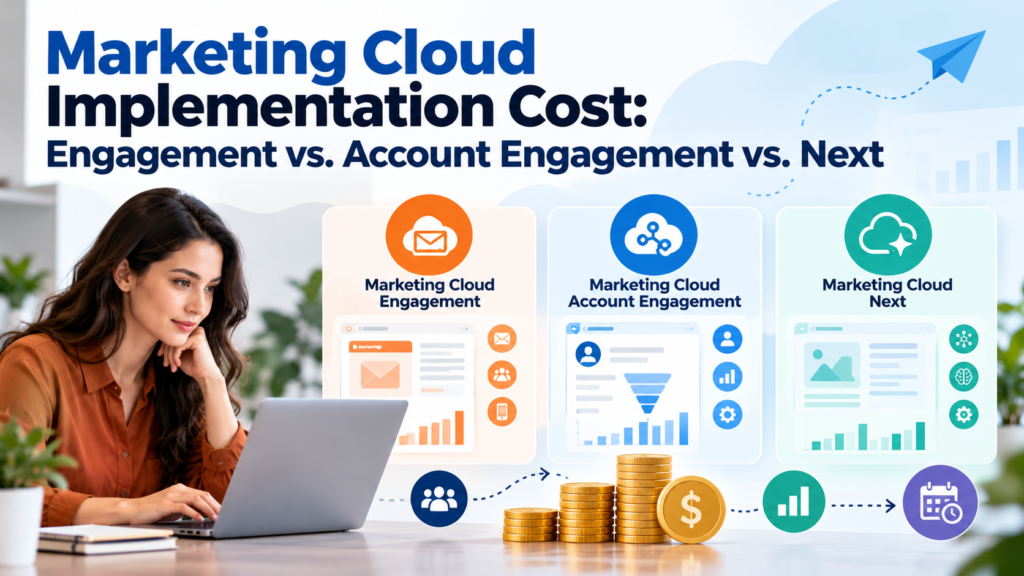
The bigger source of confusion is the product name. Salesforce sells Marketing Cloud Engagement, Marketing Cloud Account Engagement, and Marketing Cloud Next. Their features overlap, and newer “+” editions give buyers access to Next alongside established products. These aren’t 3 interchangeable versions of the same application. The right estimate depends on which processes will actually go live.
This guide compares marketing cloud implementation cost across licensing, setup work, and project assumptions. Illustrative service budgets in this article are estimates for planning, not published Salesforce or partner rates.
TL;DR
Marketing cloud implementation cost depends more on data condition, connected systems, campaign scope, and approval requirements than on the edition name alone. Engagement often requires deeper subscriber architecture and channel setup. Account Engagement usually centers on Salesforce CRM alignment, lead lifecycle rules, forms, and scoring. Next places more early work around Data 360, data models, identity, consent, and the new marketing setup. Published Salesforce subscriptions range from $1,250 per organization per month for Account Engagement Growth+ to $30,000 per organization per month for Engagement Enterprise+, with other editions between those figures. Those are subscription list prices billed annually, not implementation fees. Compare proposals against the same defined launch, insist on separate one-time and recurring lines, and reserve time for source-data repair and user testing.
What You Are Actually Buying
Marketing Cloud Engagement uses subscriber records, data extensions, business units, and journeys for email and other channels. Existing teams may already hold years of templates and journey history in this structure. An implementation therefore has to account for how those assets work today and how subscriber records relate to outside systems.
Marketing Cloud Account Engagement, formerly Pardot, organizes marketing around B2B prospects and Salesforce CRM records. It connects forms and nurturing programs with lead scoring, grading, and sales handoffs. Its key setup issue is how prospect records match leads and contacts and which system owns a field when both can update it.
Marketing Cloud Next works on the Salesforce platform with Data 360 services for marketing data. Its setup includes data streams, identity rules, and marketing data structures. Growth and Advanced are separate editions. A combined license can grant access to established products and Next, but records and journeys do not transfer between them without project work.
Buyers can check the current product families in Salesforce’s marketing product overview before reading any implementation proposal. The page lists Next alongside Engagement+ and Account Engagement+. Every estimate should still use the named SKU in the signed contract, since older edition names can appear in existing agreements and technical guidance.
Why The Names Affect The Estimate
Start the budget with the actual outcome: how many teams will use the system, which audiences they will contact, and which messages must be running at launch. Then identify the edition that supports those requirements. Marketing cloud implementation cost can only be compared fairly after those boundaries are fixed.
Current Salesforce Licensing Prices And Edition Differences
Salesforce publishes US list prices per organization per month for its principal marketing editions. The pages checked in October 2026 specify annual billing for the editions shown here. Actual quotes can differ by contract, region, negotiated terms, included allowances, and purchased add-ons. The table records the published list figures, not a universal invoice.
| Product And Edition | Published USD List Price | Annualized Base Subscription |
| Marketing Cloud Next Growth | $1,500/org/month | $18,000 |
| Marketing Cloud Next Advanced | $3,250/org/month | $39,000 |
| Account Engagement Growth+ | $1,250/org/month | $15,000 |
| Account Engagement Plus+ | $2,750/org/month | $33,000 |
| Account Engagement Advanced+ | $4,400/org/month | $52,800 |
| Account Engagement Premium+ | $15,000/org/month | $180,000 |
| Engagement Pro+ | $2,000/org/month | $24,000 |
| Engagement Corporate+ | $5,500/org/month | $66,000 |
| Engagement Enterprise+ | $30,000/org/month | $360,000 |
The included sending volumes affect the true subscription budget. Salesforce’s Engagement edition prices identify different contact and message allowances for Pro+, Corporate+, and Enterprise+. That page’s FAQ also says, as checked on October 23, 2026, that Salesforce has no announced end-of-life or end-of-sale plan for Engagement. This is a statement of current plans, not a promise about future policy. Confirm the included Next edition and all allowances in the actual quote.
Teams expecting several lead programs should inspect the Account Engagement editions before comparing quotes. The Growth+ through Premium+ packages include different capabilities and Next access. Prospect limits, analytics, and purchased features can also affect price. In an Engagement vs Account Engagement decision, several business divisions may need different entitlements from a single team.
A team planning new mobile channels should check the Next edition comparison against its intended campaigns. Growth lists at $1,500 and Advanced at $3,250 per organization per month. Features such as two-way mobile conversations and path experiments vary by edition. SMS and WhatsApp can involve extra charges or setup work; a feature table does not mean unlimited sending.
Keep License Fees Separate From Project Fees
That distinction is especially important in an Engagement vs Account Engagement comparison. An Engagement vs Account Engagement estimate can change because a less expensive base edition still requires substantial CRM cleanup or a custom integration. A higher-cost edition may be quick to set up for a limited, approved use case. Marketing cloud implementation cost estimates should explain the work, not infer effort from subscription price.
What A Marketing Cloud Implementation Budget Should Include
The marketing cloud implementation cost service budget should cover work that has a clear deliverable and acceptance test. A price presented as a single “implementation” amount makes it difficult to see whether important tasks were excluded. It also invites late change orders when business owners discover that template creation or migration wasn’t included.
A practical estimate divides services into discovery, system design, environment setup, integration, data preparation, campaign building, testing, training, and launch support. The effort in each category changes by product and by the condition of the business’s existing systems. A company with clean Salesforce records can spend less time fixing field ownership. A company with conflicting opt-out records needs more preparation before its first campaign.
Planning Ranges For One-Time Services
There is no standard Salesforce implementation services price. The bands below are calculation examples, not observed market averages or partner quotes. For each scenario, the low estimate is the lower assumed labor hours multiplied by the lower assumed blended hourly rate. The upper estimate uses the higher hours and rate. These assumed rates include a mix of delivery roles; they are not verified provider prices. All scenarios presume an existing Salesforce environment and exclude licenses, taxes, paid messaging, and replacing major outside systems.
| Planning Scenario | Assumed Hours | Assumed Rate | Calculated Services |
| Limited Account Engagement launch | 120-200 | 100-150/hr | 12,000-30,000 |
| Broader Account Engagement rollout | 250-500 | 120-150/hr | 30,000-75,000 |
| Focused Engagement launch | 200-400 | 125-150/hr | 25,000-60,000 |
| Multi-team Engagement deployment | 400-750+ | 150-200/hr | 60,000-150,000+ |
| Focused Next Growth launch | 160-440 | $125/hr | 20,000-55,000 |
| Larger Next Advanced program | 440-800+ | 125-200/hr | 55,000-160,000+ |
The limited Account Engagement case assumes a CRM connection, a few forms, 1 nurture program, and basic reporting. The broader case adds data repair, more programs, and scoring. Engagement scenarios add sending setup, data feeds, and journeys; the multi-team case also includes business units. The Next scenarios cover Data 360 setup, audience rules, and, at the high end, extra sources and channels. Ask bidders for hours by phase and a separate process for scope changes. Marketing cloud implementation cost should follow the agreed work, not these sample rates alone.
Marketing Cloud Engagement Implementation Work
Marketing Cloud Engagement implementation is often driven by audience structure and messaging operations. A first Marketing Cloud Engagement implementation may sound simple: connect customer information, create email templates, and start a welcome journey. In practice, the team must decide how subscribers are identified across systems and how messages respect opt-outs. Those choices affect almost every later campaign.
Marketing Cloud Engagement implementation architecture begins with contact keys, data extensions, attribute relationships, and rules for updating records. If the same person exists in commerce, service, and CRM systems, the team needs a stable identification approach. Choosing an email address as the universal key can cause trouble when an address changes or when multiple records share it. Data ownership should be decided before the import.
Marketing Cloud Engagement implementation also needs sender-domain preparation. The sending setup can involve Salesforce’s Sender Authentication Package and changes to DNS records controlled by an IT team. For campaigns reaching Gmail users, Google’s email sender guidelines explain SPF, DKIM, and DMARC requirements, which depend in part on sending volume. Some Salesforce sending options need additional entitlements. Allow time for authentication testing before the first live campaign.
Business Units, Journeys, And Channels
The first journey should cover a real business event and test it end to end. A welcome sequence, purchase follow-up, or renewal reminder can reveal whether entry events, exclusions, time zones, and cancellation rules work. A more involved program may include mobile messages or triggered sends, each requiring channel-specific approval and testing.
Integration also affects Marketing Cloud Engagement implementation cost. In its guide to synchronized data sources, Salesforce explains how selected Sales and Service Cloud records can enter Engagement through Marketing Cloud Connect. The project team must decide which fields to bring across and how their updates should affect campaigns. Turning on a connection doesn’t resolve those decisions.
What A Finished Engagement Launch Looks Like
At acceptance of a Marketing Cloud Engagement implementation, the business should be able to create an approved audience, send from an authenticated domain, run defined journeys, process an unsubscribe, and trace a test contact through the system. Teams should also know who can publish a journey and who can stop it during an incident.
Marketing Cloud Account Engagement Implementation Work
Account Engagement implementation is usually centered on B2B lead management and the link between marketing activity and Salesforce CRM. The most costly mistakes arise when the two teams haven’t agreed on record ownership or what makes a prospect ready for sales.
Before an Account Engagement implementation builds a nurture program, define lead sources, campaign membership, form capture, field mappings, assignment logic, and exclusion criteria. Make explicit decisions about which values Salesforce owns and which values Account Engagement may update. If the same field can be changed in both places, its sync behavior requires careful review.
During an Account Engagement implementation, use Salesforce’s connector setup lesson to check field mapping and initial import behavior. Existing Salesforce leads and contacts don’t always enter the prospect database simply because the connector is enabled. That distinction can add work to migration and testing.
Scoring, Grading, And Sales Handoffs
A score based on page visits and email clicks only helps when sales trusts what it means. Grading can assess how closely a prospect matches the agreed customer profile. Neither system should be configured before the sales team explains what signals matter and which actions are noise.
Account Engagement implementation testing needs actual handoff scenarios. A returning customer may submit a new form. An existing contact may also have an open opportunity. A prospect could change ownership or opt out while sitting in a nurture sequence. The system must behave predictably in each case.
Where The Workload Expands
A sound Account Engagement implementation estimate should state the number of lead sources and field mappings, plus the nurture programs and scoring models included. Define the historical records to import and reports to build. Without those counts, bids from different providers won’t be comparable.
Marketing Cloud Next Implementation Work
Marketing Cloud Next changes the planning discussion because its setup is closely tied to Salesforce platform services and Data 360. Organizations may already have CRM data in Salesforce, but they still need to prepare the marketing data model, permissions, audiences, and channels used in the new environment.
Before enabling campaigns, the team should use Salesforce’s Next setup instructions to confirm the required Data 360 setup, CRM connection, data spaces, permissions, and identity rules. Work differs by feature. A pilot using 1 reliable CRM source requires fewer decisions than an environment joining web activity with several outside databases.
Marketing Cloud Next implementation needs a clear owner for each data space. A lead, contact, and store account might belong to the same person. Identity rules decide when those records should be connected. The business must approve those rules and check that each record’s permissions still apply.
Data Kits And Campaign Setup
To plan the marketing environment before importing customer data, Salesforce’s data kit requirements explain the objects and streams that Next needs. Processing data streams can consume Data 360 credits. Track the imported data and refresh frequency so the project can estimate both setup effort and ongoing usage.
Don’t Assume Plus Means Automatic Migration
For a Marketing Cloud Next implementation migration plan, identify which processes will stay on the established product, which will be recreated, and which can use new features without replacing the current program. Marketing Cloud Next implementation cost can increase sharply if the project quietly changes from a limited rollout to a full historical rebuild.
Data Migration And Integration Costs Across The Products
For Marketing Cloud Next implementation, make a list of each source system. Record who owns each field, how many records it holds, and how often the data changes. Note limits on permitted use. Include inactive contacts, which can still affect account allowances or suppression. The hard part may be deciding which conflicting record is correct and whether consent allows it to be used.
Historical audiences also need a deletion plan. Salesforce’s contact deletion guidance describes how removing contacts can affect Engagement at account level. Confirm retention and suppression rules before importing old records. Removing an unwanted record later may require more checks than excluding it at the start.
Estimate Integrations By Behavior
An integration estimate in an Engagement vs Account Engagement review should name the source and destination, the fields sent, update frequency, and system owner. It should also cover authentication and how errors are reported. Decide what happens if a data feed fails. For example, a journey relying on recent purchases may need to pause when that information stops arriving.
In an Engagement vs Account Engagement project comparison, don’t assume the edition with fewer connectors is automatically cheaper. One difficult enterprise data feed can require more effort than several standard CRM fields. The better unit for an estimate is tested business behavior, including failure handling.
Reconcile Before Go-Live
Compare source and target counts, sample linked identities, and verify critical exclusions. Test changes after the initial import rather than checking only a static snapshot. An integration can pass the first upload and still fail when a record is merged, deleted, or reassigned.
Consent, Deliverability, And Security Requirements
Consent design belongs in the implementation budget from the beginning. Each product must know whether a person can receive a specific type of message through a specific channel. A single field labeled “opted out” may be insufficient when the business operates across brands, countries, or communication purposes.
Consent records have to follow the customer across the selected channels. In its October 2026 Next consent explanation, Salesforce describes the Communication Subscription Consent object in Data 360 and the ways it can be updated. The project should test form submissions and opt-out events against past consent records before campaigns launch.
Teams sending commercial email in the US should check the FTC’s CAN-SPAM guidance during acceptance testing. It covers sender identification and required unsubscribe handling, among other obligations. Other countries and message channels have their own rules. A software setting doesn’t replace a legal review.
Domain And Sender Readiness
Security design should cover administrators, content editors, data access, and publishing approval. The team must know who can modify audiences and who can approve a live campaign. External agency access should be scoped and reviewed. Marketing cloud implementation cost rises when access and privacy decisions are postponed until after campaigns are built because later changes can force rework.
Use Test Records That Reflect Real Risk
Acceptance testing should include an opted-out contact, a person with different brand preferences, a record deleted at the source, and an employee without permission to view the audience. Verify what happens in every channel included at launch. These cases are more important than proving that one sample email looks correct.
The aim is to prevent wrong recipients and unsupported messages. That reduces both operational risk and the chance of expensive campaign corrections after launch.
Realistic Implementation Timelines And Dependencies
A marketing cloud implementation cost estimate should connect calendar time to work hours and approvals. The windows below are planning models, not measured delivery averages. They assume a delivery team can dedicate roughly 30-45 project hours per week across its specialists, that client reviewers respond within 2-3 business days, and that required access is available at kickoff. Some tasks can overlap. Extensive source cleanup, custom integrations, external security reviews, or slow approvals can push dates beyond the upper end.
| Implementation Type | Modeled Window | Working Assumption |
| Narrow Account Engagement pilot | 4-8 weeks | 120-200 hours; 1 standard CRM connection |
| Broader Account Engagement rollout | 8-16 weeks | 250-500 hours; limited legacy cleanup |
| Focused Engagement email launch | 6-12 weeks | 200-400 hours; 1 sending domain and brand |
| Multi-brand Engagement program | 12-24+ weeks | 400-750+ hours; multiple approvals and feeds |
| Focused Next Growth pilot | 6-12 weeks | 160-440 hours; 1 prepared CRM source |
| Wider Next Advanced deployment | 12-24+ weeks | 440-800+ hours; identity and external-source testing |
A Marketing Cloud Next implementation schedule should hold dates for design sign-off, access, source testing, audience checks, and launch acceptance. The modeled weeks include some work in parallel, so dividing total hours by 40 won’t always reproduce each window. Add time for any external system owner who can’t confirm an integration test date.
Before changing live marketing configurations, the delivery team can review Salesforce’s Next sandbox setup for supported testing steps. A test environment can reveal permission or data issues before production changes. Confirm whether the tenant has the required sandbox rights and whether extra licenses are needed.
Work That Can Run In Parallel
Schedule assumptions should identify the client’s response time. A vendor can plan a 2-day review, but the project will slip if every approval requires a 3-week committee cycle. Marketing Cloud Next implementation programs are especially sensitive to cross-team decisions because marketing, CRM administration, and data specialists may own different prerequisites.
Sample First-Year Budgets And Hidden Costs
A useful comparison joins base subscriptions to implementation services without pretending the figures are vendor quotes. The examples below are hypothetical organizations with different launches. They illustrate the arithmetic and the main reasons budgets diverge.
| Scenario | Annual List License | Illustrative Services | Illustrative First-Year Subtotal |
| B2B team on Account Engagement Growth+ | $15,000 | $24,000 | $39,000 |
| 1-brand team on Engagement Pro+ | $24,000 | $42,000 | $66,000 |
| CRM-led team on Next Growth | $18,000 | $40,000 | $58,000 |
| Larger team on Next Advanced | $39,000 | $96,000 | $135,000 |
These illustrative services figures assume, in table order, 200 hours at $120 per hour, 280 at $150, 320 at $125, and 600 at $160. These are budgeting inputs, not partner bids. The subtotals include the listed subscription and modeled services only. For a full first-year budget, add messaging usage, paid extras, internal labor, and ongoing support. Renewal costs need a separate estimate because launch work does not repeat each year.
Costs Often Missing From The First Quote
Contact capacity can change as the database grows. Sending volume and mobile credits may increase with a successful campaign program. Data 360 processing may consume credits, and extra external connectors can carry their own fees. A new business unit, branded domain, analytics package, or support plan may also be a paid item depending on the subscription.
Marketing cloud implementation cost should therefore be discussed over at least the first contract year.
How To Compare Implementation Proposals Fairly
A credible marketing cloud implementation cost proposal defines outcomes and exclusions. It should make sense to the person who will maintain the system after the implementer leaves. Excluded launch work can make a low bid cost more.
For an Engagement vs Account Engagement comparison, start with an identical brief sent to each bidder. Specify the selected edition or ask the bidder to explain its edition assumption. Identify data sources, message channels, number of brands, active use cases, user groups, and the records to migrate. Include reporting requirements and privacy sign-off.
A vendor estimating marketing cloud implementation cost should return a deliverable list, assumptions, timeline dependencies, acceptance tests, and a process for changes. Compare who owns templates and content, who will provide test data, and who corrects failed mapping after launch. Those details often explain price gaps better than an hourly rate.
Proposal acceptance should include a field-level data review. The NIST Privacy Framework offers a way to consider privacy risks when customer data moves between systems. Ask why each field is required and who may access it. Copying every CRM field into marketing without a defined purpose can increase exposure and complicate maintenance.
Minimum Proposal Checklist
· Confirm the product edition, included Next access, and contract assumptions.
· List each data source, direction of sync, and responsible owner.
· Specify the number of journeys, forms, templates, reports, and brands.
· Define contact identity, consent, access, and deletion requirements.
· Include migration counts, reconciliation tests, and failure handling.
· State who trains staff and who supports the first live campaigns.
· Separate one-time work from annual subscription and usage charges.
Choosing Between Engagement, Account Engagement, And Next
Turn the choice into acceptance tests. If the main requirement is to retain working subscriber journeys across brands, price the cost of keeping and updating those Engagement assets. If success means qualifying leads and passing them into an active Salesforce sales process, test that handoff in Account Engagement. If the goal is to launch campaigns from Salesforce platform data, first prove that Next can ingest the intended records and apply the required consent rules. A product should remain on the shortlist only if its proposed setup passes the launch tests.
| Main Requirement | Likely Starting Point | Question To Resolve |
| Established large-scale journeys | Engagement | Which current assets must stay live? |
| B2B lead nurturing and qualification | Account Engagement | Who owns scoring and CRM handoffs? |
| New platform-native campaigns | Next | Is the Data 360 foundation ready? |
| Existing Engagement plus new capabilities | Engagement+ with Next | What runs in each environment? |
| Existing Account Engagement plus Next features | Account Engagement+ | Which processes should change first? |
Require a test for the deciding requirement before approving the edition. For Engagement vs Account Engagement, run an audience-to-message test or a lead-to-sales handoff test, depending on the use case. For Next, test the source record through to campaign eligibility. Compare the implementation effort of those tests alongside the license price, rather than ranking products by feature totals.
Conclusion: Estimate The Work Behind The License
Marketing cloud implementation cost can’t be reduced to one fixed number because Engagement, Account Engagement, and Next ask different questions of the business. Engagement emphasizes subscribers and messaging operations. Account Engagement depends on lead definitions and reliable CRM handoffs. Next requires a working platform data foundation and new marketing setup decisions.
The best comparison is a written scope with the same launch requirements for every proposal. When price, timetable, and exclusions are tied to those requirements, the business can see which option fits its current operating needs and what a later expansion will involve.
Frequently Asked Questions
What Is The Typical Marketing Cloud Implementation Cost?
There is no single verified standard fee. A narrow setup may involve much less work than a multi-brand migration with custom integrations. The article models 12,000-30,000 for a limited B2B launch using 120-200 hours at assumed rates of 100-150 per hour. Larger programs can exceed $160,000 under the stated labor assumptions. These figures are planning calculations, not observed market prices or quotes.
Is Salesforce Marketing Cloud Licensing Included In Implementation Fees?
Usually the subscription and implementation services are quoted separately, although a reseller may present them together. Licensing pays for access to the purchased edition and its allowances. Implementation covers agreed configuration and launch work. Ask for an itemized contract so recurring and one-time charges remain clear.
What Is The Difference Between Marketing Cloud Engagement And Account Engagement?
Engagement is centered on subscriber messaging operations and customer journeys. Account Engagement is oriented toward B2B prospects, nurturing, and Salesforce CRM lead handoffs. Their feature sets can overlap, especially through newer bundled editions. The right product depends on how the business manages audiences and sales processes.
Is Marketing Cloud Next Replacing Engagement?
As checked on October 23, 2026, Salesforce’s Marketing Cloud Engagement pricing FAQ says it has no announced end-of-life or end-of-sale plan. That statement can change and isn’t a permanent commitment. Next is a separate product family, and Engagement+ includes access to Next under current packaging. Check contractual terms and published updates before making migration plans.
What Does Marketing Cloud Next Cost Per Month?
Salesforce lists Next Growth at $1,500 per organization per month and Next Advanced at $3,250, with annual billing. These are published US list prices and may change. Additional usage and purchased features can affect the total. Implementation services are separate from the base subscription.
How Much Does Marketing Cloud Engagement Cost?
Salesforce lists Engagement Pro+ at $2,000 per organization per month, Corporate+ at $5,500, and Enterprise+ at $30,000, billed annually. Edition allowances and included Next access differ. A buyer should confirm messaging capacity and any add-ons in the contract.
How Much Does Account Engagement Implementation Cost?
A limited B2B rollout can be simpler than a project requiring several divisions and substantial CRM repair. The narrow example uses 120-200 hours at 100-150 per hour, producing 12,000-30,000. The broader model uses 250-500 hours at 120-150 per hour, producing 30,000-75,000. These are assumed planning inputs, not published Salesforce fees. Bids should list mappings and nurture deliverables.
How Long Does Marketing Cloud Implementation Take?
A narrow project may take several weeks, while a larger migration may take several months. The article models 4-8 weeks for a small Account Engagement pilot and 12-24 or more weeks for a wider deployment. Those windows assume about 30-45 focused team hours weekly and client review within 2-3 business days. Additional integration or approval delays can extend them.
Does Engagement+ Include Marketing Cloud Next?
Salesforce says the current Engagement+ editions include access to Next capabilities. Pro+ is paired with Growth, while Corporate+ and Enterprise+ include Advanced access under published packaging. Specific entitlements and limits still need contract confirmation. Access doesn’t automatically migrate existing campaigns.
Does Account Engagement+ Include Marketing Cloud Next?
Yes. Salesforce describes Next access as part of its current Account Engagement+ editions. Growth+ and higher packages differ in included capabilities. The marketing team must still configure the relevant features and determine how they fit existing CRM and nurturing processes.
What Increases Marketing Cloud Implementation Cost The Most?
Common causes are inconsistent records, custom integrations, unclear consent data, several business units, and large campaign migrations. Delayed decisions from internal teams can also extend the project. A detailed source inventory and testable scope make those risks easier to estimate before work starts.
Is Data 360 Required For Marketing Cloud Next?
Salesforce’s Next setup instructions include enabling Data 360 and deploying required marketing data kits. The actual work depends on the sources and functions used. Teams should check data processing charges and permissions before activation. Having Salesforce CRM records already available doesn’t remove every setup task.
Can Existing Engagement Journeys Move To Next Automatically?
Access to Next through a bundled license doesn’t mean established journeys are automatically converted. Each journey needs a design decision covering triggers, audience logic, content, and reporting. Some processes may remain in Engagement while new programs are built in Next. Test replacements before retiring live workflows.
Should A Company Pay For A Dedicated IP At Launch?
That depends on the edition, sending volume, domain setup, and Salesforce requirements for the chosen environment. A dedicated IP may be included through an applicable package or purchased separately. Sending reputation still requires good list practices. Check contract entitlements and sender setup guidance before budgeting.
How Should Marketing Cloud Implementation ROI Be Measured?
Use outcomes tied to the approved use cases, such as qualified lead handoffs, valid campaign delivery, reduced manual handling, or reliable reporting. Establish the baseline before launch and include operating costs when judging returns. Open and click activity alone shouldn’t be treated as proof of business value.



1 thought on “Marketing Cloud Implementation Cost: Engagement vs. Account Engagement vs. Next”