B2B Cold Calling Services: When Outsourcing Actually Works
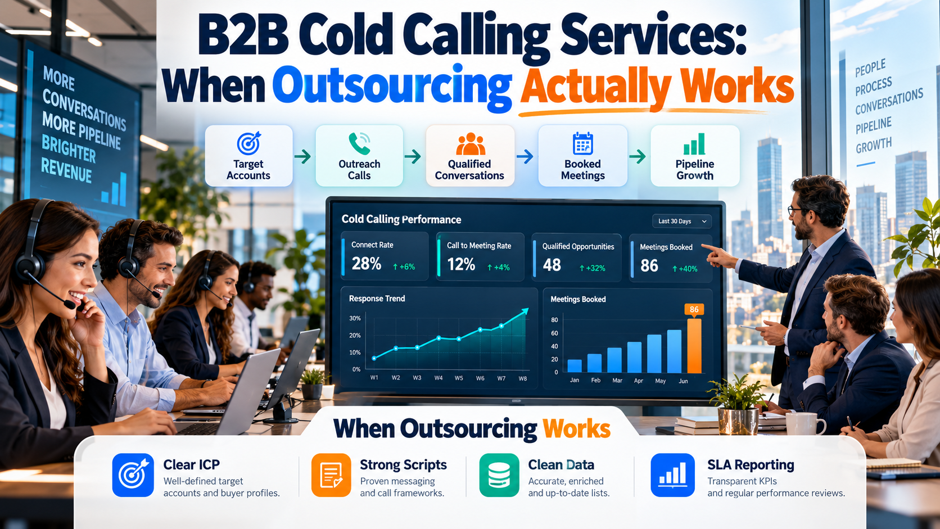
Picture an illustrative founder of a 12-person software company that sells inventory tools to regional distributors. Within a year, 2 sales hires quit, the pipeline is thin and the next funding conversation is 4 months away. A cold calling agency offers to book meetings for $4,000 a month, starting in 3 weeks. The founder wonders whether outsourcing is a shortcut that works or a habit that burns money, and nobody around her can say what separates the cases where it pays from the cases where it doesn’t.
This article explains when outsourced B2B cold calling tends to work, what it costs and how to test it before committing. It draws on pricing and benchmark pages from Prospeo and Revnew, plus law firm notes on the FTC’s Telemarketing Sales Rule. Both vendor pages sell products connected to outbound sales, so each figure is attributed and flagged, and I point out where they contradict each other. The payback model near the end uses invented numbers. Confirm prices with vendors and legal points with counsel.
TL;DR
- Outsourcing works best in narrow situations. Revnew recommends it when you need a pipeline within 30 to 60 days, are entering a new market or have lost several reps in 18 months. Prospeo says deals under roughly $15,000 fit, while enterprise or brand-sensitive sales usually belong in-house. Both are vendors, so treat the guidance as hypotheses to test with a pilot.
- Price per meeting hides the number that matters. Prospeo reports $75 to $500 per appointment and Revnew reports $250 to $1,200 per qualified meeting. At a $300 booked meeting, Prospeo’s example costs $500 per held meeting at a 60% show rate. Define “qualified” in writing, and measure cost per held meeting, opportunity and closed deal.
- Compliance still applies to business calls. A law firm note says the FTC extended the Telemarketing Sales Rule’s ban on misleading statements to business calls and added 5 years of recordkeeping. I couldn’t confirm the effective dates, so ask counsel and ask any vendor how it scrubs lists, records calls and documents consent.
What outsourced cold calling covers
Appointment setting is the core service. The provider callers phone prospects from a list, pitch a short script and book meetings with your sales team. Revnew’s page says the minimum channel coverage should be email plus phone, since email-only programs reportedly underperform multi-channel programs. Ask who writes the script, who approves changes, how many attempts each prospect gets and whether the caller can answer basic product questions. The more technical your product, the more these details decide the outcome.
Lead qualification decides what counts as a result. Providers vary in how much qualifying they do before booking. Revnew recommends defining a “qualified meeting” in the contract, with examples such as job title, confirmed business challenge and evaluation timeline. Without a definition, a provider paid by the meeting has a reason to book anyone who says yes. Write down the criteria, give the vendor examples of good and bad meetings, and agree on who can reject a meeting and when.
List building and data work come bundled or separate. Some providers supply the list, and others call the list you give them. Prospeo says outsourcing suits teams that can define a tight ideal customer profile and supply verified data. Verified direct dials reportedly answer far more often than switchboard numbers, according to the same page, which is a vendor’s own framing. Ask who owns the list, how often it’s refreshed and who pays for data when a campaign shifts to a new segment.
Reporting and handoff complete the service. A provider should report dials, connections, conversations, meetings booked, meetings held and reasons for rejection, ideally by week. It should also hand off context to your reps, such as notes on the conversation and the prospect’s stated problem. Ask for call recordings, access to the dialer or sales system and a named account manager. A provider that reports only meetings booked leaves you unable to tell whether the problem is the list, the script or the callers.
When outsourcing actually works
Outsourcing works when the job is well defined, the volume is high enough to justify a team and the cost of building in-house is higher than the cost of renting capacity. That sounds obvious, but many buyers skip the definition step and expect the provider to figure out the offer, the audience and the message on its own. Providers can execute a plan quickly. They can’t invent your positioning, and they can’t supply product expertise that your own people took years to build.
The vendor pages agree on a few conditions. Revnew recommends outsourcing when you need a pipeline within 30 to 60 days, are entering a new market, have a stretched team or have had 2 or more turnovers among development reps within 18 months. Prospeo lists scaling quickly, testing a new market and running seasonal campaigns, with average deals under roughly $15,000. In each case, speed or flexibility matters more than depth, and the offer is simple enough for a trained caller to explain.
The conditions that favor outsourcing also tell you what to prepare. A tight ideal customer profile, a clear offer, verified data and a person on your side who can review calls each week raise the odds. Without them, the provider’s early weeks go to guessing, and you pay for the learning. Treat outsourcing as a partnership with homework on both sides. A buyer who hands over a vague brief and checks in monthly is likely to be disappointed, however good the provider is.
Situations where outsourcing fits
- You need a pipeline fast and can’t wait to hire. Hiring, training and ramping a caller takes months, while a provider says it can start in weeks. Revnew cites 2 to 4 weeks from signing to the first qualified meeting as a benchmark. That figure comes from a vendor, so ask each candidate for its own timeline and for a comparable client who can confirm it. Speed only helps if the offer and list are ready on day 1.
- You’re testing a new market or message. A provider can run a short campaign against a new segment without a permanent hire. Prospeo lists testing a new market as a good fit. Set a limit on spend and duration before you start, define what result would justify more investment and agree to stop if the data says no. A test with no exit criteria turns into an open-ended retainer that nobody remembers approving.
- Your product has a short sales cycle and moderate deal size. Prospeo suggests average deals under roughly $15,000 fit outsourcing, while deals under $5,000 with short cycles may be better served by automated sequences and self-serve demos. That’s a vendor’s guidance. The logic holds: a caller can explain a simple product in a few minutes, and the economics only work if a closed deal covers the cost of many meetings.
- Your own team has turned over or lacks capacity. Revnew cites 35% to 40% annual attrition among development reps, attributed to Remote Growth Partners, and I haven’t verified it. If your own experience shows churn, an outside team removes a risk, though it adds a different risk: the provider’s callers can also leave, and you may not hear about it. Ask about caller tenure and what happens to your account when someone departs.
Situations at a glance
The table maps common situations to the option that usually fits. It’s my judgment rather than sourced data, built from the logic of the vendor pages and the work involved. Treat it as a starting point for your own test. The right answer depends on deal size, product complexity, available management time and how much you’ve already learned about what works. When a situation falls between rows, a hybrid or a short pilot usually makes more sense than a full commitment.
| Situation | Usually fits | Why (my judgment) |
| Need pipeline in 30 to 60 days | Outsource | Hiring takes longer than the window |
| Entering a new market, unproven message | Short outsourced pilot | Cheap way to learn before hiring |
| Average deal over $250,000, complex buying group | In-house | Depth and relationships matter most |
| Brand-sensitive or heavily regulated pitch | In-house or tightly managed vendor | Reputation risk is high |
| Average deal under $5,000, short cycle | Automation and self-serve | Calls may cost more than the deal earns |
| Proven playbook and a manager with time | In-house | Control and learning stay with you |
| Seasonal push or single event | Outsource | Capacity is temporary |
| Existing accounts and inbound leads | In-house | Relationship work shouldn’t go to strangers |
The case against outsourcing
Outsourcing fails when the product is too complex, the brand is too sensitive or the deal is too large for a rented caller to represent. Prospeo says enterprise or brand-sensitive sales and deals that need deep product knowledge usually do better in-house. Revnew puts the in-house threshold much higher, at average deal sizes above $250,000 with a proven playbook and a leader who can manage quality. The gap between $15,000 and $250,000 shows how loose these rules are, so use them as prompts rather than thresholds.
Prospeo also claims domestic callers outperform offshore callers by up to 2 times on conversion for complex conversations. It gives no source for the figure, and the claim comes from a vendor that sells data. Still, language, accent, time zone and industry familiarity all affect how a prospect responds, and they matter more as the conversation gets harder. Ask where callers sit, how they’re trained on your product and whether you can listen to sample calls before you sign.
The hidden cost of poor outsourcing is reputation. Revnew warns that outreach practices can damage your sending domain’s reputation, which can outlast the engagement, and a caller who misstates your offer can damage a relationship you wanted. Prospects remember a bad call about your company even if they never buy from you. Weigh that risk against the savings, and keep control of the script, the list and the right to stop the campaign at any time.
How providers price the work
Retainers charge a monthly fee for a defined effort. Prospeo reports retainers at $2,000 to $5,000 a month and subscriptions at $2,000 to $4,500, while Revnew reports $3,000 to $15,000 a month for outsourced development services and $2,500 to $4,000 for a fractional rep. A retainer gives predictable cost, but it pays the provider whether or not meetings happen. Ask for a minimum activity level, such as dials per week or meetings per month, and for a way to adjust or exit if results lag.
Pay-per-meeting charges only when a meeting is booked. Prospeo reports $75 to $500 per appointment and Revnew reports $250 to $1,200 per qualified meeting. The ranges differ, and neither explains why. Revnew warns that incentives can favor volume over quality, which is the risk of paying for meetings: a provider can book weak meetings to earn the fee. Pay-per-meeting works best with a strict definition, a rejection process and payment tied to meetings that happen, beyond those merely scheduled.
Hybrid models combine a base fee with a bonus. Revnew reports $2,000 to $5,000 a month in base fees plus $150 to $400 for each meeting above a floor. This aligns the provider’s income with results while covering its costs. Ask where the floor sits, how the provider counts a meeting toward it and what happens in a slow month. A floor set too low gives you little protection, and a floor set too high may push the provider to book weak meetings to hit it.
Hourly and per-call pricing suits tightly managed work. Prospeo lists offshore-US hourly rates at $8 to $16 and per-call pricing at $0.50 to $3.00. These models give you control but also give you the burden of managing the callers, the script and the list. They fit teams with a manager who has time to coach. Ask whether the rate includes the dialer, data, quality checks and management, because a low hourly rate can hide high add-on costs.
Reported price points
- Prospeo’s table lists 6 pricing models. Subscription at $2,000 to $4,500 a month, retainer at $2,000 to $5,000, per appointment at $75 to $500, per qualified lead at $50 to $250, offshore-US hourly at $8 to $16 and per call at $0.50 to $3.00. The page is labeled 2026 and shows no publication date. Prospeo sells data, so it benefits when buyers think outsourcing is complicated and data quality matters.
- Prospeo also lists starting prices for named agencies. It reports SCIENCE at $2,000 a month plus a $5,000 setup fee, Belkins at $2,000 a month, SalesFocus at $3,950 and Martial Group at $4,500. I haven’t verified these prices with the agencies, and they may change. Use them to see the range, then ask each candidate for a current written quote that states what’s included, the contract length and any setup or cancellation fees.
- Revnew’s page, dated July 31, 2026, gives different ranges. Outsourced services at $3,000 to $15,000 a month, pay-per-meeting at $250 to $1,200, hybrid at $2,000 to $5,000 plus $150 to $400 per meeting above a floor and fractional reps at $2,500 to $4,000. Revnew sells outsourced development services, so its figures are vendor claims. It also describes a case study with a 6.9% meeting-booked rate against 1.3% in-house, which is self-reported.
- The in-house comparison figures conflict. Revnew puts a fully loaded in-house rep at $110,000 to $160,000 a year, or about $9,200 to $13,300 a month, while Prospeo puts a 2-rep team with a manager at $300,000 to $350,000 and claims outsourcing cuts cost 40% to 60%. Revnew claims 30% to 50%. Neither shows how the numbers were built, so build your own with salary, benefits, tools, data, management time and turnover.
Cost per held meeting and the show rate
Price per booked meeting hides a second number: how many booked meetings actually happen. Prospeo gives a worked example. At $300 per booked meeting, a 60% show rate means $500 per held meeting, an 80% rate means $375 and a 90% rate means $333. My arithmetic agrees, since $300 divided by 0.6 is $500, by 0.8 is $375 and by 0.9 is about $333. A provider that books many meetings but loses 40% to no-shows costs 50% more per real conversation.
Show rates depend on how the meeting was set. A prospect who agreed to a short call after a clear explanation is likelier to attend than a prospect who said yes to end the conversation. Prospeo’s benchmark table puts average show rates at 60% to 70% and top teams at 80% or more. Those figures come from a vendor with no stated source. Ask your provider for its show rate on comparable clients, and write a target into the contract, with confirmation emails and reminders as part of the process.
Go further than held meetings and measure what each meeting produces. A held meeting that never becomes an opportunity is a cost with no return. Track the share of held meetings that become qualified opportunities, the share of opportunities that close and the average deal value. Cost per closed deal is the number that settles the question. Cost per booked meeting is the number vendors prefer to discuss, because it’s the smallest, and it’s also the number that tells you the least.
Performance benchmarks
The table reproduces Prospeo’s benchmarks. They come from a vendor of sales data with no stated sources, and some figures conflict with each other. For example, 40 to 50 dials a day at a 2.3% to 2.5% dial-to-meeting rate over 20 working days implies roughly 18 to 25 meetings a month, while the same table lists 8 to 10 meetings a month per rep. Either the rates or the activity assumptions don’t fit, so treat the table as rough context and measure your own.
| KPI | Average | Top teams | Caveat |
| Connect rate | 3% to 10% | 7% to 10% or more | Prospero; wide range, no source |
| Dials per day | 40 to 50 | 50 to 70 | Prospeo; depends on dialer and list |
| Dial-to-meeting | 2.3% to 2.5% | 5% to 8% | Prospero; conflicts with meetings per month |
| Show rate | 60% to 70% | 80% or more | Prospeo; depends on how meetings are set |
| Meetings per month per rep | 8 to 10 | 12 to 15 | Prospeo; implies lower dial-to-meeting than listed |
| Attempts to reach a prospect | 8 or more | Not stated | Prospero; claim without source |
Contract terms to check
- Define a qualified meeting in the agreement. Revnew recommends criteria such as job title, confirmed business challenge and evaluation timeline. Add the minimum company size, location and any disqualifiers, and say who decides when a meeting is disputed. Include a process for rejecting meetings that fail the test, with a credit or refund. A definition that lives only in a sales deck won’t help when you disagree about whether a meeting counts.
- Set a pilot before a long commitment. Prospeo recommends a 90-day pilot before any 6 to 12 month contract. Agree on success measures in advance, such as held meetings, qualified opportunities and cost per held meeting, and agree on the right to leave if the pilot misses them. A provider confident in its results should accept a pilot. If it insists on a long term up front, ask what it knows that justifies the lock-in.
- Specify the data and who owns it. Ask where the list comes from, how often it’s refreshed and who owns the call records and the contacts after the contract ends. Revnew cites a claim that B2B contact data decays about 30% annually, from the vendor and unverified. Ask for the right to export every contact, note and recording, and for deletion of your data on termination, confirmed in writing. Keep a copy of every export.
- Require reporting, access and a named manager. Ask for weekly reports on dials, connections, conversations, meetings booked, meetings held and rejections, plus access to recordings. Ask who manages your account and how callers are assigned. Include a notice requirement for staffing changes. Without visibility into the calls, you can’t coach the script or catch a caller who misrepresents your product, and the reputational damage may reach you before the report does.
Legal and compliance basics
Business calls aren’t free of rules. A May 2022 note from law firm Klein Moynihan Turco says the Telemarketing Sales Rule’s business-to-business exception exempts most business sales calls, with an exception for calls selling office and cleaning supplies, and that the FTC was then weighing repeal, narrowing or added categories. That note describes a proposal rather than a final rule. Another law firm summary says the FTC later extended the rule’s ban on misrepresentations to business calls, and I couldn’t confirm the date. Ask counsel.
Recordkeeping is a live issue. The same summary says telemarketers must keep call records, including the caller, the seller, the purpose, whether the call was business or consumer-facing and the outcome, along with the version of the Do-Not-Call registry used and when it was accessed, for at least 5 years. It gives effective dates as 30 days and 180 days after Federal Register publication, without a calendar date. Ask any provider how it keeps these records and whether it’ll share them.
Scrubbing and consent need answers in writing. Prospeo recommends asking about TCPA compliance, Do-Not-Call scrubbing and call recording consent. I haven’t researched state rules on recording or on calling mobile numbers, and they vary. Business numbers can’t be added to the national registry, while residential and mobile numbers can, so a list that mixes them raises questions. Ask the provider how it classifies numbers, what it scrubs against and what it does when a prospect asks not to be called.
You may share responsibility. The company that hires a calling provider may be accountable for what the provider says on its behalf, and a misleading pitch can create trouble for both. I’m not giving legal advice, and I haven’t researched every rule. Ask counsel to review the contract, require the provider to follow your approved script and ask for indemnity for violations. Keep the recordings and the scripts, so you can answer a complaint quickly.
Running a pilot that teaches you something
A good pilot answers a specific question: can this provider book meetings that turn into opportunities at a cost we can afford? Prospeo recommends 90 days before a long contract, and that length makes sense, since a shorter test may end before meetings convert. Fix the list, the offer and the script at the start so you can tell what drove the results. Changing 3 things at once produces numbers you can’t interpret, whatever they show.
Decide the measures before the pilot starts. Useful ones include calls made, connections, conversations, meetings booked, meetings held, qualified opportunities and cost per held meeting. Add a quality check by listening to a sample of calls each week, scoring them against a short checklist and sharing the feedback with the provider. Calls reveal problems that reports hide, such as a caller who rushes the pitch or promises features that don’t exist.
Mistakes buyers make
- Choosing on price per meeting. A low price per booked meeting looks attractive until you count no-shows and meetings that never become opportunities. Prospeo’s example shows a $300 meeting costing $500 when 40% don’t show. Compare cost per held meeting, qualified opportunity and closed deal, and make sure the definition of a meeting is the same in each quote. Ask providers to show these numbers for comparable clients, and verify the references.
- Handing over a vague brief. Providers can’t work from “sell to mid-size companies.” Without a defined profile, a clear offer and verified data, the early weeks go to experimenting, and you pay for it. Write a 1-page brief with target titles, company sizes, industries, pain points, proof points and objections. Give the provider your best calls from your own team, and update the brief weekly during the pilot. Review the brief together on the first call.
- Ignoring the handoff. Meetings booked by a provider arrive at your reps with little context unless you build a process. Reps who show up unprepared waste the meeting, and prospects notice. Agree on a handoff format, give reps access to notes and recordings and set a standard for how fast reps follow up. A provider can book meetings, but only your team can turn them into deals. Review lost meetings with both teams each month.
- Skipping compliance questions. Cold calling carries legal and reputational risk, and the rules are changing. Ask about list scrubbing, recording consent, recordkeeping and what the provider says about your company. Have counsel review the contract. A provider that dismisses these questions is a risk to your brand, and the savings from a cheap contract can vanish with a single complaint or a single bad call. Keep the provider’s written answers on file with the contract.
An illustrative payback model
An invented company signs a $4,000-a-month retainer for 12 months, or $48,000. It assumes 8 booked meetings a month, or 96 a year, a 70% show rate, 50% of held meetings becoming qualified opportunities and 25% of opportunities closing. Those assumptions yield 67.2 held meetings, 33.6 opportunities and 8.4 deals. An invented in-house comparison uses a fully loaded rep at $135,000, the midpoint of Revnew’s range, booking 10 meetings a month. Every input is invented, and I recomputed the arithmetic.
| Item (invented) | Outsourced retainer | In-house rep |
| Annual cost | $48,000 | $135,000 |
| Meetings booked | 96 | 120 |
| Meetings held at 70% | 67.2 | 84 |
| Cost per held meeting | About $714 | About $1,607 |
| Opportunities at 50% | 33.6 | 42 |
| Deals at 25% | 8.4 | 10.5 |
| Break-even deal value | About $5,714 | About $12,857 |
Outsourcing wins on cost in this example, since each held meeting costs less than half as much, and a deal worth more than about $5,714 covers the $48,000. At a deal value of $12,000, the 8.4 deals produce about $100,800 in revenue, or $52,800 more than the retainer costs. The result shifts quickly if the show rate, opportunity rate or close rate falls, so test each assumption in a pilot. A pay-per-meeting contract at an invented $400 would cost $38,400 for the same 96 meetings.
Managing the provider after launch
Hold a weekly review. Spend 30 minutes each week with the account manager reviewing dials, connections, meetings booked and held, rejection reasons and notes from sample calls. Share what your reps hear in the meetings and what prospects say. A provider can improve only from feedback, and weekly feedback is the cheapest way to raise quality. Skip the review and problems compound for a month before anyone notices. Put the meeting on both calendars as a standing item.
Listen to recordings. Choose 10 calls a week at random and score them for accuracy, tone and handling of objections. Look for statements that overpromise, since those create legal and relationship risk. Share examples of good calls so the callers can copy them. If the provider refuses access to recordings, treat that as a signal. Recordings protect both sides, and they give you evidence if a prospect complains about what was said.
Protect the handoff. Make sure every held meeting gets a brief from the caller, with the prospect’s role, stated problem, timing and any objections. Set a standard for how quickly reps follow up and track whether they do. A meeting that gets a slow or unprepared follow-up wastes the provider’s effort and your money. Review lost meetings with both teams to find out whether the problem was targeting, messaging or follow-up.
Plan the exit before you need it. Keep your scripts, lists, recordings and reports in your own systems, and include data return and deletion in the contract. Set a calendar date for the renewal decision 60 days ahead, with the measures you’ll use. If the program works, consider whether to bring some of the work in-house or expand it. If it doesn’t, you’ll have the data to leave without disruption, and a record of what you learned.
FAQs
When does outsourcing cold calling actually work?
It works when you need a pipeline within 30 to 60 days, are testing a new market or message, have a simple offer with moderate deal sizes and can supply a tight target profile and verified data. Revnew and Prospeo both say so, and both sell related services. It works less well for complex, high-value or brand-sensitive sales. Run a 90-day pilot with written success measures before you commit to a longer contract.
How much does outsourced cold calling cost?
The vendor pages disagree. Prospeo reports retainers at $2,000 to $5,000 a month and $75 to $500 per appointment, and Revnew reports $3,000 to $15,000 a month and $250 to $1,200 per qualified meeting. Both are unsourced vendor figures. Ask for written quotes that state what’s included, the contract length, setup fees, the definition of a qualified meeting and how the provider counts meetings that don’t show. Compare quotes line by line, not by headline price.
Is pay-per-meeting pricing better than a retainer?
It depends on how strictly you define a meeting. Pay-per-meeting ties cost to results but can reward volume over quality, as Revnew warns. A retainer gives predictable cost but pays for effort whatever the result. Hybrid models with a base fee plus a per-meeting bonus split the risk. Whichever you choose, pay for meetings that meet written criteria and keep a process for rejecting those that don’t. Review the scorecard with the provider every month.
What’s a good show rate for booked meetings?
Prospeo reports averages of 60% to 70% and top teams at 80% or more, without a stated source. At a $300 booked meeting, a 60% rate costs $500 per held meeting and an 80% rate costs $375. Ask the provider for show rates on comparable clients, set a target in the contract and use confirmation messages and reminders to raise attendance. Track no-shows by reason, so you can see what’s driving them.
Do the Telemarketing Sales Rule and the Do-Not-Call list apply to business calls?
Partly, and the rules have been changing. A 2022 law firm note says most business calls were exempt except those selling office and cleaning supplies, and another summary says the FTC extended the misrepresentation ban to business calls and added 5 years of recordkeeping. I couldn’t confirm the effective dates or other state rules. Ask counsel, and ask any provider how it scrubs lists and keeps records. Keep the contract and call records together.
Should I outsource or build an in-house team?
Compare cost per held meeting, qualified opportunity and closed deal on both options, using your own numbers. Revnew puts a fully loaded in-house rep at $110,000 to $160,000 a year, and Prospeo says outsourcing can cut costs 40% to 60%, while Revnew claims 30% to 50%. Those claims conflict and lack sources. A pilot, with an in-house comparison if possible, will give you better evidence. Include management time and turnover in the in-house figure.
What should be in a cold calling contract?
Include a precise definition of a qualified meeting, a pilot period with exit rights, ownership of lists, notes and recordings, weekly reporting, access to call recordings and a named account manager. Add compliance terms for list scrubbing, recording consent and recordkeeping, plus data return and deletion at the end. Ask counsel to review the agreement, since I haven’t researched every rule that may apply. Keep a signed copy alongside the approved call scripts.
What mistakes should I avoid?
Choosing on price per booked meeting, handing over a vague brief, ignoring the handoff to your reps and skipping compliance questions. Prospeo’s example shows a $300 meeting costing $500 once no-shows are counted. Write a 1-page brief, define success measures before the pilot, listen to recordings each week and track results through to closed deals so that you judge the provider on outcomes. Treat the provider as a partner, with homework on both sides.