Sports Medicine vs. General Orthopedics: Why Your List Should Separate the Two
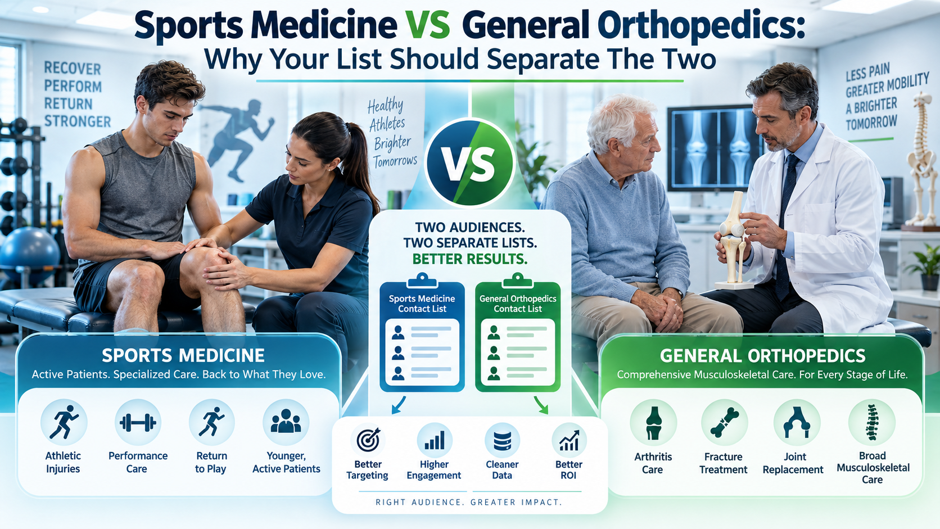
A campaign built around “orthopedic surgeons” that doesn’t separate sports medicine from general orthopedics is making an error one layer deeper than the subspecialty problem covered in most orthopedic targeting guides. Even after a list has been correctly split into joint reconstruction, spine, trauma, and the other recognised orthopedic subspecialties, sports medicine still gets treated as though it’s simply one more item on that list, a single homogenous category alongside the others. It isn’t. Sports medicine cuts across a training and credentialing boundary that none of the other orthopedic subspecialties do, and collapsing it into a single tag hides a distinction that changes almost everything about who a given contact actually is and what they can act on.
The confusion starts with a fact most marketing and sales teams targeting this space have never had explained to them clearly: “sports medicine physician” and “orthopedic surgeon” are not 2 points on the same spectrum. A meaningful share of practitioners using the sports medicine title are not surgeons at all, having trained through family medicine, internal medicine, pediatrics, or emergency medicine before completing a sports medicine fellowship, while another group carries the sports medicine label specifically because they completed a full orthopedic surgery residency followed by an orthopedic sports medicine fellowship and operate regularly. A list that tags both groups identically as “sports medicine” is merging 2 professionally and commercially distinct audiences into one, on top of whatever separate error already exists in failing to distinguish sports medicine from general orthopedics as a category in the first place.
This guide walks through exactly where these distinctions sit, why each one matters for targeting precision, and how to build a list structure that actually reflects the real professional landscape rather than a simplified label that happens to be convenient to build but expensive to keep using.
TL;DR
| Distinction | What it actually separates | Why collapsing it costs you |
| Sports medicine vs. general orthopedics | Non-operative, activity-focused practice versus broader surgical and degenerative-condition practice | Messaging, procedure relevance, and patient population assumptions all break down when treated as one audience |
| Surgical vs. non-surgical sports medicine | Orthopedic surgeons with a sports medicine fellowship versus primary-care-trained sports medicine physicians who don’t operate | Surgical device and procedure content sent to a non-operating physician is entirely irrelevant, and vice versa |
| Patient population | Younger, active, injury-driven patients versus older, degenerative-condition patients | Clinical evidence, outcome data, and even the tone of outreach need to differ |
| Training pathway and credentialing | 5-year orthopedic residency plus fellowship versus 3-year primary-care residency plus fellowship | Determines board certification, prescribing scope, and what “orthopedic surgeon” even means for a given contact |
| Site of care | Sports medicine clinics, team affiliations, and outpatient-first settings versus hospital-centred general orthopedic practice | Changes decision-making speed, purchasing authority, and the channels most likely to actually reach the contact |
| Referral direction | Sports medicine often refers upward into general orthopedics for major surgical cases | A list that can’t distinguish referral source from referral destination misses an entire relationship layer |
None of these distinctions is subtle once named, but almost no generically built orthopedic list captures them, because doing so requires understanding the specialty at a level of detail most data vendors and internal marketing teams never invest in until a campaign underperforms badly enough to force the question.
The Training Split That Most Lists Completely Miss
Before covering how sports medicine and general orthopedics differ as practice categories, it’s worth addressing something even more foundational: the sports medicine label itself doesn’t describe a single training pathway, and this is the distinction almost every existing targeting list gets wrong before any of the other differences even enter the picture.
Two Genuinely Different Professional Tracks Share One Title
Orthopedic sports medicine surgeons typically complete orthopedic surgery residency training followed by additional sports medicine-focused training. These practitioners provide operative and non-operative sports-related care, with the exact training pathway and certification depending on applicable medical education and certification standards.
Primary care sports medicine physicians may enter sports medicine through family medicine, internal medicine, pediatrics, emergency medicine, or related residency pathways followed by additional sports medicine training. Their practice often focuses on non-operative care, injury management, rehabilitation coordination, and athlete health.
Why This Split Matters More Than Almost Any Other Segmentation Decision in This Space
A contact list that tags both groups simply as “Sports Medicine” is combining a board-certified orthopedic surgeon who operates weekly with a non-surgical primary care physician who has never performed an orthopedic procedure and refers surgical cases elsewhere. For a medical device company selling arthroscopic instruments, ACL graft materials, or any surgical implant, the primary care sports medicine physician on that list represents essentially zero addressable opportunity for the core product, despite carrying an identical “sports medicine” tag to the surgeon who represents genuine, high-value addressable demand.
The reverse holds for organisations selling non-surgical treatment modalities, rehabilitation protocols, or conservative care products: the orthopedic surgical sports medicine specialist, whose practice may skew heavily toward surgical cases specifically because non-operative cases were already managed or referred elsewhere before reaching them, may represent a weaker opportunity than the primary care sports medicine physician actively managing a larger volume of conservative treatment cases directly.
Sports Medicine vs. General Orthopedics: The Core Practice Differences
Setting aside the surgical versus non-surgical split within sports medicine itself for a moment, the broader distinction between sports medicine as a category and general orthopedics as a category reflects genuinely different clinical focus, patient population, and treatment philosophy that matter independently of the surgical question.
What Each Category Actually Treats
Sports medicine practitioners, whether surgical or non-surgical, concentrate on injuries connected to an active lifestyle, athletic participation, or occupational physical demand: ACL and other ligament tears, meniscus injuries, rotator cuff strains, tennis and golfer’s elbow, runner’s knee, ankle sprains, stress fractures, and concussion. The unifying thread is that these conditions are typically acute, injury-driven, and connected to activity rather than to age-related degeneration.
General orthopedics covers a substantially broader range that includes degenerative joint disease, arthritis management, congenital musculoskeletal conditions, carpal tunnel syndrome, and the full spectrum of joint and bone conditions that aren’t specifically tied to athletic or activity-related injury. General orthopedic surgeons are also the practitioners most likely to perform major joint reconstruction and replacement procedures, a category that sits largely outside what sports medicine, as a category, typically addresses.
The Patient Population Divide
| Dimension | Sports medicine | General orthopedics |
| Typical age range | Skews younger; youth athletes, working-age “weekend warriors,” and active adults | Skews older; degenerative conditions become more common with age |
| Condition origin | Acute injury tied to activity, sport, or occupational strain | Often degenerative, congenital, or unrelated to a specific injury event |
| Treatment philosophy | Frequently favours non-operative management first, with surgery reserved for cases that don’t respond conservatively | Surgical intervention, including elective joint replacement, is a core and frequent part of practice |
| Urgency pattern | Often injury-driven with a defined onset, sometimes urgent depending on the injury | Frequently a gradual, planned decision process for elective procedures |
| Return-to-activity focus | Central to treatment planning and patient priorities | Present but typically framed around functional daily living rather than athletic return specifically |
This patient population divide can influence the type of clinical evidence, outcome data, and messaging that are most relevant. Sports medicine and general orthopedics often focus on different patient needs, although treatment priorities can vary by individual practice and healthcare setting.
Referral Patterns and the Relationship Layer Most Lists Ignore
Beyond who each group treats, understanding the referral relationship between sports medicine and general orthopedics reveals a targeting dimension that a flat, undifferentiated list structurally cannot capture at all, regardless of how detailed the individual contact records otherwise are or how much other enrichment has been layered on top of them.
The typical referral flow works like this:
- Primary care sports medicine physicians frequently serve as a first point of contact for active patients with musculoskeletal complaints, managing what can be treated conservatively and referring surgical candidates onward
- Orthopedic sports medicine surgeons receive referrals both from primary care sports medicine colleagues and directly from primary care physicians, athletic trainers, and physical therapists identifying surgical candidates
- General orthopedic surgeons, particularly those focused on joint reconstruction, receive a meaningful share of their case volume from sports medicine colleagues whose conservative treatment approach has been exhausted, or whose injury has progressed to a degenerative condition requiring reconstruction rather than repair
- Team and school-affiliated sports medicine physicians, covering athletic programmes directly, often function as an informal but genuinely influential referral gateway into the broader orthopedic network in a given geography
Why this referral relationship matters for targeting:
A contact list that captures referral relationships where available can provide additional context beyond demographic or credential data. These relationships may help organizations understand connections between physicians, practices, and potential outreach opportunities.
Site of Care: Where Each Group Actually Practices
Sports medicine and general orthopedics diverge meaningfully in where care is actually delivered, and this divergence changes both the purchasing environment and the practical channels most likely to reach a given contact successfully with a given message at the right moment in their decision process, independent of the training and patient population differences already covered.
Sports Medicine’s Distinct Practice Environments
Sports medicine practice frequently includes team and institutional affiliations that have no equivalent in general orthopedics: covering a professional, collegiate, or high school athletic programme directly, providing sideline coverage during games, and maintaining a relationship with an athletic department or training staff that shapes both the physician’s schedule and their referral network in ways that a purely clinic-based sports medicine practice simply doesn’t experience. Sports medicine clinics, sometimes standalone and sometimes embedded within a larger orthopedic group, frequently operate with an outpatient-first model built around rapid injury assessment and conservative treatment initiation, a genuinely different operational rhythm than a general orthopedic practice built primarily around surgical scheduling.
General Orthopedics and Hospital-Centred Practice
General orthopedic surgeons, particularly those performing joint reconstruction and other major surgical procedures, maintain a practice structure more centred on hospital or larger surgical facility affiliation, reflecting the greater complexity, recovery requirements, and institutional resources major joint surgery typically requires compared to the arthroscopic and rehabilitation-focused work that characterises a larger share of sports medicine practice.
Why Site of Care Changes the Purchasing Conversation
A sports medicine clinic with a smaller, more direct decision-making structure can often move faster on evaluating and adopting a new product or service than a general orthopedic practice operating within a larger hospital system’s procurement and value analysis process. This isn’t a universal rule, since plenty of sports medicine practice happens within larger hospital-affiliated systems too, but it’s a pattern significant enough that a targeting list capturing practice setting alongside category and credential provides meaningfully better signal for prioritising outreach and calibrating expected decision timelines than category data alone.
What Gets Lost When These Categories Are Collapsed Into One
Understanding the abstract distinctions above becomes more concrete when mapped against the specific ways a collapsed, undifferentiated list actually degrades campaign performance in practice, rather than staying an interesting but purely theoretical distinction with no obvious commercial consequence attached to it for the teams actually running these campaigns.
Clinical content and messaging get diluted toward the lowest common relevance. Content written broadly enough to avoid contradicting both a non-operative primary care sports medicine physician and a hospital-based joint reconstruction surgeon ends up too generic to resonate strongly with either, since the clinical priorities, evidence types, and even vocabulary that build credibility with each audience genuinely differ.
Surgical product campaigns waste spend on non-operating contacts. A campaign for an arthroscopic device or surgical implant sent against an undifferentiated “sports medicine and orthopedics” list inevitably reaches primary care sports medicine physicians who will never purchase or use the product directly, representing pure waste that a correctly segmented list would have avoided entirely from the outset.
Non-surgical and rehabilitation-focused campaigns underreach their actual best audience. The inverse problem occurs just as often: a conservative treatment product, rehabilitation protocol, or non-invasive therapy gets marketed against a list weighted toward surgical orthopedic contacts who represent a comparatively smaller share of the genuinely relevant conservative-care decision-makers this specific product should be prioritising.
Referral-based strategies have no data foundation to build on. Without visibility into which sports medicine contacts function as active referral sources into which general orthopedic practices, an account-based strategy built around influencing referral relationships simply has no data to work from, forcing the sales or marketing team to rediscover this relationship structure manually, account by account, rather than having it available as a structured targeting asset from the start.
Event and conference invitation lists misfire on relevance. A continuing education event built specifically around advanced arthroscopic surgical technique, promoted against a list that doesn’t distinguish operating sports medicine surgeons from non-surgical sports medicine physicians, wastes invitations on an audience with no genuine use for the specific technical content being offered, while a broader sports injury management conference aimed at the full spectrum of sports medicine practitioners might have been the more appropriate, higher-response invitation for that same non-surgical segment.
Building a List Structure That Actually Reflects This Landscape
Fixing the collapsed-category problem requires a targeting structure with enough dimensions to capture the distinctions covered above, rather than a single flat specialty tag applied uniformly across a fundamentally varied population that was never genuinely one coherent audience to begin with, however convenient that single tag was to build.
The core fields a properly structured list needs to include:
- Surgical status, explicitly distinguishing operating orthopedic surgeons, including those with a sports medicine fellowship, from non-operative sports medicine physicians trained through a primary care pathway
- Board certification and fellowship detail, capturing both the base residency training pathway and any subspecialty fellowship completed, since this single field does most of the work in resolving the surgical versus non-surgical ambiguity
- Practice category, distinguishing sports medicine focus from general orthopedic focus as a structured field rather than inferring it loosely from a practice name or job title that may not accurately reflect actual case mix
- Team or institutional affiliation, where applicable, capturing athletic programme relationships that signal both referral network position and a genuinely distinct professional context
- Practice setting, distinguishing standalone sports medicine clinics, hospital-affiliated sports medicine programmes, and general orthopedic hospital-based practice, since this shapes both purchasing process and communication channel effectiveness
- Referral relationship data where available, connecting sports medicine contacts to the general orthopedic practices or surgeons they most frequently refer into, adding the relationship layer that a purely individual-level record misses entirely
What this structure enables that a flat list cannot:
Campaigns for surgical products can be targeted specifically at operating physicians, whether their base training was orthopedic surgery with a sports medicine fellowship or general orthopedic surgery without one, while excluding non-surgical sports medicine contacts who represent no genuine addressable opportunity for that specific product category. Conservative treatment and rehabilitation-focused campaigns can be weighted appropriately toward the full non-surgical population, including both primary care sports medicine physicians and any general orthopedic contacts whose practice includes meaningful conservative care volume. Account-based strategies can incorporate referral relationship data to prioritise outreach toward well-connected sports medicine referrers whose influence extends meaningfully beyond their own direct patient volume. And event and content marketing can be calibrated to the genuine clinical interest and technical depth appropriate to each distinct segment, rather than defaulting to generic messaging built to avoid contradicting an audience that was never actually one audience to begin with.
Who Loses the Most From the Collapsed Label
The cost of merging sports medicine and general orthopedics into one undifferentiated category doesn’t land evenly across every organisation marketing or selling into this space, since the underlying products and services involved have very different relationships to the surgical versus non-surgical distinction. Understanding where the cost lands hardest helps prioritise which teams should treat this as an urgent fix.
| Organisation type | How the collapsed category hurts them specifically | Priority level |
| Surgical device manufacturers (arthroscopy, ACL grafts, implants) | Non-surgical sports medicine physicians on the list represent zero addressable demand for the core product, diluting every campaign | High, since a meaningful share of “sports medicine” contacts on most lists never operate at all |
| Rehabilitation and conservative therapy companies | The surgical sports medicine and general orthopedic contacts on an undifferentiated list are lower-priority for a product built around non-operative care | High, for the mirror-image reason surgical device companies face the problem |
| Pharmaceutical companies (pain management, biologics, injectables) | Prescribing patterns and clinical priorities differ enough between surgical and non-surgical practitioners that a single message rarely lands well with both | Moderate to high, depending on how procedure-specific the product actually is |
| Continuing education and certification providers | Technical surgical content wasted on a non-operative audience, and vice versa, depresses registration and engagement rates | Moderate, since the cost shows up as weaker response rather than direct lost revenue |
| Healthcare staffing and recruitment firms | Matching a non-surgical candidate against a surgical role requirement, or the reverse, derails placements built on the mismatch | High, since a bad match can unwind an entire recruitment process |
| Athletic organisations and team affiliations seeking physician partnerships | Outreach that doesn’t distinguish surgical capability from non-operative coverage capability misjudges which physicians actually fit a given partnership need | Moderate, since team affiliation needs vary by the specific coverage role being filled |
Surgical device manufacturers and rehabilitation-focused companies sit at opposite ends of the same underlying problem: each one needs precisely the segment the other one should be excluding, and a single undifferentiated list serves neither well. This is exactly the kind of mirror-image cost that becomes obvious only once the distinction is named explicitly, since from a distance, both types of company appear to be targeting the same broad “sports medicine” audience, when in practice they need almost opposite subsets of it.
Staffing and recruitment firms deserve particular attention on this list because, unlike a marketing campaign that simply underperforms when the targeting is wrong, a mismatched placement based on collapsed category data represents a much more direct and costly failure: a candidate accepting or being placed into a role that doesn’t match their actual scope of practice, discovered only after the placement process is already well underway.
A Practical Audit for Existing Sports Medicine and Orthopedic Lists
Organisations uncertain whether their existing targeting data already reflects this level of distinction can apply a focused audit before investing further budget in campaigns built on an undifferentiated foundation that was never actually examined this closely before now, using the checklist below as a starting point.
The specific questions to ask of an existing list:
- Pull a sample of contacts tagged “sports medicine” and confirm what share carry a verifiable orthopedic surgery board certification versus a primary care specialty board certification, since this single check reveals whether the surgical versus non-surgical split has been captured at all
- Check whether the list distinguishes practice category as a structured, filterable field, or whether “sports medicine” and “general orthopedics” exist only as inconsistent free-text variations within a broader, undifferentiated specialty field
- Review recent campaign performance data specifically for any surgical product or procedure-specific content, and assess what share of sends reached contacts who, on closer inspection, don’t actually perform surgery at all
- Ask whether any referral relationship or team affiliation data exists for sports medicine contacts specifically, since the absence of this layer indicates a meaningful, addressable gap in account-based targeting capability
- Confirm whether event and continuing education invitation lists have historically been built around this distinction, or whether technical, procedure-specific content has been broadcast indiscriminately across an audience that includes a substantial non-surgical population with no direct use for it
Running this audit consistently surfaces the same underlying pattern found consistently across most orthopedic and sports medicine targeting reviews conducted this way: a meaningful share of budget directed at what appears to be a coherent “sports medicine” audience has actually been reaching a professionally and commercially distinct population, non-operative primary care sports medicine physicians, general orthopedic surgeons with no sports medicine focus, or both, whose relevance to the specific campaign in question was never properly evaluated in the first place, simply because the underlying data never made that distinction possible to evaluate at all.
FAQs
Is every sports medicine physician who isn’t a surgeon a lower-priority contact for a medical device company?
Not necessarily, and treating non-surgical sports medicine physicians as universally lower priority misses genuine opportunity. While these contacts don’t represent addressable demand for surgical implants or operative instruments, they frequently represent significant addressable demand for non-invasive treatment products, injectable therapies, bracing and support devices, diagnostic imaging referral relationships, and rehabilitation-adjacent products entirely outside a surgical company’s core portfolio. They also often function as meaningful referral sources into the surgical sports medicine and general orthopedic network, giving them indirect commercial relevance even for companies whose core surgical product they’ll never personally use or prescribe directly to a patient.
How can a list distinguish surgical from non-surgical sports medicine physicians reliably at scale?
The most reliable signal is board certification detail, specifically whether the physician holds board certification in orthopedic surgery as their primary credential, with sports medicine as an added qualification, versus board certification in a primary care specialty such as family medicine or internal medicine with sports medicine as the added qualification instead. This data is generally available through board certification databases and, where present, NPI taxonomy codes, and a data provider that captures this detail systematically, cross-referenced against board certification records, produces far more reliable segmentation than inferring surgical status loosely from job title or practice name alone.
Does this same surgical versus non-surgical distinction apply within general orthopedics, or is it unique to sports medicine?
General orthopedic surgeons, by definition, have all completed a surgical residency and are surgeons, so this specific surgical versus non-surgical ambiguity doesn’t arise within general orthopedics the way it does in sports medicine. However, a related distinction still matters within general orthopedics: not every general orthopedic surgeon performs every type of procedure at meaningful volume, and a surgeon whose practice skews heavily toward non-operative management of a specific condition still represents a different opportunity than one with high surgical volume in that same condition category, even though both hold identical surgical credentials and could, in theory, be marketed to identically without the distinction ever being questioned.
Should sports medicine and general orthopedics always be targeted as completely separate campaigns, or can they sometimes be combined?
Complete separation isn’t always necessary, and the right approach depends on what’s actually being marketed. A genuinely cross-cutting product or message relevant to both categories, such as a broad musculoskeletal health platform or a continuing education programme covering shared clinical ground, can reasonably target both segments within a single campaign, provided the underlying list still captures the distinction as structured, filterable data so results can be analysed separately by segment afterward, once the campaign has actually run. The separation becomes essential specifically when the product, procedure relevance, or messaging genuinely differs between the 2 audiences, which describes the majority of surgical device, pharmaceutical, and procedure-specific marketing in this space, even when a single overarching campaign umbrella still makes sense at the strategic level.
How does this distinction affect healthcare staffing and recruitment specifically?
Staffing and recruitment firms placing physicians into sports medicine or orthopedic roles need this distinction captured with particular precision, since a facility recruiting for a surgical sports medicine position has fundamentally different candidate requirements than one recruiting for a non-operative primary care sports medicine role, despite both roles potentially appearing under a similar job title. Matching a non-surgical candidate against a surgical role requirement, or the reverse, represents exactly the kind of costly, avoidable mismatch that properly segmented candidate and facility data is specifically designed to prevent from happening in the first place.
What’s the most common reason existing lists fail to capture this distinction, even when the underlying data theoretically exists somewhere?
Most generically built healthcare contact lists prioritise breadth and record count over the depth of subspecialty and credential detail required to make distinctions like this reliably, since capturing and verifying board certification pathway, fellowship detail, and practice category systematically requires meaningfully more data infrastructure and ongoing maintenance than simply compiling names, titles, and contact information from broader, less specialised public directories and general physician databases. The gap typically isn’t that the underlying information doesn’t exist anywhere; it’s that most list-building processes were never designed to capture and structure it at the level of granularity this specific distinction requires.
How quickly can an organisation realistically fix this gap in an existing list?
For organisations working with a data provider capable of appending board certification pathway and practice category detail to an existing contact base, meaningful improvement is often achievable within a matter of weeks. For organisations building this level of segmentation entirely from scratch, including establishing verification processes for board certification pathway, fellowship detail, and practice category data, a more realistic timeline runs 6 to 10 weeks, though the investment pays for itself quickly once campaigns stop wasting spend on contacts who were never actually part of the intended addressable audience in the first place, and once sales teams stop receiving leads that don’t match their actual product or role focus.