What Does “AI Visibility” Actually Mean for Your Rankings?
Every SEO team eventually hits the same wall. The site ranks on page 1, the content calendar is full, and then someone asks why a competitor’s product keeps showing up in ChatGPT answers and yours doesn’t. That’s where AI visibility earns its place on the roadmap, especially when broader AI SEO services are already part of the search strategy. Some of what drives it overlaps with SEO you already do, some of it is new, and some of it is barely understood outside a handful of practitioners who’ve tested it directly. Getting this wrong is expensive in a way that rarely shows up in a rankings report: a brand that’s invisible in the answers people now trust for research, comparisons, and decisions.
This guide covers what AI visibility is actually built from, where it overlaps with traditional SEO and where it splits off, and which factors matter most depending on your situation. The wider shift is covered in more detail in IInfotanks’ AI SEO in 2026 guide, which looks at how Google, ChatGPT, and Gemini can surface different sources for the same topic. We also flag a few metrics and tactics that keep showing up in “AI SEO” content even though they don’t hold up under any real testing.
Citation and mention data is the hardest part of this topic and the least discussed. It depends on content existing across sources you don’t control, it’s shaped by how AI systems decide what counts as a trustworthy answer, and it doesn’t show up in any dashboard you’re used to checking. Google’s current documentation on AI features and websites also makes clear that its AI Overviews and AI Mode build on existing Search foundations rather than requiring a separate AI-only technical standard. None of that makes AI visibility impossible to influence. All of it has to be understood before anyone rewrites a page hoping it’ll show up in an AI Overview.
This breakdown is built around that gap. It covers what AI visibility means in practice, and at every stage it separates what you can control from what you’re mostly reacting to. The pattern that shows up across teams working on this: the ones who treat AI visibility as a distinct discipline with its own signals get ahead of it, and the ones who assume “rank well and the rest follows” find the gap months later, when a competitor is being cited and they aren’t.
TL;DR
AI visibility isn’t one metric. It’s a mix of technical accessibility, content clarity, external references, and consistent entity information that can influence how AI systems discover and present information.
Chasing a single AI platform backfires. Focusing only on how content appears in ChatGPT, or only for Google’s AI Overviews, ignores that these systems pull from overlapping but different source pools, and a narrow focus leaves you exposed when any one platform changes its approach.
Your situation decides what matters first. A local service business, a SaaS company that already ranks well, a publisher, and an enterprise brand each need a different starting point, and the checklist below is built around that split rather than a single generic plan.
What AI visibility actually means (and what it doesn’t)
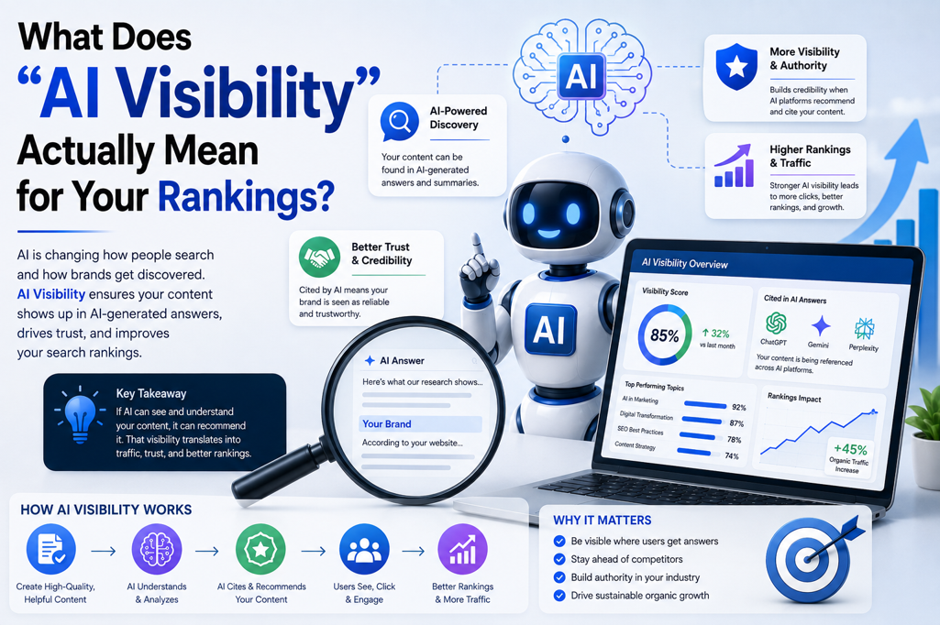
AI visibility describes how likely your brand, product, or content is to appear, get cited, or get recommended when someone asks an AI system a question related to what you do. Companies that already invest in broader search engine optimization services have part of the foundation in place, but AI citation introduces additional questions around extractability and source recognition.
That covers 3 distinct things, and most content strategies only address 1 of them:
● Being crawlable and readable by AI systems. Your content has to be technically accessible to the crawlers and retrieval systems these platforms use, which isn’t guaranteed just because Google can index it.
● Being citable. The content has to say something clear and specific enough that an AI system can extract it as a direct answer, rather than a page that requires a human to read the whole thing to find the point.
● Being present across the sources these systems already trust. Reviews, forums, comparison sites, Wikipedia, industry publications, and your own site all feed into how often you get mentioned, and mentions outside your own domain often carry more weight than anything you publish yourself.
AI visibility is not the same thing as a rank-tracking dashboard
A lot of content still treats “AI visibility” as a new column on an SEO rank tracker: track your position in an AI Overview the way you’d track a keyword position. Position in an AI answer isn’t stable, isn’t guaranteed to appear at all for a given query, and isn’t influenced by the same signals that move a traditional SERP ranking. A tool that reports an “AI rank” is describing a snapshot of one query at one moment, and it will not tell you whether your content is actually citable.
Several articles on this topic also collapse “AI visibility” and “generative engine optimization” into a single checklist of keyword tweaks. Keyword targeting still matters for discoverability, but it doesn’t determine whether an AI system trusts your content enough to cite it. If your goal includes both traditional rankings and AI citation, you’re working on 2 related but separate problems.
| Layer | Example factors | What it affects |
| Technical access | Crawl permissions, JavaScript rendering, page speed | Whether AI systems can read your content at all |
| Content structure | Direct answers, clear definitions, scannable formatting | Whether your content is extractable as a citation |
| External presence | Reviews, forum mentions, press coverage, Wikipedia | Whether AI systems recognize you as a trustworthy source |
Four situations that change what AI visibility means for you
The right starting point depends far more on your situation than on your industry. Each of these 4 scenarios calls for a different first move.
A local service business trying to show up in AI-assisted local search. Volume of content is low, but consistency of business information across directories, reviews, and your own site carries a lot of weight. The fastest wins here are usually cleanup, not new content. Companies handling regional search can also compare this requirement with the technical and local elements covered by IInfotanks’ SEO services in India.
A SaaS or B2B company that already ranks well but never gets cited. This is the most common frustration we see. The content ranks because it’s built around keywords and backlinks, but it’s structured as long narrative pages that bury the actual answer, which makes it hard for an AI system to extract anything quotable.
A publisher or content site with a large archive. Volume isn’t the problem, freshness and structure are. Older pages with outdated information get skipped in favor of a competitor’s page that says the same thing more recently and more clearly.
An enterprise brand with a recognizable name. The brand itself is often already an entity AI systems recognize, so the priority shifts from earning recognition to making sure the information tied to that entity, on Wikipedia, in press coverage, on review sites, is accurate and current.
How we evaluate AI visibility
We assess AI visibility work on the same 8 criteria, whether it’s our own content or a client’s existing site. These are the questions worth asking before investing in any tactic that claims to improve it.
● Crawl access. Can AI crawlers and retrieval systems actually reach and render the page?
● Answer extractability. Does the content state its main point in a sentence or 2 that could stand alone as a citation?
● Structured data coverage. Is schema markup in place for the content types that support it, such as FAQs, products, and articles?
● External mention frequency. How often does the brand or topic get mentioned on sites the person doesn’t control?
● Source diversity. Are mentions spread across multiple domains and formats, or concentrated on 1 or 2 sites?
● Freshness signals. Is there a visible, accurate update date, and does the content reflect current information?
● Entity consistency. Does the same name, description, and set of facts appear consistently everywhere the brand is mentioned?
● Traditional ranking strength. Does the content already perform well in standard search, since that remains one of several inputs into what AI systems surface?
The building blocks of AI visibility, prioritized areas to evaluate
The list below covers areas commonly evaluated when improving AI visibility. The order reflects a practical review sequence based on common site issues, not an official ranking model published by AI platforms.
1. Crawl and render access
What it is: Whether AI crawlers and retrieval systems can actually reach your content, parse it, and see the same page a human visitor sees.
Why it matters: A page that requires heavy JavaScript to render its main content, or that’s blocked by an overly broad robots.txt rule, may be invisible to a crawler even though it looks fine in a browser. OpenAI’s current publisher guidance for ChatGPT search specifically tells site owners to allow OAI-SearchBot if they want public content to be eligible for summaries, citations, and links.
How it shows up: Server-rendered or pre-rendered content performs more reliably than content that only appears after client-side scripts run. Site design and underlying technical structure also matter, which is why technical work tied to web design and development can affect whether important content remains accessible to crawlers and users.
A growing number of sites are also publishing an llms.txt file, a simple text file that gives AI systems a clear map of what content exists and where.
Where teams get it wrong: Assuming that because Googlebot can index a page, every other crawler can too. Different systems have different rendering capabilities, and a page that ranks fine in Google can still be functionally invisible to a system with a lighter-weight crawler. Bing’s documentation on robots.txt configuration is also useful when reviewing basic crawler access rules.
Our take: Fix this first. Every other item on this list is wasted effort if the content never gets read in the first place.
2. Direct-answer content structure
What it is: Writing that states its conclusion clearly, near the top of the relevant section, in language that could be lifted out and used as a standalone answer.
Why it matters: AI systems extract short, self-contained statements far more easily than they extract a point buried 4 paragraphs into a narrative explanation. Existing pages often need restructuring rather than replacement, which is where disciplined content marketing services can support both search intent and clearer page structure.
How it shows up: A clear definition early in a section, a direct answer to an implied question, a sentence that doesn’t depend on the paragraph before it to make sense.
Where teams get it wrong: Writing for SEO in a way that front-loads keywords but not the actual point, or writing a full narrative arc before revealing the answer, which works for a human reader with patience but not for a system extracting a citation. Google’s guidance on using generative AI content responsibly also keeps the focus on adding value for users rather than producing large volumes of low-value content.
Our take: This is the change with the single biggest payoff available, and it’s also the one most existing SEO content violates by habit.
3. Structured data and schema markup
What it is: Machine-readable markup, such as FAQPage, Article, Product, and Organization schema, that tells a system exactly what a piece of content is and how its parts relate to each other.
Why it matters: Structured data removes ambiguity. Instead of a system inferring that a block of text is an answer to a question, schema markup states it directly. Google’s documentation for Article structured data explains how publishers can mark up article information and test whether Google can access the page correctly.
How it shows up: FAQ schema on genuine FAQ sections, Article schema with accurate author and date fields, Product schema with real pricing and availability.
Where teams get it wrong: Applying FAQ schema to content that isn’t actually structured as questions and answers, purely to try to earn a rich result. Google’s structured data guidelines require markup to represent the visible page content and make clear that structured data doesn’t guarantee a particular search feature.
Our take: Not a guarantee of citation, but a low-cost, high-clarity signal that removes friction for any system trying to parse the page.
4. External citations and brand mentions
What it is: How often your brand, product, or claims get mentioned on sites you don’t own: press coverage, comparison articles, review platforms, and industry publications.
Why it matters: Third-party mentions can influence how a brand is perceived and may contribute to broader trust signals. A claim supported by independent sources can provide additional context beyond information published only on your own site. External visibility also intersects with demand generation, so teams should consider where prospects encounter the brand before they reach a conversion page.
How it shows up: Coverage in trade publications, inclusion in “best of” comparison articles, customer reviews on independent platforms.
Where teams get it wrong: Treating this as a traditional link-building exercise focused only on domain authority, when the actual driver is whether the mention states something specific and verifiable about you, not just a link with anchor text.
Our take: Slower to build than any on-page change, and usually the single biggest gap between a company that ranks well and one that gets cited well.
5. Source diversity
What it is: Whether mentions of your brand or content are spread across many independent domains, or concentrated on a small number of sites you influence directly.
Why it matters: A system pulling information from several unrelated sources that all agree on a fact treats that fact as more reliable than the same fact appearing on only your own domain and a single partner site.
How it shows up: Presence across forums, review sites, industry press, comparison content, and social platforms, not just your own blog and a press release wire service. IInfotanks’ guide to social SEO and brand visibility covers how discoverability also extends into social platforms where people research brands and topics.
Where teams get it wrong: Concentrating all outreach effort on a handful of large publications while ignoring smaller, topic-specific communities like forums and niche review sites that AI systems also draw from heavily.
Our take: Breadth beats a single big placement. A dozen credible, varied mentions outperform one large feature that isn’t repeated anywhere else.
6. Content freshness
What it is: How recently a piece of content was published or meaningfully updated, and whether that update is visible and accurate.
Why it matters: Systems answering time-sensitive or fast-moving questions favor content that reflects current information, and a page with an outdated statistic or a retired product mention loses out to a competitor’s more current page.
How it shows up: A visible last-updated date that’s genuinely accurate, content revisions that update facts rather than just changing the timestamp, removal of information that’s no longer true.
Where teams get it wrong: Changing the published date without actually updating the content, which some systems can detect and which damages trust once discovered.
Our take: Cheap to maintain and easy to neglect. A quarterly review of high-traffic pages catches most of the decay before it costs citations.
7. Entity and author signals
What it is: Consistent, verifiable information tying content to a real author or organization: bios, credentials, an About page, and consistent facts across every place the entity is described.
Why it matters: Systems weigh content more heavily when it’s tied to an identifiable source with a track record rather than unattributed or inconsistently described content. Accurate customer and company information also matters outside SEO, which is why profile enrichment services can be relevant when businesses need to correct incomplete or outdated records across their own systems.
How it shows up: Author bios with real credentials, an About page that matches what’s said elsewhere, a Wikipedia or Wikidata entry with accurate facts for brands large enough to have one. Google’s Organization structured data documentation also provides a formal way to describe organizational details on a website.
Where teams get it wrong: Generic “Admin” or “Staff” bylines on content that would benefit from a real, credentialed author, or conflicting descriptions of the same company across different pages and platforms.
Our take: Small effort, compounding return. Fixing inconsistent entity information across a handful of key pages is a weekend project with a long payoff.
8. Community and forum presence
What it is: Mentions and discussions on platforms like Reddit, Quora, and industry-specific forums, which several AI systems draw from heavily when answering comparison and recommendation queries.
Why it matters: Community discussions can provide additional context about how people perceive a brand or topic. Genuine participation in relevant communities may support trust and reputation, while automated promotion can reduce credibility.
How it shows up: Genuine participation in relevant communities, honest answers to questions that mention your product where it’s actually the right fit, and, just as important, honest silence where it isn’t.
Where teams get it wrong: Posting obviously promotional content into forums, which gets flagged, downvoted, or removed, and can damage trust faster than it builds visibility.
Our take: The slowest signal to build authentically and the easiest to damage with a shortcut. Treat it as reputation management, not a content channel.
9. Traditional search ranking strength
What it is: Standard organic ranking performance in Google and other search engines.
Why it matters: This still functions as one input among several. Content that ranks well has usually already cleared a baseline of relevance and technical quality that also helps with AI visibility. Google’s 2026 guidance on generative AI search features explicitly states that established SEO practices remain relevant because Google’s generative Search experiences use its existing ranking and quality systems.
How it shows up: Page 1 rankings for relevant terms, strong click-through rates, and a healthy technical SEO foundation.
Where teams get it wrong: Assuming a strong ranking guarantees AI citation. It doesn’t. It’s a necessary foundation, not a sufficient one, and this guide exists because so many well-ranked pages get skipped over anyway.
Our take: Keep doing this work. It’s the floor, not the ceiling.
10. Consistent structured brand data
What it is: How a brand’s core facts, name, founding date, location, leadership, product lineup, are represented in structured, authoritative sources like Wikidata, Wikipedia, and knowledge graph entries.
Why it matters: These sources feed directly into how AI systems build an internal understanding of who you are, independent of anything on your own website. Internal company information also needs similar consistency. Services such as data appending can help organizations correct missing contact, URL, social, or business information inside existing datasets.
How it shows up: An accurate, well-maintained Wikipedia entry where notability supports one, consistent facts across Crunchbase, LinkedIn, and other structured profiles.
Where teams get it wrong: Ignoring this layer entirely because it feels outside the scope of content marketing, when for an established brand it’s often the single source an AI system defaults to for basic facts.
Our take: Most relevant for brands with enough size or history to qualify for these entries. For smaller companies, focus on consistency across the profiles you do control, like LinkedIn, Crunchbase, and directory listings.
Signals people still chase that don’t move the needle, and why
A few tactics show up in nearly every “AI SEO” article. Some of them don’t hold up.
● “AI rank tracking” tools that promise a precise position. AI answers aren’t a stable, ordered list the way a SERP is, so a tool reporting your exact rank in an AI Overview is describing 1 snapshot of 1 query, not a reliable position.
● Stuffing content with the literal phrase people might type into ChatGPT. AI systems parse meaning and context, not exact-match phrasing, and content written for a phrase match reads as unnatural to both the system and the human who eventually lands on it.
● Buying low-quality citations or mentions in bulk. A flood of low-credibility mentions doesn’t build trust the way a smaller number of genuine, varied ones does, and some of these services actively damage the entity signals covered above.
● A single “AI meta tag” or markup that guarantees inclusion. No such universal tag exists. Structured data helps parsing, it doesn’t purchase a citation.
● Chasing 1 platform’s specific quirks. Tuning narrowly for how 1 AI system currently behaves is a short-lived advantage, since these systems change their retrieval and ranking approaches often, sometimes without notice.
Side-by-side: where each signal matters most
| Signal | Google AI Overviews | Chat-based assistants | Traditional rankings | Effort to build |
| Crawl and render access | High | High | High | Low |
| Direct-answer structure | High | High | Medium | Low |
| Structured data | Medium | Medium | Medium | Low |
| External citations | High | High | Medium | High |
| Source diversity | High | High | Low | High |
| Freshness | Medium | Medium | Medium | Low |
| Entity and author signals | Medium | Medium | Medium | Low |
| Community presence | Medium | High | Low | High |
| Traditional ranking strength | Medium | Low | High | Medium |
| Structured brand data | Medium | Medium | Low | Medium |
Which signals matter most for your situation?
Match your situation, then prioritize from the list above. This is the order we’d suggest tackling things in.
● Already ranking well but never cited: Start with direct-answer content structure, since this is usually the single biggest gap between ranking and getting cited.
● New site with limited authority: Start with crawl access and structured data, the foundation everything else depends on, then build external mentions gradually.
● Local business: Prioritize entity consistency across directories and reviews before investing in new content.
● Large content archive: Prioritize freshness reviews on your highest-traffic pages before writing anything new.
● Recognizable enterprise brand: Prioritize structured brand data accuracy and community sentiment, since the entity is likely already recognized and the risk is inaccurate or outdated facts attached to it.
Two things apply regardless of situation. First, the fastest wins usually come from fixing what already exists rather than producing new content. Second, none of these signals work in isolation, a technically perfect page with no external mentions is about as invisible as a well-cited brand with pages AI crawlers can’t render.
The work no tool automates for you
Every tactic above assumes 6 things have already happened. When they haven’t, the tactic gets blamed for a problem it didn’t cause.
Define what AI visibility means for your specific goals. Getting cited in a broad informational query is a different objective than getting recommended in a comparison query, and they call for different content.
Audit where you currently stand. Search a handful of realistic queries in the AI tools your customers actually use, and note honestly whether you appear, get cited, or get recommended.
Fix crawl access before anything else. Confirm AI crawlers can actually render your key pages. This is a technical check, not a content one, and it comes first because nothing downstream matters if it fails.
Rewrite for extractability, not just keywords. Go through your highest-value pages and ask whether a system could lift a clean, accurate sentence out of each section. If it can’t, that’s the rewrite.
Build mentions deliberately, not opportunistically. A short list of publications, forums, and review platforms relevant to your industry, with a real plan for earning genuine mentions on each, beats waiting for coverage to happen on its own.
Review quarterly, not once. AI systems change how they retrieve and weigh sources more often than search engines change their core ranking algorithm. A one-time audit goes stale within a couple of quarters.
When existing SEO work is enough, and when you need a dedicated push
A team with solid technical SEO and a habit of writing clearly can improve AI visibility with the checklist above, without a separate specialist. The same foundation can be supported by accurate customer and company information from wider B2B data services when data consistency affects marketing, sales, or audience targeting.
The picture changes when 1 or more of these is true:
● Your content ranks well but competitors with weaker rankings are the ones getting cited.
● Your industry involves comparison or recommendation queries where being included, or excluded, has real revenue impact.
● Your brand has little to no presence outside your own domain.
● You’ve never audited what your actual entity data looks like across Wikipedia, Wikidata, or industry directories.
● Nobody on the team is currently tracking how the brand shows up in AI-assisted search at all.
In those cases, the content itself is usually not the bottleneck. The gap is in the external presence and entity work, which takes longer to build and is easy to deprioritize behind work with a more familiar dashboard.
Building AI visibility into an ongoing content process
Treat this as a process, not a one-time project. A workable version looks like this:
Set a quarterly check-in against the 8 evaluation criteria above, using a consistent, small set of real customer queries rather than a broad automated scan.
Fix technical access issues as soon as they’re found. These are usually quick to resolve and block everything else.
Prioritize rewriting existing high-traffic pages for extractability before producing new content. Most sites get more value from fixing 10 pages than from publishing 10 new ones.
Track mentions across the web, not just backlinks. A simple alert system for brand mentions catches most of what matters without expensive tooling.
Keep a short list of target communities and publications, and revisit it. Relevance shifts as an industry changes, and a list built a year ago may already be missing where the conversation has moved.
What to watch after you’ve made changes
Do not expect a fast, visible shift. AI systems don’t publish a changelog, and a citation gained today may not show up in a spot check for weeks.
Watch trends across your query set rather than a single result. Track the same handful of realistic queries over time and note whether mentions, citations, and recommendations trend upward, rather than judging any 1 snapshot. Keep improving traditional SEO in parallel. It remains the foundation, and none of the changes here replace it.
The bottom line on AI visibility
AI visibility is a real, measurable set of factors, not a single score and not a mystery. It’s built from crawl access, content structured for extraction, external mentions across varied sources, consistent entity data, and the traditional ranking strength you likely already have. None of it works in isolation, and none of it moves quickly.
Fix the technical foundation first, rewrite for extractability, build genuine mentions across sources you don’t control, and keep your entity data consistent everywhere it appears. Do that and AI visibility becomes a predictable extension of good SEO. Skip it and no single tactic on this list will make up the difference.
FAQs
1. Is AI visibility the same thing as SEO?
No. Traditional SEO focuses on ranking in a search results list, built on keywords, backlinks, and technical signals search engines have used for years. AI visibility focuses on whether your content actually gets read, extracted, and cited by an AI system answering a question, which depends more on clarity and third-party validation than on rankings alone. The 2 share a foundation, but they reward different things and need separate tracking.
2. Can I track my AI visibility with existing SEO tools?
Most traditional rank trackers were not designed for AI visibility. Manual checks across realistic customer queries can provide useful context, while automated scores should be treated as directional signals rather than confirmed positions.
3. Does getting cited in an AI answer drive real traffic?
Sometimes. Some AI answers provide links that can send visitors to a source, while others may only provide information. Citations can support visibility, but direct traffic impact varies.
4. How long does it take to see a change in AI visibility?
There’s no fixed timeline, and anyone promising an exact number is guessing. Technical fixes like crawl access or removing a blocking robots.txt rule can matter within weeks, since they simply let a system read content it couldn’t reach before. External mentions, entity consistency, and community presence build slower, typically over months, because they depend on other sites and platforms publishing or updating information you don’t control.
5. Do I need separate content for AI systems versus human readers?
No, and trying to maintain 2 versions usually backfires, since it doubles the maintenance work and often creates conflicting facts between the pages. Content structured to state its point clearly near the top, in language that could stand alone as an answer, serves both a human skimming the page for the answer and a system trying to extract a citation from it. Write once, structure well, and both audiences get what they need.
6. Are backlinks still relevant to AI visibility?
Yes, but the framing shifts. A traditional link-building mindset asks whether a link passes authority and uses the right anchor text. AI visibility cares more about whether a mention adds a credible, independent voice confirming what you claim about yourself, regardless of the anchor text attached to it. A citation-style mention on a relevant, trusted site often carries more weight than a backlink engineered purely for ranking purposes.
7. Should small businesses worry about Wikipedia or Wikidata?
Usually not directly, since most small businesses don’t meet the notability requirements for their own entry, and attempting one without real coverage can backfire. Focus instead on consistency across the profiles you do control: Google Business Profile, LinkedIn, industry directories, and review platforms. Matching name, address, and description across every one of those cuts the chance an AI system finds conflicting facts about you.
8. Does AI visibility differ by industry?
Yes. Industries with heavy comparison and recommendation search behavior, such as software, travel, and consumer products, tend to see AI visibility affect buying decisions more directly, since people often ask AI systems to compare named options before choosing. Industries with less comparison-driven search, like highly local or regulated services, still benefit from visibility, but the commercial cost of a missed citation tends to be smaller.
9. Can a company damage its AI visibility by mistake?
Yes. Inconsistent facts across pages, an outdated statistic or retired product presented as current, and promotional spam dropped into community spaces like forums or review threads can all hurt trust signals rather than simply fail to help. AI systems weigh consistency and credibility heavily, so a page that contradicts your own About page, or a post that reads as an obvious plant, can actively work against the visibility you’re trying to build.
10. Should I hire a specialist for this, or can my existing content team handle it?
An existing content and SEO team can handle most of this with a clear checklist, particularly the technical fixes and content-structure work, since both build on skills the team likely already has. A specialist becomes more valuable when the real gap sits in external mentions, entity data, and community presence, since that work takes longer to build, needs outside relationships, and is easy to deprioritize behind familiar dashboard-driven tasks.