How to Build a LinkedIn Content Calendar for B2B Lead Generation
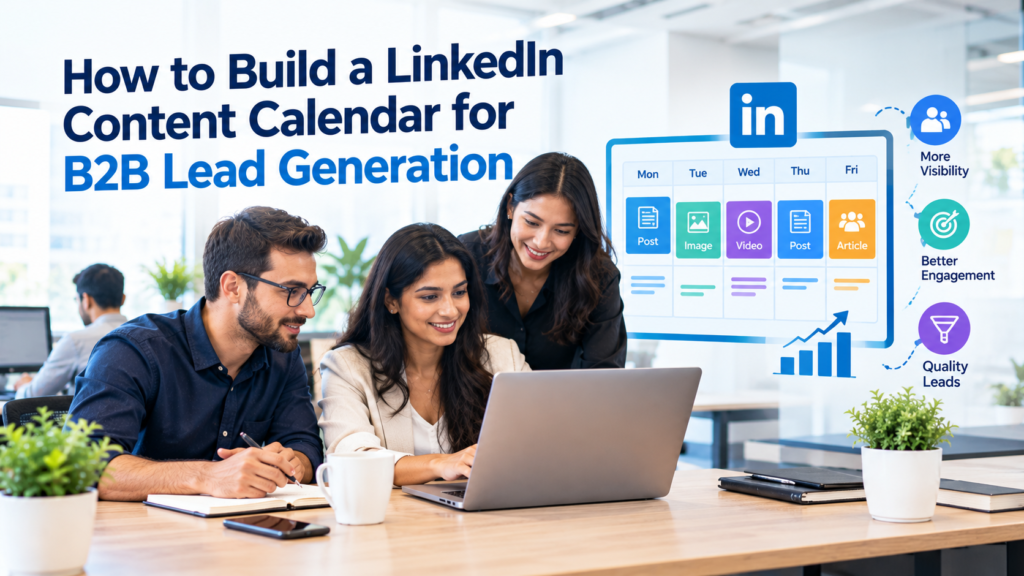
LinkedIn content works best for B2B lead generation when every post has a clear job. Some posts help the right buyers recognize a problem. Others help them compare approaches, build internal support, or take a next step. A calendar gives that work a repeatable structure so the team isn’t deciding what to publish a few hours before a post goes live.
A useful LinkedIn content calendar for B2B connects each post to a buyer, a business problem, a buying stage, a publishing voice, and a measurable action. That structure matters because B2B decisions involve more people than the obvious end user. It also keeps the calendar from becoming a list of dates, captions, and random format ideas that produce activity without helping the pipeline.
This guide explains how to build the calendar from the buyer backward. It covers audience mapping, content pillars, formats, publishing cadence, lead offers, paid support, production workflow, and measurement. The goal is a system that helps a B2B team publish useful content consistently while keeping lead quality and pipeline impact visible.
TL;DR
A LinkedIn content calendar for B2B should start with buyer questions and lead goals, then assign each post a role in the buying journey. Plan for both visible target buyers and less visible stakeholders who can influence approval. Give every post a defined owner, format, CTA, destination, and KPI before it enters production. Use the calendar to balance education with conversion activity, then review results monthly so future topics are based on evidence rather than habit.
· Build content pillars from recurring buyer problems rather than broad labels such as “education” or “company news.”
· Match each post to a buying stage and a realistic next action.
· Decide whether the company Page, an executive, or a subject-matter expert is the right publishing voice.
· Track audience quality and lead outcomes alongside impressions and engagement.
Start With The Lead Generation Goal
The calendar should begin with the business result it is expected to support. A LinkedIn content strategy for B2B can serve awareness, category education, lead capture, sales support, or account expansion, but a single post rarely does all of those jobs at once. Define the main outcome for the quarter before choosing topics. That gives the team a way to judge whether a post belongs in the plan.
For B2B LinkedIn lead generation, the most useful goals are tied to observable buyer movement. Examples include attracting more qualified visitors to a solution page, increasing registrations from target accounts, generating downloads from a defined role, or creating sales conversations around a specific problem. Vanity goals can still help diagnose performance, but they shouldn’t be the end point of the calendar.
The reason to separate demand creation from immediate capture is simple: most potential buyers aren’t actively shopping at the same time. LinkedIn’s discussion of the 95-5 rule for B2B marketing argues that only a small share of a category is in market at a given moment, which means useful content has to build memory before many buyers are ready to act. That makes an always-on LinkedIn content calendar for B2B more practical than a feed made only of demo offers.
Write 1 primary goal at the top of the calendar. Then define 2 or 4 supporting signals that show whether content is moving in the right direction. For example, a team trying to create more conversations with IT leaders might track qualified site visits, guide downloads, meetings sourced from LinkedIn, and opportunities influenced by LinkedIn touches. This keeps the LinkedIn content calendar for B2B tied to a commercial result without forcing every post into a hard-sell CTA.
Define The ICP And The Buying Group
A calendar becomes more useful when it is built for a buying group instead of one generic persona. Start with the ideal customer profile, then list the roles that take part in problem discovery, technical evaluation, budget approval, risk review, and final signoff. The list will vary by market. A cybersecurity purchase may involve security leadership, IT operations, finance, procurement, and an executive sponsor. A marketing platform may involve demand generation, marketing operations, IT, finance, and legal.
This matters because hidden stakeholders can affect a deal even when they rarely interact with sales. LinkedIn and Edelman’s 2025 research on hidden B2B buyers found that 56% of target buyers and 55% of hidden buyers use thought leadership during vendor evaluation. The same research says more than 40% of B2B deals stall because buying groups are misaligned. A LinkedIn content strategy for B2B should therefore answer questions from people beyond the daily product user.
Then add a “buyer role” column to the LinkedIn content calendar for B2B. That makes coverage visible over a month. If 12 posts in a row are written for practitioners while finance and executive stakeholders receive nothing, the calendar exposes the gap before publishing. LinkedIn lead generation improves when content helps the wider group reach a shared view of the problem and the proposed approach.
Turn Buyer Problems Into Content Pillars
Content pillars should describe subjects the buyer repeatedly needs help with. Broad labels such as “education,” “engagement,” and “promotion” are too vague to guide a writer. A useful pillar names a problem area that can support many specific questions without drifting away from the company’s expertise.
For a B2B SaaS company selling data integration software, pillars might include migration planning, integration reliability, governance, total cost, and implementation risk. For a staffing firm, pillars might cover hiring speed, role scoping, candidate assessment, workforce planning, and retention. Each pillar should be narrow enough to keep the brand associated with a clear set of problems.
Good thought leadership earns attention by helping buyers judge a problem or vendor more clearly. LinkedIn has cited research showing 73% of decision-makers view an organization’s thought leadership as a more trustworthy basis for assessing capability than conventional marketing materials and product sheets. That is a strong reason to build a LinkedIn posting schedule around useful expertise instead of repeating product claims.
Once the pillars are chosen, create 8 to 15 question ideas under each one. Pull them from sales calls, support tickets, search queries, customer interviews, webinar Q&A, implementation reviews, and objections that repeatedly appear late in deals. A LinkedIn content calendar for B2B becomes easier to maintain when the team has a bank of real questions rather than a blank spreadsheet every month.
Map Content To The Buying Journey
A LinkedIn content calendar for B2B lead generation needs content for different levels of buyer readiness. The simplest useful model is problem recognition, evaluation, and action. The calendar doesn’t need a rigid percentage split. It needs enough coverage that buyers can move from “we may have an issue” to “we know what to compare” without every post asking for a meeting.
Problem-recognition content helps buyers name an issue. Useful formats include diagnostic questions, short explanations, benchmarks, operational warning signs, and examples of common process gaps. The post should make the problem easier to understand, especially for people who aren’t yet searching for a product category.
Evaluation content helps a buyer compare approaches or reduce uncertainty. This is where decision criteria, implementation choices, pricing factors, migration questions, and side-by-side methods belong. The strongest LinkedIn content strategy for B2B gives buyers language they can reuse internally when discussing the issue with colleagues.
Action content creates a next step once interest is real. A guide, webinar, checklist, calculator, assessment, or case study can work when it matches the problem discussed in the post. The content offer should feel like the next piece of useful information rather than a sudden jump from education to a sales pitch.
LinkedIn’s B2B thought leadership research reinforces the need to reach buyers who aren’t ready to purchase yet. The research uses the same 95-5 framing to show why content has a role before active demand appears. A B2B LinkedIn lead generation plan should therefore treat early-stage relevance as a pipeline input rather than wasted effort.
Add a “buying stage” column to the calendar and review the mix each month. If every planned post sits in the action stage, the calendar is too dependent on buyers who already have intent. If every post is educational with no next step, the team may build attention without giving interested readers a path forward.
Choose Formats And Publishing Voices
Format should follow the idea. Text posts work well for a sharp point, a lesson, or a short explanation. Documents can package a framework or process visually. Video can carry expert commentary, demonstrations, and event clips. Articles can handle deeper subjects that need more context, while newsletters can support recurring themes for people who want continued coverage.
Video deserves a place in a current LinkedIn content strategy for B2B because usage on the platform has been growing. LinkedIn reported in 2025 that video viewing had increased 36% year over year and that video creation was growing at twice the rate of other original post formats. That doesn’t mean every topic should become video. It means teams should test video when a person explaining the idea adds value.
Long-form content also has a distinct job. LinkedIn’s 2026 guidance on using LinkedIn Articles for visibility argues that articles can support deeper authority and discovery, including visibility in AI-led search environments. A calendar can pair a detailed article with several shorter posts that answer one question at a time and direct interested readers toward the deeper resource.
The publishing voice matters as much as the format. Some ideas belong on the company Page because they represent official research, product news, or event information. Others are stronger from an executive, consultant, engineer, customer leader, or salesperson who has direct experience with the issue. The LinkedIn posting schedule should therefore include an “author” or “publisher” field instead of assuming every idea belongs to the brand account.
Employee reach can also extend beyond the Page audience. LinkedIn has reported that, on average, employees have about 10 times as many connections as their company has followers. Treat that as a reason to help subject-matter experts publish useful material in their own voices, not as a reason to hand employees identical copy to repost.
Set A Posting Cadence The Team Can Sustain
A posting cadence should match the team’s ability to produce useful work. Frequency helps only when the content remains relevant and the production process can support it. A calendar that calls for daily posts but produces rushed filler will usually be harder to maintain than a smaller plan built around strong subjects.
LinkedIn has reported that organizations posting at least weekly can see about twice the engagement of organizations that post less often. More recent LinkedIn guidance for AI visibility also suggests publishing consistently and cites 2 to 3 posts per week as a useful working cadence. Neither point should be treated as a universal law for every audience.
A practical starting range for many B2B teams is 3 to 5 posts per week across the company Page and selected people, but the right LinkedIn posting schedule depends on resources and audience response. A small team with one expert may publish twice a week and still create more value than a large team publishing thin updates every day.
Use the LinkedIn posting schedule to plan themes farther ahead than individual posts. A quarterly plan can set the key buyer problems, launches, events, research releases, and campaigns. A monthly B2B content calendar can assign topics and authors. The final copy can be completed closer to publication so the team still has room for new customer questions, market changes, and useful reactions to current events.
LinkedIn allows Page admins to schedule posts from 1 hour to 3 months ahead, which makes planned publishing easier. The calendar should still keep some open capacity. B2B teams need room for timely posts that weren’t predictable when the month was planned.
Build The Calendar With The Fields That Matter
The calendar should make editorial decisions visible. A row that contains only publish date, caption, and asset status tells the team when a post is going out, but it doesn’t show why the post exists or who it is meant to influence. A stronger LinkedIn content calendar for B2B carries enough context that another team member can understand the post’s role without opening 4 other documents.
A useful set of fields is shown below.
| Field | What It Controls |
| Publish date | When the post is planned to go live |
| Buyer role | The person or stakeholder group the post serves |
| Business problem | The issue the post addresses |
| Content pillar | The recurring topic area |
| Buying stage | Problem recognition evaluation or action |
| Working angle | The specific point the post will make |
| Evidence source | Research SME input customer evidence or internal data |
| Format | Text video document article or newsletter |
| Publisher | Company Page executive or subject-matter expert |
| CTA | The next action offered to the reader |
| Destination | Page guide webinar form or other asset |
| KPI | The measure used to judge the post |
| Owner | Person responsible for production |
| Status | Brief draft review scheduled or published |
Don’t fill every field with a value just because the column exists. A thought-leadership post may have no external destination, and a company update may not need a lead offer. The purpose of the B2B content calendar is to make important choices explicit, not to turn editorial planning into administration for its own sake.
Add a campaign or source code field when website attribution matters. Use consistent tracking rules so LinkedIn traffic can be separated from other channels inside analytics and CRM reporting. Keep the naming convention simple enough that writers and campaign managers use it correctly.
A “repurpose source” field can also reduce production effort. If the post comes from a webinar, research report, blog, customer interview, or sales call, record the source. This makes it easier to trace the idea and create related assets later without pretending each post was invented from scratch.
Connect Posts To CTAs And Lead Offers
B2B LinkedIn lead generation improves when the CTA matches the reader’s level of intent. A person learning how to diagnose a problem may be ready for a checklist but not a product demo. Someone comparing vendors may want a case study, cost guide, or technical session. Someone who has already engaged with several solution-specific posts may be ready for a meeting.
Create a small CTA library for each buying stage. Early-stage options can include reading a deeper article, following a subject-matter expert, or subscribing to a newsletter. Evaluation-stage options can point to a guide, webinar, benchmark report, or comparison resource. Action-stage options can include a consultation, assessment, product walkthrough, or contact form when the post gives enough context to justify that request.
LinkedIn newsletters can support recurring education because subscribers may receive feed updates, notifications, and email when a new edition is published. LinkedIn’s newsletter guidance describes newsletters as a series of regularly published articles around a topic. That makes them useful when a B2B team has a subject it can cover repeatedly rather than a one-off announcement.
The offer should solve the next problem created by the post. A post about the reasons CRM migrations exceed budget might lead to a migration planning checklist. A post about board-level cybersecurity questions might lead to an executive risk briefing. Keep the connection tight so the reader doesn’t have to work out why the destination is relevant.
Add “CTA” and “destination” fields to the LinkedIn content calendar for B2B, then review them separately from the copy. This simple check often reveals content that asks for too much too early or posts that generate interest but give a qualified reader nowhere to go.
Use Organic Content To Support Paid Lead Capture
Organic and paid LinkedIn activity should share learning. Organic posts can reveal which topics, voices, and angles attract the right people. Paid campaigns can then extend selected messages to a defined audience or use a related offer to capture known demand. The goal is a connected B2B LinkedIn lead generation system rather than 2 teams publishing independently.
Add a “paid support candidate” field to the B2B content calendar. Mark posts that have a clear audience, useful evidence, and an offer that could work in paid distribution. Don’t automatically sponsor the posts with the most likes. A lower-engagement post may be a stronger paid candidate if it attracts the exact roles or accounts the company wants.
LinkedIn Lead Gen Forms can reduce the amount of typing required because profile details can be prefilled. LinkedIn’s current Lead Gen Form guidance recommends using 3 to 4 fields and warns that adding unnecessary fields can hurt conversion. This makes form design part of the calendar discussion when a post or campaign is meant to capture leads directly.
Paid support also gives the team another measurement layer. Compare the organic version of a topic with the paid version, then look at lead quality instead of only cost per lead. A high-volume offer can be a weak result if the leads don’t match the ICP or fail to progress after handoff.
Keep paid and organic calendars connected through the same topic and buyer taxonomy. That makes reporting easier and helps the team understand whether a problem area performs because of the idea itself, the audience, the author, or the distribution method.
Build A Production And Approval Workflow
A LinkedIn posting schedule fails when the team plans more content than it can review and publish. The calendar therefore needs production fields as well as editorial fields. Define who owns the brief, who supplies expert input, who writes, who reviews facts, who approves sensitive claims, and who schedules the post.
A simple workflow might use these stages: brief ready, SME input complete, draft in review, design ready, approved, scheduled, and published. This is a genuine operational list, so it can be longer than the rhetorical patterns that make marketing copy feel artificial. The statuses should reflect the real bottleneck in the team rather than copy a generic workflow from another company.
Set deadlines backward from the publish date. If a document post requires design, the draft may need to be approved several days before publication. If a subject-matter expert records video, allow time for review and captions. A B2B content calendar should make those dependencies visible before the post becomes urgent.
Repurposing can also be built into production. One webinar may produce a short video, an objection post, an article, and a document summary. Record the parent asset in the calendar and space related posts so they support the same theme without repeating the same wording. This reduces blank-page work while keeping the LinkedIn content strategy for B2B coherent across the month.
Measure Audience Quality Lead Quality And Pipeline
The calendar should carry the metric that matters for each post. An awareness post may be judged by relevant reach and audience fit. An evaluation post may be judged by clicks or engaged visits. A lead offer may be judged by form submissions, qualified leads, meetings, or opportunity influence. One metric shouldn’t be forced across every content type.
LinkedIn provides post-level analytics for impressions, members reached, in-network and out-of-network distribution, social engagement, and other signals. The current post analytics documentation also notes that the numbers are estimates. Use those metrics to understand distribution and response, then connect them with site and CRM data when the business question is lead generation.
Page admins have a wider set of measures. LinkedIn’s Page analytics documentation includes content performance, follower demographics, visitor information, search appearances, and newsletter analytics. Audience demographics are especially useful because a post reaching 8,000 relevant operations leaders may be more valuable than one reaching 80,000 unrelated people.
For B2B LinkedIn lead generation, the final layer can include content downloads, form fills, meetings, marketing-qualified leads, opportunities influenced, pipeline created, and revenue where attribution is reliable. Don’t force a single-touch attribution story onto a long B2B buying cycle. Use the calendar to record the post and campaign context so later analysis can see repeated influence across the journey.
A LinkedIn content calendar for B2B should also mark the KPI before publication. That prevents the team from choosing whichever metric looks best afterward. If a post exists to send qualified traffic to a technical guide, a large comment count is useful context but not the primary result.
Review Results And Build The Next Month From Evidence
The monthly review is where a B2B content calendar becomes a learning system. Group published posts by buyer role, pillar, buying stage, format, author, CTA, and outcome. Then compare patterns instead of judging one post in isolation. This makes the next month’s plan more grounded than simply repeating the highest-impression topics.
Start with audience fit. Which posts reached the roles or industries the company wants? Which employee or executive authors reached people outside the company Page’s existing network? Which pillars attracted qualified site visitors? These questions improve the LinkedIn content strategy for B2B because they reveal whether the topic and publisher are reaching the intended market.
Then examine business movement. Which posts drove guide downloads, newsletter subscriptions, webinar registrations, or conversations? Which lead offers produced contacts that sales accepted? Which themes appeared before opportunities were created or progressed? LinkedIn lead generation becomes easier to manage when the review looks beyond platform engagement.
Current LinkedIn guidance on AI visibility for posts also emphasizes clear answers, consistent publishing, and educational value. That creates another reason to keep useful evergreen questions in the calendar. A strong post can support discovery outside the immediate feed as LinkedIn content becomes more visible in AI-led search.
End the review by changing the next B2B content calendar. Increase coverage where the audience and pipeline signals are strong. Rewrite weak angles rather than automatically dropping good subjects. Reduce formats that consume heavy production effort without enough return. Preserve space for customer questions that emerge during the month.
A Practical 30-Day Calendar Model
A 30-day plan works best as a balanced set of buyer questions rather than a rigid sequence such as “tips Monday” and “product Friday.” Use the month to cover different buying stages, stakeholder roles, and content depths while keeping the workload realistic.
The example below assumes 4 posts per week. It is a planning model, not a platform rule.
| Week | Main Purpose | Example Topics | Likely CTA |
| Week 1 | Problem recognition | Benchmark gap common mistake market change | Read deeper article |
| Week 2 | Education | Process explanation expert lesson implementation question | Follow or save resource |
| Week 3 | Evaluation | Comparison cost factor risk checklist | Guide or webinar |
| Week 4 | Action and proof | Customer lesson use case decision checklist | Assessment or meeting |
Within the month, assign posts to several voices. The company Page can publish research or event content. A product leader can explain a decision framework. A consultant can share an implementation lesson. A salesperson can answer a question that appears repeatedly in discovery calls. This produces a LinkedIn posting schedule that feels connected to real work rather than a brand feed built in isolation.
Use one long-form source to support several shorter posts. A research report can feed a finding post and an expert reaction. A webinar can feed a video clip and a question answered during Q&A. A customer interview can feed a problem story and a decision lesson. A LinkedIn content calendar for B2B becomes easier to sustain when each major asset has several useful derivatives.
Final Take
A LinkedIn content calendar for B2B lead generation should make the reason behind each post visible. The calendar needs to show who the post serves, which problem it addresses, where the reader is in the buying journey, who should publish it, what action is appropriate, and how the team will judge the result.
The strongest calendars also accept that many readers won’t become leads immediately. A useful LinkedIn content strategy for B2B earns attention before active demand appears and gives interested buyers a clear path when their intent grows. That means education and lead capture belong in the same system without forcing every post to act like an ad.
A disciplined B2B content calendar also improves production. Writers know the buyer and evidence source before drafting. Subject-matter experts know where their input is needed. Paid teams can see which organic ideas deserve wider distribution. Sales teams can see which topics are bringing in relevant conversations.
The calendar should change as the evidence changes. Review audience quality, lead quality, and pipeline contribution every month. Keep the topics that help the right people make decisions. Fix or remove the work that creates activity without business value. That is how B2B LinkedIn lead generation moves from irregular posting to a repeatable content operation.
FAQs
What Is A LinkedIn Content Calendar For B2B?
A LinkedIn content calendar for B2B is a planning document that connects publishing dates with buyer roles, topics, buying stages, formats, owners, CTAs, and measurement. It helps a team manage content as part of a wider B2B marketing process instead of treating each post as a separate task.
How Far Ahead Should A B2B LinkedIn Calendar Be Planned?
Plan major themes about 1 quarter ahead and finalize individual posts monthly or weekly. This gives the team enough structure to prepare assets while leaving room for new customer questions, market changes, launches, or current events that deserve timely coverage.
How Often Should A B2B Company Post On LinkedIn?
There is no single frequency that fits every company. Many teams can start with 2 to 5 useful posts per week across the company Page and selected people, then adjust based on production capacity, audience response, and business results.
What Should Be Included In A B2B Content Calendar?
Include the publish date, buyer role, business problem, content pillar, buying stage, working angle, evidence source, format, publisher, CTA, destination, KPI, owner, and production status. Add tracking fields only when the team will actually use them.
How Does A LinkedIn Content Calendar Generate Leads?
It creates a planned path from useful content to an appropriate next action. Early posts can help buyers understand a problem, evaluation content can reduce uncertainty, and higher-intent posts can connect interested readers with guides, webinars, assessments, or sales conversations.
Should Every LinkedIn Post Have A CTA?
Every post should have a purpose, but it doesn’t need a conversion CTA. Some posts exist to teach, build familiarity, or answer a buyer question. Add a stronger CTA only when the reader has enough context for the proposed next step.
What Are Good B2B LinkedIn Content Pillars?
Good pillars are recurring buyer problem areas tied to the company’s real expertise. Examples might include implementation risk, cost planning, governance, hiring quality, security readiness, or migration planning. Avoid vague pillars that don’t tell writers what buyer question to answer.
Should B2B Teams Post From The Company Page Or Personal Profiles?
Use both when they serve different jobs. Company Pages are useful for official research, events, product information, and brand updates. Executives and subject-matter experts are often better for practitioner lessons, opinions, technical explanations, and firsthand experience.
Which LinkedIn Formats Work Best For B2B Lead Generation?
There is no universal best format. Text works for concise ideas, video works when a person explaining the subject adds value, documents can package frameworks, and articles can cover topics that need more depth. Choose the format that fits the idea and the buyer’s information need.
How Should A LinkedIn Posting Schedule Be Organized?
Organize it around buyer questions and business priorities rather than repetitive weekday themes. Spread topics across buying stages and stakeholder roles, assign the right publisher, and keep enough open space to respond to timely issues during the month.
What Is The Difference Between A Social Media Calendar And A B2B LinkedIn Lead Generation Calendar?
A general social calendar often focuses on dates, channels, captions, and assets. A B2B LinkedIn lead generation calendar adds buyer role, buying stage, CTA, lead offer, destination, and pipeline measurement so each post has a defined commercial purpose.
How Can Sales Teams Contribute To LinkedIn Content Planning?
Sales teams can provide repeated objections, questions from discovery calls, deal blockers, buyer language, and examples of what prospects misunderstand. Those inputs are strong sources for content because they come from current conversations with the market.
How Should LinkedIn Content Be Measured?
Measure distribution and engagement first, then check audience quality, website behavior, lead quality, meetings, opportunity influence, and pipeline where the data is available. Match the KPI to the purpose of the post rather than using one metric for every format.
Should Organic LinkedIn Posts Be Used In Paid Campaigns?
Some should. Organic performance can help identify topics and angles worth testing with paid distribution. Choose posts based on audience relevance and business value rather than likes alone, then adapt the offer and targeting for the paid campaign.
How Often Should The Content Calendar Be Reviewed?
Review it at least monthly. Compare results by buyer role, topic, buying stage, author, format, CTA, and lead outcome. Use repeated patterns to adjust the next month while keeping room for experiments and new buyer questions.