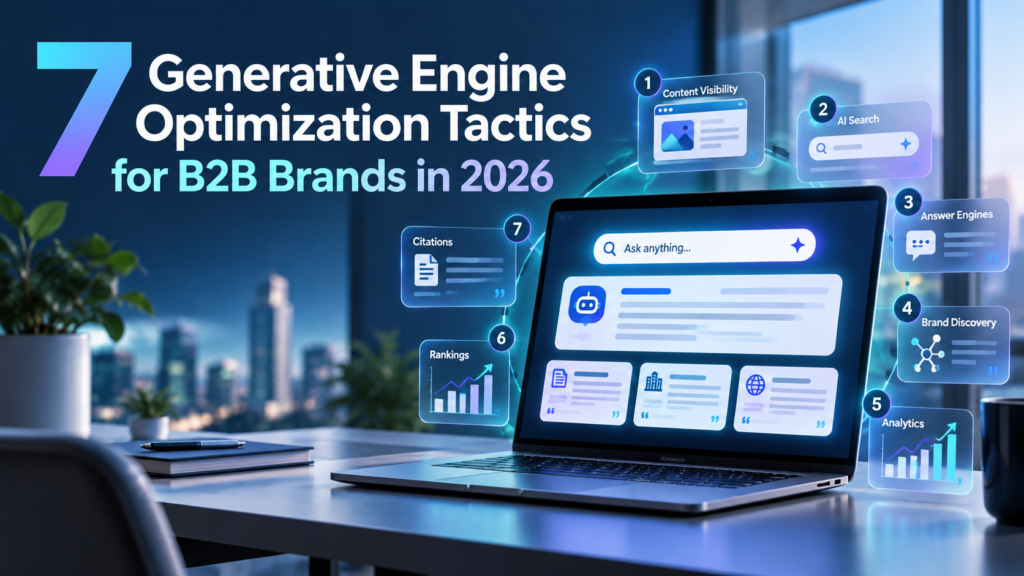
7 Generative Engine Optimization Tactics for B2B Brands in 2026
B2B search has changed from a list of links into a layer of generated answers. A buyer can now ask a long question in Google AI Mode, ChatGPT search, Microsoft Copilot, or another answer system and receive a summary before visiting a vendor site. That shift changes what content teams need to measure. Traditional rankings still matter, but being cited inside an answer can influence discovery before a buyer reaches a search results page or a company website.
Generative engine optimization is the practice of making useful web content easier for generative systems to retrieve, understand, trust, and cite. It sits beside SEO rather than replacing it. Google now says its generative search features are rooted in core Search systems, while OpenAI and Bing publish separate guidance on crawler access and citation reporting. For B2B teams, the job is therefore wider than chasing a new acronym. The real work is publishing evidence that an AI system can identify as relevant and that a human buyer would still find worth reading.
This guide explains 7 tactics that fit that reality in 2026. The focus is practical: original evidence, answer-ready structure, clear entities, crawl access, structured context, freshness, and measurement. The tactics also fit a normal B2B content strategy, which matters because a separate content operation for every answer engine would be expensive and hard to maintain.
TL;DR
Generative engine optimization works best when it improves the source page rather than trying to manipulate the answer layer. Publish first-hand evidence that other sites cannot copy, answer real buying questions in clear sections, make authors and companies easy to identify, keep important pages crawlable, use structured data where it accurately describes the page, refresh claims that can age, and measure citations alongside normal search and pipeline metrics. Google explicitly says there is no special markup required for its generative features, and Bing now exposes citation activity in Webmaster Tools. OpenAI separately lets publishers control search access through OAI-SearchBot.
The commercial reason to care is also becoming clearer. A 2026 Pew Research Center survey found that 60% of U.S. adults said they read AI summaries at the top of search results at least sometimes. At the same time, earlier browsing research found that people clicked traditional results less often when Google showed an AI summary. That means AI search visibility can matter even when it does not produce a direct click. B2B teams need a measurement model that connects citations, brand discovery, assisted visits, branded search, and qualified pipeline rather than treating referral traffic as the only outcome.
Why GEO Matters for B2B Brands in 2026
The first reason is that buyers ask longer and more specific questions when an interface can answer in plain language. Instead of searching for a two-word category term, a buyer may ask which platform fits a 500-person company, what the migration risks are, how pricing usually works, or which implementation path is safest. Those questions create room for detailed vendor content, research, documentation, and expert commentary to become source material.
The second reason is that citations do not behave like classic rankings. The original academic work that introduced the term generative engine optimization tested ways to increase source visibility inside generated answers and reported gains that varied by domain. TheGEO research paper is useful because it frames the problem as source visibility inside synthesized responses, but it should not be treated as a permanent recipe for every current model. Search systems have changed since the paper was written, and vendors now publish more direct guidance about how their own products retrieve and cite information.
The third reason is commercial. B2B buying usually involves comparison, risk review, and repeated research. A strong B2B content strategy already serves those stages with buying guides, customer evidence, and technical documentation. Generative engine optimization raises the value of that work when the same assets can support generated answers and human research.
There is also a traffic reality to plan for. Pew Research Center found that users in its March 2025 browsing study clicked a traditional result in 8% of visits when a Google AI summary appeared, compared with 15% when one did not. The samePew analysis of AI summary behavior found that direct clicks on cited AI-summary sources were rare. That does not mean source visibility has no value. It means a B2B brand needs to track more than last-click sessions when evaluating generative AI search.
How Generative Search Finds and Cites Sources
Generative systems do not use one retrieval stack, but public guidance shows common requirements. A page must be discoverable, relevant to the information need, and clear enough for a system to extract supporting passages. Clear source identity and current facts also reduce ambiguity.
Google Search And AI Overviews
Google’s 2026 guidance says AI Overviews and AI Mode use core Search systems and techniques such as retrieval-augmented generation and query fan-out. The company also says there are no extra technical requirements beyond being indexed and eligible to appear with a snippet. It sofficial generative AI search guidance rejects several popular shortcuts, including special AI markup for Google and forced content chunking. That is an important guardrail for generative engine optimization: improve the page for readers and retrieval rather than building a second artificial version for machines.
OpenAI Search Crawling Controls
OpenAI uses a separate control. OAI-SearchBot is the crawler associated with search discovery, while GPTBot covers a different purpose related to training controls. OpenAI’scrawler documentation says publishers can allow OAI-SearchBot while disallowing GPTBot because the controls are independent. For a B2B site that wants ChatGPT search visibility but has separate training policies, that distinction belongs in the technical checklist.
Bing Citation Reporting
Bing now gives publishers a more direct view of citation use. ItsAI Performance report shows cited pages, citation counts, grounding queries, and trends across Microsoft Copilot, Bing AI experiences, and selected partner surfaces. This creates a practical feedback loop that did not exist in the early GEO discussion. Teams can inspect which pages receive citations and then compare those pages with uncited content on the same topic.
Tactic 1: Publish Evidence That Cannot Be Easily Recreated
The strongest GEO asset is information that an answer system cannot get from hundreds of near-identical pages. For a B2B brand, that can come from product telemetry, customer research, implementation records, original benchmarks, survey data, expert interviews, or a repeatable internal analysis. The point is not novelty for its own sake. The evidence should answer a question a buyer actually asks.
Google’s current guidance puts unusual weight on what it calls non-commodity content. TheGoogle people-first content guidance asks whether a page contains original reporting, research, analysis, clear expertise, and information beyond obvious summaries. Those standards line up with a durable B2B content strategy because the same evidence that makes a page more useful to a buyer also makes it more distinct from mass-produced summaries.
A software company could publish implementation time by customer size from anonymized projects. A staffing company could publish role-level time-to-fill ranges. A cybersecurity provider could summarize incident patterns from a defined review set. Each example gives a generated answer a specific fact or framework worth citing.
Evidence needs enough method detail to be trustworthy. State the sample size, date range, inclusion rules, and important limits. If results only cover U.S. customers, say so. This makes AI search visibility more defensible because the claim carries context with it.
Avoid turning every internal metric into a public statistic. Some datasets are too small, too biased, or too sensitive to publish. In those cases, use expert analysis with concrete examples instead. Generative engine optimization should improve the quality of public knowledge, not create a reason to publish weak numbers.
Tactic 2: Write for Buying Questions and Extractable Answers
B2B pages should answer the question early, then supply the detail needed to trust the answer. That structure works for people who scan and for retrieval systems looking for passages that directly support a response. A section about cost should state the cost drivers near the beginning. A section about implementation risk should name the main risk before explaining causes and controls.
Google describes query fan-out as a process where a generative search system may issue several related queries to build a broader answer. Its separateAI features documentation says pages shown as supporting links still need to be indexed and eligible for normal Search snippets. That suggests a practical AI search rule: create one strong page that covers the important subquestions around a real task instead of publishing dozens of shallow pages for tiny query variations.
For example, a page titled “Salesforce Data Cloud implementation cost” should cover price drivers, project phases, integration needs, license boundaries, staffing, and common causes of overrun. Those are parts of one buying decision and belong together when the reader benefits from the full picture.
Answer blocks should still read naturally. A useful pattern is a direct two- or three-sentence answer followed by explanation, evidence, and exceptions. Do not write a page as a stack of dictionary definitions. Generative AI search can retrieve longer passages, and Google specifically says there is no requirement to split content into tiny chunks for AI systems.
The same rule applies to comparison content. State the decision condition, not a vague “it depends.” Explain which option fits which environment and why. A B2B content strategy becomes more useful when each comparison gives readers a decision path instead of repeating product feature lists.
Tactic 3: Make Authors Brands and Claims Easy to Identify
Generated answers often need to distinguish a source from the entities discussed inside that source. B2B sites therefore benefit from clear author identity, organization identity, product naming, and claim attribution. This is basic publishing hygiene, but it becomes more important when content is retrieved outside the visual context of the full website.
Author Identity
Google recommends clear authorship information in its guidance for helpful content. For article pages, itsArticle structured data documentation recommends properties such as author name and author URL when they accurately reflect the page. Structured data does not guarantee AI citations, but it can provide consistent machine-readable context around information that is already visible to readers.
Author pages should explain why the person is qualified to write or review the topic. A security article can list relevant professional experience. A Salesforce article can identify implementation roles or certifications when they are current and real. A finance operations article can name the practitioner’s area of responsibility. Do not invent authority signals or use generic bylines such as “Admin Team” when a real expert is responsible for the work.
Organization Identity
The company entity deserves the same care. Google’sOrganization structured data guidance explains how organization markup can help Search disambiguate a company. Consistent naming across the home page, about page, author pages, product pages, and external profiles reduces ambiguity.
Claim Attribution
Claims also need visible attribution. If a page cites a government rule, link to the agency. If it cites a research finding, name the study and date. If a statistic comes from internal analysis, label it as internal and describe the method. This helps AI citation tracking later because the team can separate citations earned by original claims from citations earned by summaries of third-party work.
Tactic 4: Keep High-Value Pages Crawlable and Retrievable
A page cannot earn reliable source visibility if the relevant system cannot fetch it. Technical access is therefore part of generative engine optimization even though there is no single GEO crawler. Google, OpenAI, Bing, and other products have different indexing and crawling rules, so the correct configuration depends on which surfaces matter to the business.
Search Access
Start with normal search access. Important B2B pages should return a valid status code, use a stable canonical URL, avoid accidental noindex rules, and expose the main text in rendered HTML. Google still treats normal indexing as the basis for its AI search surfaces. Its guidance also warns that JavaScript-heavy sites can create more search work if important content is difficult to render or blocked.
AI Crawler Access
Then check AI-specific crawler policy where the vendor provides one. OpenAI’spublisher FAQ says a public site can appear in ChatGPT search and advises publishers that want summaries and clear citations not to block OAI-SearchBot. That creates a straightforward control point for teams managing ChatGPT search visibility.
Internal Linking And Discovery
Internal links matter because crawlers still need a path to important pages. Google’slink best-practices documentation says crawlable anchor links help Search discover pages and understand their relationship to surrounding content. For AI search visibility, the same architecture also helps group a brand’s evidence around product areas, industries, use cases, technical docs, and research topics.
Audit orphan pages, blocked resource directories, duplicate URLs, and important content hidden behind forms. Gated assets can still generate leads, but the public page should explain what the asset contains. Unique PDF research can also have an HTML summary with key findings and method notes.
Tactic 5: Add Structured Context Without Chasing Special Markup
Structured data helps search systems understand page types and entities, but it is not a secret GEO switch. That distinction matters because 2026 has produced a lot of advice about special files, AI-only markup, and machine-first rewrites that are not supported by major search vendors.
Google’s generative AI guide states that structured data is not required for its AI search features and that there is no special schema.org type needed for those features. It also says Google does not use llms.txt as a special signal for Search. That makes the correct AI search approach fairly conservative: use established structured data when it truthfully describes visible content and serves an existing search purpose.
For B2B publishing, Article or BlogPosting markup can describe the headline, dates, and author. Organization markup can describe the company. Other schema types may make sense when the page genuinely fits them. The markup should match what a visitor can see.
The strongest context still comes from the page itself. Use a clear H1, descriptive section headings, accurate product names, explicit units, stated dates, and tables when a comparison needs a table. Avoid vague references such as “the platform” when 4 platforms are discussed in the same section. AI systems can often resolve context, but clear naming reduces unnecessary ambiguity.
This is where a good B2B content strategy helps technical teams. Editors can define naming standards for products, roles, locations, industry terms, and metrics. Developers can then map those visible elements to appropriate markup. The result supports normal search and may make generative AI search retrieval cleaner without creating an extra publishing system.
Tactic 6: Treat Freshness as Claim Maintenance
Freshness is more precise than adding a new date to an old article. A B2B page becomes stale when the facts that support its recommendation have changed. Pricing, product limits, compliance rules, release schedules, leadership roles, integrations, feature availability, and market statistics can all age at different speeds.
Review Cadence By Claim Type
Set review intervals by claim type. A product comparison with active SaaS pricing may need quarterly checks. A guide to a stable framework may only need annual review. A legal or compliance page may need event-based review whenever a regulator changes the rule. The goal is to keep high-risk facts current while avoiding cosmetic updates that add a new timestamp without new verification.
Google’s 2026 launch of dedicated generative AI reporting in Search Console makes this easier to observe. TheSearch Console announcement says the reports cover visibility in generative Search features such as AI Overviews and AI Mode, with worldwide rollout completed by August 31, 2026. Teams can compare content changes with shifts in AI impressions, but they should avoid assuming a single edit caused a change because many ranking and demand factors move at once.
Claim Register
Create a claim register for pages that influence buying decisions. Record the claim, source, date, owner, and next review. Keep the documentation used to verify product features and the methodology behind cited research. This makes generative engine optimization easier to maintain because editors can refresh risky claims instead of rewriting the whole page.
Freshness also affects original research. Publish the field dates of surveys, the period covered by usage data, and the date a benchmark was calculated. That context lets a reader or answer system distinguish current evidence from historical evidence without guessing.
Tactic 7: Measure Citations Alongside Search and Pipeline
GEO measurement should answer 3 different questions: where the brand is cited, what content earns those citations, and whether the resulting visibility contributes to business outcomes. Referral sessions alone cannot answer those questions because many AI interactions end without a click.
Citation Metrics
Bing’s 2026 updates make citation measurement more useful. The company added Intents, Topics, Citation Share, and Compare to its AI Performance tools. ItsJune 2026 AI visibility update explains that Citation Share measures a site’s portion of citations for a grounding query rather than classic rank. That is a useful model for AI citation tracking because it treats visibility as participation in an answer’s source set.
Cross-Platform Measurement
Google now exposes generative search visibility separately in Search Console, while Bing exposes citations and grounding queries. OpenAI does not provide an equivalent publisher dashboard for every site, so ChatGPT search visibility often requires a mix of referral analytics, server logs, manual query sampling, and third-party monitoring. Treat each source as partial evidence rather than combining them into a fake universal rank.
A practical AI citation tracking dashboard can include citations by platform, cited URLs, AI referrals, assisted conversions, branded-search changes, and pipeline touches where attribution is available. Keep definitions stable from month to month so trends remain comparable.
Do not turn prompt checking into a vanity exercise. One handpicked prompt says little about broad AI search visibility. Use a fixed set of buying questions and sample them on a repeatable schedule alongside platform data.
A 2026 Pew survey adds context to why this matters. ThePew chart on AI summaries reports that 60% of U.S. adults say they read AI summaries at the top of search results. For B2B teams, the exact percentage of business buyers will differ, but the broader behavior confirms that generated answers are now part of mainstream information discovery.
GEO and SEO Should Share One Content System
The most sustainable approach is to treat generative engine optimization as an extension of search and content operations. Google says its AI features depend on core Search systems. OpenAI search still needs accessible public web content. Bing’s citation tools are built into Webmaster Tools. Those facts argue against creating a separate library of thin AI-only pages.
Traditional SEO still handles crawlability, indexing, internal linking, canonicalization, page speed, information architecture, and search demand. GEO adds more attention to source-worthiness, entity clarity, extractable evidence, and citation measurement. The overlap is large enough that one editorial calendar can support both.
The clearest difference is the unit of success. Classic SEO often tracks a page against a query and rank position. Generative AI search can retrieve several pages across related subqueries and synthesize them into one answer. A source may therefore matter even when it is not the first traditional result for the original wording.
That shift changes keyword planning. Instead of creating a page for every wording variant, group questions around a real job the buyer needs to complete. A strong B2B content strategy might have one deep migration cost guide supported by a calculator, implementation checklist, customer study, and technical documentation. Those assets can reinforce one another in both classic search and generated answers.
Keep normal SEO discipline. Google Search Essentials still recommends helpful content, crawlable links, and language people use. Those basics remain useful because generative engine optimization cannot rescue a site with broken indexing, weak content, or no credible evidence.
A 90-Day GEO Rollout for a B2B Team
A 90-day plan should improve a small group of high-value pages before expanding the program. Start with content closest to revenue and buyer risk: category pages, comparison pages, cost guides, implementation guides, customer evidence, and research pages. Those assets usually answer the questions that generative systems are asked during B2B evaluation.
Days 1 To 30
During the first 30 days, audit technical access and evidence quality. Confirm that important pages are indexable. Review crawler rules based on company policy. Map existing articles to buying questions, flag old claims, and record current AI search visibility as a baseline.
Days 31 To 60
During days 31 through 60, rebuild 5 to 10 priority pages. Add direct answers, replace generic claims with sourced evidence, fix author and organization identity, improve internal links, and add relevant structured data. Publish 1 original evidence asset if the company has suitable data or practitioner insight.
Days 61 To 90
During days 61 through 90, measure. Use Google and Bing reporting where available, then sample a fixed set of buyer questions in relevant AI tools. Record citations, source pages, referrals, branded queries, and influenced opportunities. Use the findings to choose the next pages to improve.
Keep ownership clear. SEO can own crawl and search reporting, content can own editorial quality, and subject-matter experts can own technical accuracy. Marketing operations can connect discovery signals with pipeline. AI search visibility becomes easier to improve when each part has an owner.
Common GEO Mistakes B2B Brands Should Avoid
The first mistake is publishing pages that restate public information. Generative engine optimization needs a source to add experience, evidence, or useful framing that generic summaries lack.
The second mistake is building dozens of near-duplicate pages for prompt variations. Google now explicitly warns against creating separate content for every possible fan-out query when the purpose is to manipulate visibility. That pattern can also make a site harder for buyers to use. One deep page with a clear information structure is often more useful than many weak pages.
The third mistake is treating schema as a citation hack. Structured data can clarify an article or organization, but it should describe visible content accurately. It cannot make a weak page authoritative. The same applies to llms.txt. It may be useful for systems that choose to support it, but Google says it does not improve visibility in Google Search.
The fourth mistake is blocking search crawlers by accident. Security teams sometimes copy broad bot-blocking rules without separating training crawlers from search crawlers. OpenAI makes OAI-SearchBot and GPTBot separate controls, so a company can set different policies. Review crawler rules with legal, security, and marketing stakeholders instead of assuming every AI bot serves the same purpose.
The fifth mistake is measuring one prompt as if it were a rank tracker. Answers can vary by wording, location, model, date, and source freshness. AI citation tracking should use a stable query set, platform data where available, and trend analysis over time.
The sixth mistake is forgetting the buyer. A page written only to look quotable can become shallow. If the full article does not help a buyer make a decision, formatting will not fix the weakness.
Final Takeaway
The 2026 GEO playbook is less exotic than the label suggests. Generative engine optimization starts with the same foundation that has always made strong B2B publishing work: original evidence, clear answers, credible authorship, crawlable pages, accurate context, current claims, and measurement tied to business questions.
What has changed is the discovery layer. Search systems can now synthesize several sources into one response, which means AI search visibility can matter before a buyer visits any website. Generative AI search also creates new reporting needs because citations, AI impressions, referrals, branded demand, and pipeline influence do not move in the same way.
B2B brands should therefore build one content system that serves people, classic search, and generated answers. Use AI search work to make useful evidence easier to retrieve and cite. Keep the B2B content strategy centered on real buyer tasks. Track AI citation tracking alongside established search and revenue measures. That approach is harder to game, but it is also easier to defend when search platforms change again.
Frequently Asked Questions
What Is Generative Engine Optimization?
Generative engine optimization is the practice of improving web content so generative search systems can discover, understand, retrieve, and cite it when producing answers. It usually involves normal SEO foundations plus stronger source evidence, clear entity information, useful page structure, and citation measurement. It does not require one universal technical standard because Google, OpenAI, Bing, and other systems use different retrieval and crawler controls.
How Is GEO Different From SEO?
SEO usually focuses on crawlability, indexing, rankings, clicks, and search-result visibility. GEO adds attention to whether a page becomes source material inside a generated answer. The work overlaps heavily because generative systems often depend on search indexes and public web pages. A B2B team should usually run both through the same content and technical program rather than building a separate AI-only site.
Does GEO Replace SEO in 2026?
No. Google’s official guidance says its generative features use core Search ranking and quality systems. A page still needs normal technical access and useful content before it can appear as a supporting source. Other answer engines also rely on crawled or indexed web content. GEO is therefore an added visibility layer rather than a replacement for search basics.
What Is the Best GEO Tactic for B2B Brands?
Original evidence is usually the strongest starting point because it gives a generated answer something distinct to cite. Product data, implementation benchmarks, customer research, expert analysis, and well-documented internal studies can all work when the method is clear. The evidence should answer a real buying question rather than exist only to attract citations.
Do B2B Brands Need llms.txt for GEO?
Google says llms.txt is not needed for visibility in Google Search or its generative search features. Other tools may choose to support the file, so a company can maintain one if it has a defined purpose. It should not replace normal robots.txt controls, sitemaps, crawlable pages, or established structured data.
Does Structured Data Improve AI Citations?
Structured data can help search systems understand page types, authors, organizations, products, and other entities when the markup matches visible content. Google says structured data is not required for its generative AI search features and there is no special AI schema. Use established schema types for their intended purpose instead of treating markup as a citation guarantee.
How Often Should GEO Content Be Updated?
Update content when its important claims can become stale. Pricing pages and product comparisons may need frequent checks, while stable educational guides can use a longer review cycle. Track the source and review date for claims involving product limits, regulations, statistics, feature availability, and other facts that can change.
How Can a B2B Brand Measure AI Search Visibility?
Use platform data where it exists, then add repeatable observation. Google Search Console now reports visibility in generative Search features, while Bing Webmaster Tools reports citations and grounding queries across supported AI experiences. For other systems, track referral traffic, server logs, cited pages, and a fixed set of buyer questions over time.
What Is AI Citation Tracking?
AI citation tracking is the process of recording when a brand’s web pages are shown as sources in generated answers. A useful program records the platform, question or topic, cited URL, date, and answer context. It should be analyzed as a trend because generated answers can change between users and over time.
Should B2B Brands Create Separate Pages for Every AI Prompt?
Usually no. Buyers ask many variations of the same underlying question, and search systems can issue related queries behind the scenes. Creating a separate page for every wording can lead to duplicate or shallow content. Build strong pages around real buyer tasks and cover the important subquestions where they belong.
Can ChatGPT Search Find a Site That Blocks OAI-SearchBot?
OpenAI says sites that opt out of OAI-SearchBot will not be shown in ChatGPT search answers as normal search sources, though a navigational link may still appear in some cases. Companies should review OAI-SearchBot separately from GPTBot because the two controls serve different purposes.
Does Author Expertise Matter for GEO?
Clear authorship can make a B2B page easier for readers and search systems to evaluate. Use real bylines, author pages, current credentials, and clear review responsibility where appropriate. Expertise signals should reflect actual experience. A generic byline or invented qualification can reduce trust instead of improving it.
How Does GEO Affect B2B Content Strategy?
GEO gives more value to content that answers detailed buying questions with clear evidence. Research reports, comparison guides, implementation pages, technical documentation, and expert analysis can support both human evaluation and generated answers. The content plan should still follow buyer needs rather than a list of AI buzzwords.
Is Referral Traffic Enough to Measure GEO Success?
No. Many generated answers satisfy part of the user’s question without a click. Track citations, generative search impressions where available, AI referrals, branded search changes, assisted conversions, and pipeline influence. No single measure proves causation, so the strongest view combines several signals over time.
How Long Does It Take to See GEO Results?
There is no fixed timeline. Crawl access, indexing, topic demand, source quality, platform refresh cycles, and model changes can all affect when a page begins appearing in generated answers. A B2B team should compare results over several reporting periods and avoid judging the program from one prompt or one week of data.