What a Cardiologist Email List Costs, and Why 2 Quotes for the Same Audience Land 60x Apart
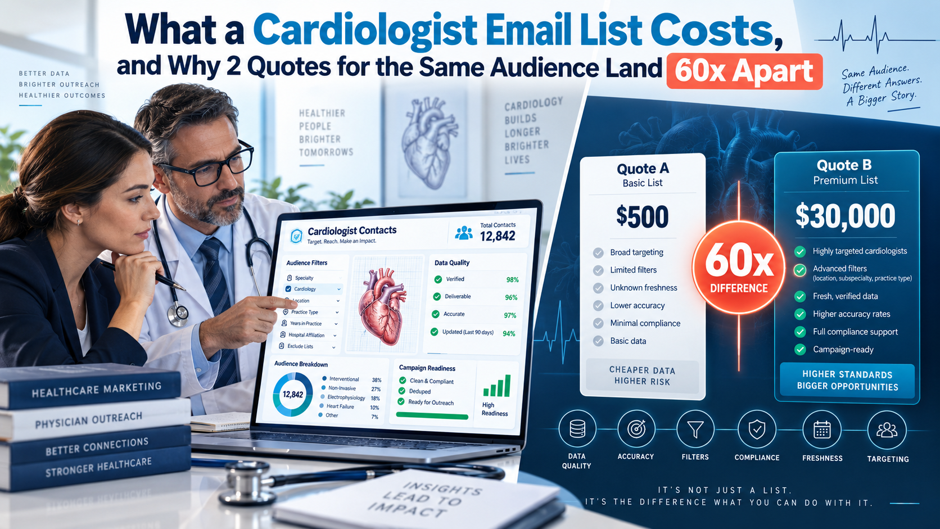
A pharmaceutical marketing manager gets 2 quotes for the same target audience: roughly 20,000 practicing cardiologists in the United States. One vendor may provide a lower-cost list while another may quote a higher price for additional data services, verification, segmentation, or usage rights. The difference usually reflects different products being offered under the same generic label, “cardiologist email list.”
This guide breaks down what actually drives cardiologist email list pricing from roughly $0.03 per record at the cheapest end of the market to $1.80 or more per record at the premium end, a spread that regularly produces exactly the 60x gap described above between 2 quotes covering what looks, on paper, like an identical audience of practicing US cardiologists. Understanding these cost drivers isn’t just an academic exercise in data vendor economics. Choosing the wrong end of that spread for a given use case either wastes significant budget on data quality nobody needed, or produces a list that bounces, ages out, and creates deliverability and compliance exposure within months of purchase.
TL;DR
| Price tier | Typical range per record | What you’re actually buying |
| Budget / bulk compiled | $0.03 to $0.07 | Scraped or aggregated public data, minimal verification, no NPI cross-reference |
| Standard verified | $0.10 to $0.50 | NPI-matched records, basic deliverability checks, quarterly or better refresh |
| Enterprise segmented | $0.20 to $0.80 | Sub-specialty depth, hospital firmographics, EHR signal, ongoing verification |
| Premium / consent-documented | $1.00 to $1.80-plus | Opt-in documentation, real-time verification, exclusivity terms, custom enrichment |
The 60x gap in the opening example isn’t unusual once these tiers are laid out side by side; it’s simply what happens when a budget-tier quote at $0.03 per record is compared directly against a premium-tier quote at $1.80 per record for a list of the same size, with neither party pausing to ask which tier the other one is actually quoting before the comparison gets made and a decision follows from it.
Why the Same Audience Produces Such Different Numbers
There are roughly 35,000 active cardiologists practicing in the United States, a number every legitimate data vendor in this space can cite with reasonable confidence because it’s grounded in publicly available workforce data. That shared starting point is exactly why the pricing spread feels so confusing to a first-time buyer: if everyone is working from the same underlying universe of licensed professionals, why does the resulting product vary in price by a factor of 60 or more?
The answer is that “the same audience” is doing a lot of hidden work in that sentence. A budget vendor and a premium vendor can both technically point to the same 35,000 cardiologists and claim coverage of that universe, while delivering products that differ enormously in accuracy, freshness, segmentation depth, deliverability, and legal defensibility. The record count on the label is identical. Almost everything else about what that record count actually represents is not, and price is the variable that reflects those hidden differences most directly.
The variables that actually drive the price difference:
- Sourcing method, ranging from scraped public directories with no cross-verification to licensed data partnerships with professional organizations and direct NPI registry matching
- Verification depth, spanning everything from a one-time bulk validation run to continuous, real-time deliverability checking against live mail servers
- Refresh cadence, since a list updated once a year decays substantially before the next update, while a continuously maintained dataset stays current throughout the subscription period
- Segmentation richness, distinguishing a flat list of names and emails from a dataset that includes sub-specialty, hospital affiliation, cath lab tier, and procedure volume
- Compliance documentation, covering whether the vendor can actually demonstrate how each record was sourced and whether opt-out and consent obligations were properly tracked
- Exclusivity terms, since a list resold to hundreds of buyers behaves very differently in the inbox than one licensed to a smaller number of companies
Each of these variables independently moves the price, and because they tend to correlate, a vendor investing heavily in one is usually investing in several others too, which is exactly why the market clusters into recognisable tiers rather than spreading evenly across the full price range from cheapest to most expensive option available.
Cost Driver 1: How the Data Was Actually Sourced
Sourcing method is the single biggest lever on price, because it determines almost everything downstream: how accurate the initial record is, how defensible the compliance story is, and how much ongoing maintenance the vendor needs to invest in to keep the dataset genuinely usable rather than steadily decaying toward uselessness over time.
The Sourcing Spectrum
Scraped and compiled public data sits at the cheap end of the spectrum. A vendor pulls names, practice addresses, and sometimes emails from publicly available directories, medical board websites, and general business listing aggregators, then compiles them into a purchasable file with minimal cross-referencing against authoritative sources. This approach can genuinely produce a large record count cheaply, but the resulting data frequently contains outdated practice affiliations, guessed or pattern-generated email addresses, and no reliable way to confirm the person listed still practices where the record says they do.
NPI registry matching represents the next tier up, where a vendor cross-references its raw contact data against the CMS National Provider Identifier registry, a genuinely authoritative federal database of licensed healthcare providers. This step alone meaningfully improves confidence that a given record refers to a real, currently licensed cardiologist rather than a stale or fabricated entry, and it’s the baseline that most credible mid-market vendors build from.
Licensed data partnerships with medical associations, specialty colleges, and professional platforms sit higher still, because these arrangements typically involve some degree of direct, ongoing data exchange rather than a one-time public scrape, and the underlying source organisations have their own incentive to keep member and directory data reasonably current.
Opt-in collection through professional platforms, such as continuing education registrations, webinar sign-ups, or professional networking platforms where a cardiologist has actively provided contact information for a specific purpose, sits at the top of the sourcing spectrum. This is both the most expensive data to acquire and the data with the clearest, most defensible consent story attached to it.
Why Sourcing Method Alone Can Explain a 10x Price Gap
A vendor working entirely from scraped public data has genuinely low acquisition costs and can price a list at $0.03 to $0.07 per record while still generating a healthy margin. A vendor maintaining licensed partnerships, running continuous NPI cross-referencing, and documenting opt-in status for a meaningful share of its records carries substantially higher ongoing costs that get reflected directly in the per-record price. Sourcing method alone, before any other variable is even considered, regularly explains a 5x to 10x difference between the cheapest and most credible options in the market.
Cost Driver 2: Verification Depth and What “95% Verified” Actually Means
“95% verified” is one of the most commonly used phrases in healthcare data marketing, and it’s also one of the most ambiguous, because the claim rarely specifies verified against what, by what method, or at what point in time relative to when the buyer actually receives and starts using the file.
Questions a buyer should ask before accepting any verification claim at face value:
- Was the email address verified through a live server check confirming the mailbox actually exists and accepts mail, or only checked for correct formatting?
- Was the practice affiliation confirmed against a current, authoritative source, or simply carried forward from whenever the record was originally compiled?
- Was the NPI number matched against the live CMS registry, or only checked for a plausible format?
- What was the date of the most recent verification pass, and how does that compare to the vendor’s stated refresh cadence?
- Does the 95% figure apply to the entire database, or only to a curated subset that happens to score well, with the full purchased file performing meaningfully worse?
A vendor unable or unwilling to answer these questions specifically, falling back instead on a repeated assurance that the data is simply “high quality,” is signalling that the verification claim on the sales page may not hold up under the kind of scrutiny a buyer should reasonably apply before committing real budget to a 5-figure purchase.
The Real Cost of Verification Infrastructure
Genuine, continuous verification is expensive to maintain. Live email deliverability checking against real mail servers, ongoing NPI registry synchronisation, and periodic manual review of edge cases that automated systems flag but can’t resolve confidently all require dedicated infrastructure and staff time that a bulk-compiled list simply doesn’t carry as a cost. This is one of the more legitimate and easily explainable reasons a premium list costs meaningfully more than a budget one, and it’s also one of the easier claims for a buyer to actually verify by asking specific, pointed questions rather than accepting a marketing percentage at face value.
Cost Driver 3: Segmentation Depth and Firmographic Enrichment
A flat list containing only a cardiologist’s name and email address is meaningfully less valuable, and therefore priced lower, than a record enriched with the sub-specialty, hospital system affiliation, and practice-level detail that lets a marketing or sales team actually target their outreach with precision. That kind of firmographic enrichment supports a more targeted approach than a single undifferentiated message sent to everyone on the list equally.
What Segmentation Depth Adds
| Data field | What it enables | Typical tier where it appears |
| Sub-specialty (interventional, EP, structural heart, imaging) | Targeting device or drug campaigns to the physicians actually relevant to that product category | Standard verified and above |
| Hospital or health system affiliation | Account-based outreach coordinated with a specific health system’s broader relationship | Enterprise segmented and above |
| Cath lab tier or procedure volume | Prioritising high-volume operators for device trials or early adoption campaigns | Enterprise segmented and above |
| EHR platform signal | Coordinating outreach with product integrations relevant to the specific EHR a practice uses | Enterprise segmented and above |
| Employment status (hospital-employed vs. independent) | Adjusting messaging and decision-maker targeting based on organisational structure | Standard verified and above |
Roughly 60% of practicing cardiologists in the US are hospital-employed rather than independent, and around a quarter specialise specifically in interventional cardiology. A list without this kind of segmentation forces a buyer to either blast the same message to a genuinely diverse professional population with very different purchasing dynamics, or manually research and re-segment a purchased list after the fact, which erodes much of the time savings the purchase was supposed to deliver in the first place.
Why Enrichment Adds Real Cost, Not Just Perceived Value
Firmographic and segmentation data doesn’t come bundled for free with a basic contact record. It requires either licensing additional third-party datasets covering hospital affiliations and health system structures, or building and maintaining proprietary enrichment processes that map individual physicians to the organisations and practice settings they work within. Both paths carry ongoing cost, and vendors offering this depth of segmentation are pricing that cost into the per-record rate, which is a legitimate and explainable reason a segmented, enriched list costs several times more than a flat, unsegmented one covering the exact same underlying group of cardiologists, despite both files technically representing the same 35,000-person national workforce.
Cost Driver 4: Compliance Documentation and Legal Defensibility
Compliance is frequently misunderstood in this specific market, and clearing up the confusion matters because it directly affects how a buyer should weigh compliance-related pricing claims from competing vendors, several of which lean heavily on compliance language that doesn’t actually hold up once a buyer starts asking specific questions.
What actually applies to cardiologist email marketing:
- Physician professional contact information, including name, specialty, practice affiliation, and professional email address, is not classified as protected health information under HIPAA, because HIPAA governs patient data, not the professional business contact details of healthcare providers themselves
- CAN-SPAM does apply directly to commercial email sent to physicians in the United States, requiring accurate sender identification, a non-deceptive subject line, a physical mailing address, and a functional one-click unsubscribe mechanism in every message
- CAN-SPAM does not require prior opt-in consent to legally send a first commercial email to a physician under U.S. federal law, which surprises many buyers who assume the same GDPR-style consent requirement applies domestically
- State-level privacy laws in California, Vermont, Virginia, Colorado, and Connecticut extend certain rights, including the right to opt out of data sales, and a vendor selling into these states should be able to confirm sourcing and opt-out compliance at the state level specifically
- GDPR applies to any outreach targeting physicians based in the European Union, with legitimate interest standards for B2B marketing varying meaningfully by individual member state
An analysis of FTC and state attorney general enforcement actions against healthcare data buyers found that 73% of actions cited CAN-SPAM violations specifically, not HIPAA, which reflects where the actual practical risk sits for a company buying and using this kind of list, regardless of how vendor marketing pages tend to frame the compliance conversation around HIPAA rather than the rules that actually apply.
Why Documented Compliance Still Commands a Price Premium
Even though CAN-SPAM doesn’t require opt-in consent, a vendor that can demonstrate clean sourcing, active suppression list management, and documented opt-out handling meaningfully reduces a buyer’s practical risk of a bounce-driven sender reputation problem or a state-level compliance dispute. Maintaining that documentation, actively honouring opt-outs across every downstream use of the data, and keeping records defensible under audit all require ongoing operational investment that a vendor selling undocumented, scraped data simply isn’t carrying as a cost, and that difference in operational overhead shows up directly in the price both vendors ultimately charge their customers.
Cost Driver 5: Refresh Cadence and Data Decay Economics
Physician contact data decays faster than most first-time buyers expect, and refresh cadence is one of the cost drivers that produces the most expensive mistakes when it’s underestimated during the initial purchasing decision, since the consequences don’t show up until well after the purchase has already been finalised and paid for.
Physician contact data changes over time because of job changes, practice relocations, and other updates. The level of change depends on the specialty, source, refresh process, and time period measured.
What refresh cadence costs the vendor, and therefore the buyer:
A vendor promising quarterly or continuous refresh needs an ongoing process actively re-verifying records against current sources on a rolling basis, rather than compiling a dataset once and reselling the same static file repeatedly to successive buyers. This ongoing maintenance cost is real and recurring, distinct from the one-time cost of building the initial dataset, and it’s reflected directly in subscription-style pricing models or higher per-record costs for datasets that come with a genuine, contractually backed freshness guarantee attached to them.
A buyer evaluating 2 quotes at a similar price point should specifically ask about refresh cadence as a differentiator, because a static list sold once at a low price can end up costing more in wasted campaign spend and damaged sender reputation over an 18-month period than a modestly more expensive, continuously refreshed alternative would have cost across that same window of time.
Cost Driver 6: Exclusivity and Resale Terms
The final major cost driver, and one of the least visible to a first-time buyer, is how many other companies have already purchased and are actively emailing the exact same list of cardiologists, since this factor never appears on an invoice yet quietly shapes every campaign result that follows it.
A non-exclusive list resold repeatedly to dozens or hundreds of buyers produces a very different inbox experience for the cardiologist on the receiving end than a list licensed to a smaller, controlled number of companies. A physician receiving unrelated commercial email from a dozen different vendors, all drawing from the same underlying purchased list, becomes progressively less likely to open, engage with, or trust any single sender, which directly degrades deliverability and response rates for every company using that shared list, regardless of how well any individual company’s own messaging is crafted or how relevant their specific offer happens to be.
Vendors offering exclusivity, whether through limiting the total number of buyers, restricting resale within a defined industry vertical, or offering a genuinely custom-built list constructed specifically for one buyer’s ideal customer profile, carry meaningfully higher costs because they’re forgoing the economics of reselling the same dataset repeatedly across many customers. This exclusivity premium is legitimate and explains a real portion of the gap between budget bulk lists and premium custom-built alternatives, distinct from the sourcing, verification, and segmentation differences already covered above.
A Practical Framework for Evaluating Competing Quotes
Given how many independent variables drive price, comparing 2 quotes purely on the headline per-record cost is close to meaningless without first normalising for what each vendor is actually including in that number, since the number alone says nothing on its own about which of the 6 cost drivers above it actually reflects.
The comparison checklist to apply before accepting any quote:
- Request the vendor’s sourcing methodology in writing, specifically asking whether records are NPI-matched against the live CMS registry or compiled from other sources without that cross-reference
- Ask for the specific verification method used, including whether email deliverability is checked through a live server ping and how recently that check was last run on the specific file being quoted
- Confirm the refresh cadence explicitly, including what happens to pricing and data freshness if the list isn’t used immediately upon delivery but instead deployed several months into a longer campaign timeline
- Clarify exclusivity terms precisely, including how many other buyers currently hold rights to the same underlying records and whether any vertical or competitive restrictions apply
- Request a small sample file before committing to the full purchase, and independently spot-check a portion of it against the CMS NPI registry and each cardiologist’s current publicly listed practice affiliation
- Ask directly how the vendor handles opt-outs and suppression requests across their broader customer base, not just within a single campaign, since a fragmented suppression process means a physician who opted out through one buyer’s campaign may still receive email from other companies using the same underlying list
Applying this checklist consistently across every vendor being evaluated normalises the comparison enough that a genuine price difference, reflecting a genuine quality or service difference, becomes clearly visible, rather than 2 quotes simply looking arbitrarily far apart with no clear, defensible explanation available anywhere to justify the gap.
A Worked Example: Pricing Out 3 Real Scenarios
Abstract cost drivers become easier to apply once they’re mapped against a few concrete, realistic buying scenarios, since the right tier genuinely differs depending on what the list is actually being used for, how long it needs to keep performing, and how much is genuinely at stake if the campaign underperforms.
| Scenario | Realistic tier to choose | Approximate cost for 20,000 records | Why this tier fits |
| One-time conference invitation email | Budget to standard verified | $600 to $10,000 | A single, low-stakes send with a clear, non-controversial offer tolerates a higher bounce rate and doesn’t require deep segmentation |
| Ongoing pharma rep territory targeting | Enterprise segmented | $4,000 to $16,000 | Reps need hospital affiliation and sub-specialty data to prioritise call lists, and the list will be reused across many campaigns over a full year |
| Medical device launch requiring interventional cardiologist targeting | Premium consent-documented | $20,000 to $36,000-plus | High-value device trials justify the cost of exclusivity, precise sub-specialty and procedure-volume targeting, and documented compliance for a scrutinised launch |
The conference invitation scenario illustrates why budget-tier data isn’t inherently a mistake: a single email with a genuinely relevant, low-friction offer, sent once, doesn’t carry the same compounding risk that a longer, reused campaign does, and the cost difference between tiers is largest precisely in the scenarios where a buyer might otherwise assume more expensive data is always worth it regardless of use case.
The territory targeting scenario shows where mid-tier segmentation earns its price premium. A pharmaceutical sales team working the same list for months needs to know which physicians sit within which health system and which sub-specialty they practice, because that data directly determines how a rep prioritises their limited call time each week. Paying for that segmentation once, up front, is meaningfully cheaper than absorbing the lost productivity of reps working from an unsegmented list and manually researching affiliation data themselves.
The device launch scenario justifies premium pricing because the stakes and scrutiny are genuinely higher. A device company launching a new catheter-based technology needs to reach high-volume interventional cardiologists specifically, wants documented compliance given the regulatory attention medical device marketing attracts, and benefits meaningfully from exclusivity, since a physician who’s already fatigued by a dozen other vendors emailing about competing devices is measurably less likely to engage with any single company’s outreach, however well-crafted that individual company’s messaging happens to be.
FAQs
Is the cheapest cardiologist email list ever the right choice?
It can be, depending on the use case. A one-time, low-stakes campaign with modest expectations and a tolerance for higher bounce rates may reasonably use budget-tier data, particularly if the buyer independently verifies a sample before committing to the full send and builds in realistic expectations about response rates. The risk with budget-tier data isn’t that it’s always the wrong choice; it’s that buyers frequently purchase it while expecting premium-tier performance, then conclude that physician email marketing as a channel doesn’t work, when the actual problem was a mismatch between the data tier purchased and the campaign’s actual requirements. Setting expectations correctly before the campaign launches, rather than discovering the mismatch afterward through disappointing open and response rates, is what separates a reasonable budget-tier decision from an avoidable one.
Why would a vendor charge $1.80 per record when a competitor charges $0.05 for what looks like the same list?
The $1.80 vendor is typically bundling several cost drivers simultaneously: licensed or opt-in sourcing rather than scraped public data, continuous rather than annual verification, rich segmentation and firmographic enrichment, documented compliance handling, and meaningful exclusivity restrictions on resale. Each of these adds real, ongoing operational cost on the vendor’s side, and the cumulative effect of stacking several premium attributes together, rather than any single one in isolation, is what produces pricing at the top of the market range.
How much does list size affect the per-record price within a given tier?
Most vendors apply volume discounts, so a larger record count typically reduces the per-record rate somewhat within the same quality tier, though the effect is usually modest compared to the difference between tiers. A jump from a budget-tier list of 5,000 records to 50,000 records might reduce the per-record price by 10 to 20%, whereas moving from budget tier to premium tier at the same record count can move the per-record price by a factor of 20 or more. Volume matters, but tier matters substantially more when explaining large gaps between competing quotes, and buyers who focus primarily on negotiating volume discounts within a single tier are usually optimising the smaller of the 2 available levers.
Does buying a more expensive, higher-quality list guarantee better campaign results?
Not automatically, though it materially improves the odds. A premium, well-verified, properly segmented list still requires competent campaign execution, relevant messaging, and realistic expectations about response rates in a professional audience that receives a high volume of commercial email daily. What premium data reliably delivers is a lower bounce rate, better sender reputation protection, and more accurate targeting, all of which remove common failure points, but none of which substitute for a genuinely compelling offer and well-crafted outreach on top of the underlying data quality. Treating a premium list as a complete solution rather than one input among several is a common and avoidable source of disappointment after an otherwise sound purchasing decision.
How often should a purchased cardiologist list be re-verified after the initial purchase?
Given documented annual decay rates in the 10 to 30% range depending on the specific analysis referenced, a list used for anything beyond a single, immediate campaign should be re-verified at least every 6 months, and ideally sourced from a vendor offering continuous refresh as part of the original purchase or subscription. A static list purchased once and reused repeatedly over an 18-month period without any re-verification will have degraded substantially by the later campaigns in that window, even if it performed well when it was first delivered.
Are there legitimate reasons a legal or compliance team should get involved before purchasing a physician email list?
Yes, particularly for larger purchases, purchases involving international targets subject to GDPR, or purchases from a vendor whose sourcing methodology isn’t fully transparent. Legal review typically focuses on confirming the vendor’s compliance documentation is genuine rather than simply asserted, understanding what contractual liability the vendor accepts if the data turns out to be sourced improperly, and confirming the buyer’s own outbound email practices meet CAN-SPAM and any applicable state-level requirements independent of whatever the data vendor claims about their own sourcing compliance. This independent verification matters because the buyer, not the vendor, is the party actually sending the commercial email and carrying the direct regulatory exposure if something goes wrong.
What’s the single biggest mistake buyers make when comparing cardiologist email list quotes?
Comparing the headline price per record without first establishing what each vendor actually means by “verified,” what the sourcing methodology involves, and what the refresh cadence looks like after the initial purchase. A buyer who asks these specific questions consistently across every vendor being evaluated almost always discovers that the 60x price gap in the opening scenario reflects 2 genuinely different products being marketed under an identical, generic label, rather than one vendor being predatory and the other being a bargain. Once that distinction is visible, the actual decision stops being about which quote is cheaper and becomes a much more useful question: which product genuinely matches what this specific campaign needs to succeed.