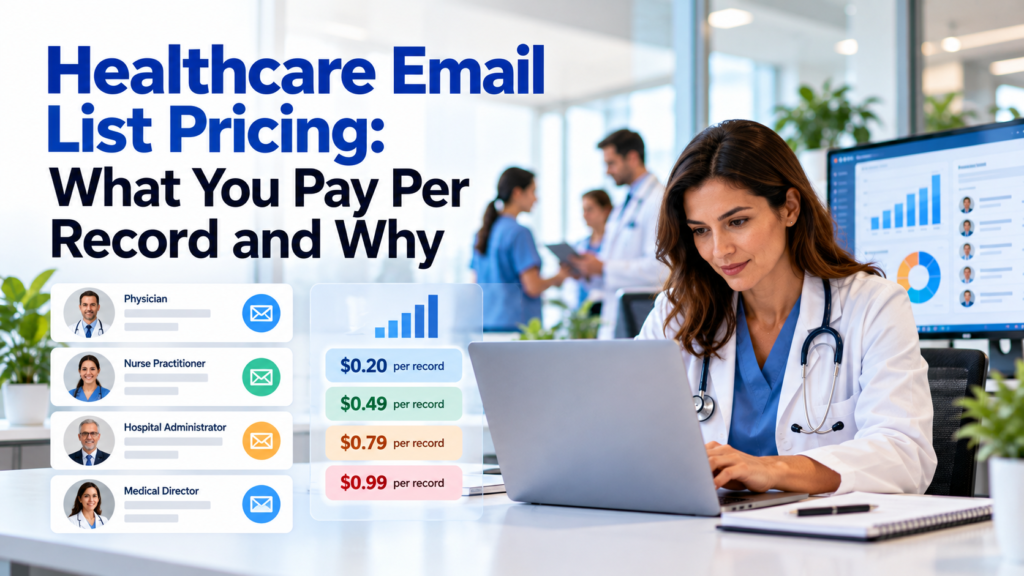
Healthcare Email List Pricing: What You Pay Per Record and Why
A company selling surgical equipment might ask for 2,000 orthopedic surgeon emails. Another company may want 2,000 hospital purchasing directors. Both requests sound like healthcare contact lists, yet the people, verification work, and data fields are different. Healthcare email list pricing means little until the buyer knows what each record contains.
Healthcare email list pricing ranges widely across published offers. Some flat-price packages advertise about $0.20 for a contact when the full allowance is delivered. A specialist’s October 2026 rate card puts certain smaller clinician-email orders at $0.79 to $0.99 per address, before processing and optional charges. Those are different products and seller quotations, not an independent market average.
This guide explains the billable unit, real price examples, specialty filters, data checking, additional fees, and usage rights. It also shows how to calculate what a usable contact actually costs. Legal requirements and email platform rules matter because an accurate address may still be unsuitable for a proposed campaign.
TL;DR:
Compare healthcare email lists by the all-in cost of unique contacts who meet your audience rules, not by the advertised price of a database row. Check whether each record has a named professional, a suitable work email, current specialty and organization details, and enough evidence to support permitted use. Larger orders can lower the quoted rate, but fixed fees and unwanted contacts change the result. Ask how emails were checked, what replacements cover, and when the data was updated. Public provider identifiers can help confirm identity, but they don’t prove an email address is accurate or give permission to send. A small sample and clear contract terms matter more than a huge record count.
What a Healthcare Email Record Actually Includes
A healthcare email list cost comparison starts with a clear billable-record definition. One seller may charge for every row with a professional’s name. Another may charge only when a usable email address accompanies a matching professional. Some suppliers count multiple addresses for one doctor as separate units. If a buyer wants unique decision-makers, those billing methods produce different results even when the file looks similar.
A verified healthcare email list should state whether the address belongs to a named person or is a general inbox such as a practice’s reception address. A generic address may serve an organization-level notice, but it usually can’t be treated as a direct contact for a named surgeon.
For a more useful comparison, classify the fields before examining the invoice. The federal NIST data framework describes quality in terms of accuracy, completeness, consistency, and timeliness. Those ideas translate into simple questions about whether the record identifies the right person and can support the intended task.
| Record component | What to check | Why it affects value |
| Person and role | Name, title, present responsibility | Confirms the intended recipient |
| Organization | Practice or hospital and location | Links contact to the right account |
| Clinical classification | Specialty or provider taxonomy | Supports role-specific targeting |
| Work address and verification date | Determines whether the address is usable | |
| Identifiers | NPI where relevant | Helps resolve duplicate clinicians |
| License terms | Permitted use and retention | Determines how the file may be used |
The cost per healthcare contact becomes misleading when a file includes duplicates, stale associations, or organizations instead of the requested individuals. Ask the supplier to distinguish total rows, distinct people, and distinct qualified email addresses.
Healthcare Email List Prices in 2026
Published seller offers show why healthcare email list pricing cannot be reduced to one standard rate. An advertised flat-price package may offer up to 2,500 contacts for $500, or $0.20 each if all 2,500 arrive. A separate specialist rate card effective October 1, 2026 lists clinician email addresses at $0.99 for 200 to 499 records and $0.79 for 500 to 999.
The flat offer may include a different collection of fields and a package limit. The specialist rate card can carry processing charges and separate premiums for selected contact types or preferences. Comparing the two as though they are identical medical records would produce a weak conclusion.
| Example offer | Advertised unit price | Important condition |
| Flat package of up to 2,500 | $0.20 at full count | Fixed $500 price even if fewer are supplied |
| Clinician email order of 200 to 499 | $0.99 | Published October 2026 volume rate |
| Clinician email order of 500 to 999 | $0.79 | Processing charge may apply |
| Clinician email order of 1,000 to 3,999 | $0.69 | Larger order band |
| Clinician email order of 8,000 to 14,999 | $0.49 | Larger order band |
| Very large clinician orders | Lower quoted rates | Contract and record definition vary |
A published healthcare email list cost is a starting point for a budget. It isn’t evidence of the data passing the buyer’s checks. Ask for the final quantity available for your selected specialties and regions. If a $500 package yields 1,600 suitable records, its effective delivered-record price is about $0.31 rather than $0.20.
Physician email list pricing also shifts when a quote covers a small niche. A broad file may have many eligible addresses, whereas a rare specialty in a defined county may have very few.
Why Specialty and Job Role Change the Price
Healthcare email list pricing changes with the kind of healthcare buyer sought. A physician may influence a clinical purchase without signing the software contract. A hospital purchasing director may evaluate suppliers but require clinical approval. A practice manager can control purchasing at an independent clinic. A list that mixes these people without clear job functions can make inexpensive records poor matches for a campaign.
Physician email list pricing depends partly on how reliably the supplier can match clinical roles to active workplaces. Orthopedic surgeons, radiologists, pediatricians, and primary care physicians should be separated by relevant classifications. Geography and practice setting also matter. A surgeon affiliated with a teaching hospital may have different purchasing responsibilities from a surgeon working in a private practice.
For many US medical specialties, the official NUCC taxonomy guide explains that taxonomy codes describe provider classifications and areas of specialization. The codes are selected by providers and don’t define license scope. A taxonomy field can assist filtering, but the buyer should still check whether it represents the role needed today.
The cost per healthcare contact should be judged against the buying decision. If a medical device company needs operating room supply managers, a general physician file may miss the relevant decision-makers. Paying more for a carefully scoped list could reduce wasted review work, but only a tested sample can establish whether the records are truly better.
A verified healthcare email list for hospital IT sales needs different fields from a clinician-focused file. Facility type, business responsibility, and current employer matter more than a medical taxonomy. Ask the vendor whether administrator records are sourced and checked separately, since the physician directory method may not cover them well.
What Public NPI Data Can and Cannot Prove
The National Provider Identifier helps explain part of healthcare email list pricing for US professionals and organizations. The number gives a consistent way to compare names and connect records from different sources. It can also help distinguish 2 professionals who share a name, although the buyer must still confirm that the matched person fits the target audience.
For public provider identity checks, the free NPI Registry provides names, reported classifications, and practice addresses for active NPI records. It does not serve as a complete list of verified business email addresses. CMS also says the issue of an NPI does not validate a provider’s current license or credentials. A vendor that cites NPI matching as proof of email accuracy is making a claim that needs separate evidence.
CMS now publishes Version 2 NPPES files, with the October 2026 download available in its monthly data. Version 2 accommodates longer names and includes reference files for additional practice locations and endpoints. Regular publication helps with identity matching, but it doesn’t confirm that a physician still works at a listed site or opens the proposed email inbox.
This is why physician email list pricing can include real work beyond obtaining public files. The supplier may connect the NPI to a recent employer, compare several reported locations, and identify a professional email address. The buyer needs to know when that association was made and how uncertain matches are handled. An NPI alone shouldn’t be counted as a verified email record.
Some sellers charge extra for license fields. The CMS clinician datasets can help cross-check certain public information, but buyers should distinguish a recorded license number from independently confirmed active licensure. Where licensure affects eligibility, use an appropriate state board or other authorized source. Never infer active practice solely from the existence of an NPI.
Why Verification Changes the Value of a List
A claim that a list is verified can refer to several different checks. A supplier may test whether the address has a valid format and whether a mail server responds. Another may confirm that the address belongs to a named professional at the relevant organization. Both activities can be useful, but neither establishes that the recipient has agreed to marketing.
An accurate match needs multiple questions answered. Does the professional currently hold the role shown? Is the organization correct? Is the email a professional contact rather than an unrelated or shared address? When was the finding checked? What does the supplier do when evidence conflicts?
The cost per healthcare contact should therefore include the cost of rejecting records that don’t meet the brief. A contact with a valid email but the wrong specialty is unusable for that project. A stale organization association can send a relevant message to the wrong employer. Removing those records before buying may be worth more than a broad email-validation promise.
Check several records manually and ask how the sample was selected. If a supplier claims that the full file is fresher than the sample, request a consistent date standard for both. Avoid assigning a quality score based only on a few handpicked contacts.
A verified healthcare email list can still perform poorly when messages are unwelcome. Address validity, legal permission, email service policy, and inbox placement are separate issues. Treat all 4 as checks in the buying decision instead of assuming that an email-validation badge solves them.
Volume Discounts, Minimum Orders, and Extra Charges
Healthcare email list pricing may fall with order size, but the total cost does not always fall at the same pace. A fixed processing charge has a much larger effect on a 200-record order than a 20,000-record order. Extra filters or field appends can also erase part of the saving from a larger volume band.
Consider a published-style example: 500 emails at $0.79 each cost $395 before fees. Add a $90 processing charge and the invoice becomes $485, or $0.97 per delivered email. That is a calculation using observed rate-card terms, not a general price guarantee. The exact fees must come from the vendor’s written quote.
Some flat packages charge for a maximum allowance rather than the exact number delivered. A $1,000 package promising up to 5,000 contacts looks like $0.20 each at full count. If only 4,000 meet the filters, the effective price is $0.25. The contract should state whether unused capacity is credited or simply part of the fixed charge.
For physician email list pricing, organization decision-maker requests, business-email-only preferences, NPI matching, geographic customization, and extra firmographic fields can change the total. The supplier may quote those items as percentages or flat amounts. A buyer should ask which are included before comparing one list against another.
Write down the invoice components: base records, minimum order, processing, enrichment, custom suppression, refresh, taxes, and license charges. A single all-in amount is easier to compare than an attractive record rate followed by several additions. It also protects the budget when the final available record count is smaller than estimated.
Calculate the Cost Per Usable Healthcare Contact
For healthcare email list pricing, the key measure is the cost per healthcare contact that passes the buyer’s rules. Start with the total invoice. Remove exact duplicates and contacts who don’t meet the agreed specialty, geography, role, and email requirements. Divide the total by the remaining distinct contacts. This answers a more useful question than the vendor’s advertised base rate.
Cost per delivered record = total invoice ÷ total records delivered.
Cost per usable contact = total invoice ÷ unique records that pass all agreed checks.
| Illustrative calculation | Amount |
| Data purchase | $1,250 |
| Processing and approved extras | $250 |
| Total invoice | $1,500 |
| Records delivered | 5,000 |
| Unique eligible contacts after checks | 3,750 |
| Cost per delivered record | $0.30 |
| Cost per usable contact | $0.40 |
These numbers are hypothetical and show the math only. They aren’t industry bounce or match benchmarks. The same method can compare a smaller carefully selected file with a much larger package. It also tells procurement exactly which record definition should appear in the acceptance criteria.
A second measure is cost per usable account. If a hospital software provider buys 20 contacts at one hospital but needs only 3 roles on its buying committee, some records may add little value. The account-level view helps explain why contact count alone isn’t a sensible result measure for every campaign.
A healthcare email list cost comparison can also include work performed by the buyer. Deduplicating a large file and researching thousands of wrong roles consumes employee time. After the campaign, measure qualified conversations using your own observed results rather than assuming that a particular record price predicts response rates.
One-Time Purchases, Licensing, and Data Appending
Healthcare email list pricing appears in several commercial models. A one-time file purchase provides a defined set of records. A credit package may let buyers retrieve contacts over time. A subscription can offer ongoing data access or periodic updates. A custom research project may be billed for a narrowly defined population. The contract determines what may be retained or reused.
A verified healthcare email list sold as a downloadable file is not always an unrestricted asset. The supplier may limit transfers to agencies, resale, the number of sends, or access after a term ends. Ask what happens to previously exported records if a license expires. Data ownership and permitted use should be explicit before purchase.
Data appending deserves a separate decision. If the buyer already has reliable professional identifiers and organizational relationships, paying to add missing work emails may be more appropriate than purchasing another full list. The useful denominator becomes successful matches to the buyer’s existing records. Unmatched input rows shouldn’t be treated as completed results unless the agreement says so.
For broader public provider and facility research, the CMS Provider Data Catalog offers public datasets covering providers and facilities. These can help buyers cross-check parts of their existing organization or clinician files, although they don’t replace professionally verified outreach email data. Public access to an identity record also doesn’t settle marketing permissions or commercial licensing questions for enriched datasets.
The healthcare email list cost of a subscription should be evaluated against actual usage. A credit plan might offer a low nominal rate while unused credits expire. A yearly agreement may be sensible for regularly refreshed segments but wasteful for a single campaign. Buyers should compare usable exports over the contract period rather than the maximum number theoretically available.
Test the Sample Against the Exact Buying Brief
A small sample matters to healthcare email list pricing only when it represents the audience the buyer will purchase. A hospital executive sample can’t establish the quality of a state-specific physician list. Likewise, 10 excellent records selected by a salesperson don’t prove that the whole file will have the same accuracy. Define how the sample should be selected and what happens if it fails.
For physician email list pricing, a sample review should cover current role, specialty, practice location, and a plausible professional email association. The buyer should cross-check against suitable authoritative sources where available. If the list relies on a named affiliation, confirm the affiliation rather than stopping at an NPI match.
A verified healthcare email list may pass a technical validation and still contain irrelevant professionals. Give the sample to someone who understands the campaign. Ask whether those individuals can reasonably use, recommend, or purchase the product being promoted. This simple review often catches targeting mistakes that an email checker cannot find.
A sample acceptance plan could use these steps:
1. Set the population and exclusions in writing.
2. Ask for randomly selected records from the proposed segment.
3. Check identity, job responsibility, and work email association.
4. Record ambiguous or failed matches without silently replacing them.
5. Agree on a minimum acceptable result and remedy before ordering.
The cost per healthcare contact should be recalculated if the delivered file doesn’t resemble the approved sample. The contract may permit replacement records, credits, or another remedy. Confirm the response deadline and whether the buyer must provide failure evidence in a particular format.
Email Rules That Can Change the Value of a Purchase
Healthcare email list pricing should account for legal and sending rules before a file is used. US commercial email rules differ from those in Canada and the UK. The rules may also change according to whether the recipient is a business organization or an individual professional operating as a sole trader. A seller’s generic compliance claim can’t substitute for an analysis of the intended campaign.
United States: Commercial Email and Patient Data
For US commercial healthcare outreach, the FTC’s CAN-SPAM business guide states that the law covers commercial B2B email as well as consumer messages. It requires truthful sender information, nondeceptive subjects, a valid postal address, and a working opt-out process, among other duties. US CAN-SPAM doesn’t generally require advance opt-in for commercial email, but suppression and lawful acquisition still matter.
When addressing purchased email lists, the FTC explains risks in its purchased-list warning, the FTC explains that bought addresses may include people who already opted out or were collected by unlawful means. Companies remain responsible for campaigns sent on their behalf. A low-priced list that includes previously suppressed contacts can create a serious operational problem.
Professional business contacts must also be kept separate from patient health information. HHS’s HIPAA marketing guidance explains limits on sharing protected health information for third-party marketing. A list of public professional contact details isn’t automatically patient PHI simply because the individuals work in healthcare. The origin and actual contents of the file determine what rules apply.
International Healthcare Campaigns
For UK contacts, the Information Commissioner’s Office B2B marketing guidance distinguishes corporate subscribers from sole traders and some partnerships. UK GDPR can still apply to identifiable business contacts. The ICO notes that its guidance is under review, so buyers should confirm the current rule before using the file.
For Canadian email recipients, the relevant regulator’s CASL consent guidance explains that commercial electronic messages generally need consent, identification, and an unsubscribe method. An implied-consent exception based on a published address has specific conditions, including relevance to the person’s role. Purchasing a contact doesn’t establish those conditions on its own.
The cost per healthcare contact becomes irrelevant when the contact cannot lawfully or appropriately be approached through the proposed channel. Buyers should exclude records that cannot meet the intended use requirements before comparing vendor quotes.
What an Email Deliverability Guarantee Really Covers
A 95% deliverability claim can change how healthcare email list pricing looks, but its meaning depends on the contract. A seller may promise to replace addresses that hard bounce within a defined window. Another may refund part of the invoice after receiving a qualifying bounce report. Neither promise establishes an inbox placement rate, an open rate, or permission to contact the recipient.
For a verified healthcare email list, ask which failures count toward the guarantee. Does it cover a wrong professional association? An old employer? A role outside the selected specialty? Or only a hard bounce? The answer determines how much protection the buyer receives if the file passes a basic technical check but fails the campaign brief.
For platform rules affecting campaign delivery, Google’s sender guidelines advise against purchasing addresses and contacting people who didn’t sign up to receive messages. The guidance also explains authentication and spam-rate requirements for mail sent to personal Gmail accounts. A list vendor’s bounce guarantee cannot override the policies of the service used to send email or the recipient’s provider.
Before launch, check that the sending platform permits the intended use. Keep the company’s own suppression records current and make opt-outs work. No supplier should promise a campaign’s delivery result without knowing the sender’s reputation and the recipients’ responses.
Physician email list pricing should not be judged by a deliverability percentage alone. The buyer needs a written definition and a remedy that applies to the quality problems most likely to affect the chosen audience. A replacement address for the wrong physician doesn’t solve a specialty targeting mistake.
Match the List to the Campaign’s Actual Buyer
Healthcare email list pricing has meaning only when the records match the task. A laboratory software company contacting practice owners has different requirements from a medical equipment company contacting hospital procurement teams. The product’s buying process should guide the record selection before a vendor quotes the count.
A verified healthcare email list for specialty physicians should distinguish clinical influence from purchasing authority. Surgeons may influence equipment selection, while purchasing teams negotiate contracts. Sending every message to the same type of contact can miss the people who approve the purchase. A smaller group covering the actual decision roles may be more useful than a large physician-only file.
The buyer should decide whether the campaign targets individuals or accounts. For account-based outreach, count unique eligible hospitals and the relevant people at each. For clinical education, specialty and permitted communication may be more important than purchasing titles. For staffing, active practice and current employment are important because a clinician may have moved.
The cost per healthcare contact should be assessed against that precise audience. The NPI taxonomy definitions provide a reference for provider classifications, but they do not establish purchasing responsibility. A procurement contact needs business-role confirmation beyond a clinician’s classification.
Don’t buy extra fields simply because they exist. NPI may be essential for matching physician records but less useful for certain nonclinical executives. LinkedIn profile URLs or direct phone numbers should be considered only when permitted use and campaign requirements justify their expense.
Compare Quotes Without Guessing About Quality
The final comparison should use the same buying brief for every vendor. Ask each supplier for the population definition, estimated available count, a sample, the record and email billing unit, all fees, and the license period. An offer cannot be fairly assessed if one supplier quotes all hospital employees and another quotes only purchasing managers.
Healthcare email list pricing should be compared at 3 levels: what the supplier says each record costs, what the full invoice costs per delivered record, and what the file costs after the buyer’s agreed quality checks. Keep those numbers separate so a good advertised rate doesn’t hide a weak match to the intended audience.
| Quote question | What a clear response includes |
| What is billable? | Named professional, distinct email, or database row |
| Who qualifies? | Specialty, role, geography, and organization rules |
| What has been checked? | Method, source category, and date |
| What costs extra? | Processing, enrichment, suppression, and refresh |
| What may we do with it? | Use, sharing, retention, and license restrictions |
| What if it fails? | Definition of defect, evidence, and remedy |
Supplier review should also cover data handling. The July 2026 NIST due-diligence guide addresses structured supplier investigation for technology supply chains. Applying that principle to a contact-data purchase, buyers can separately ask about access controls, subcontractors, delivery security, and deletion procedures. These are buyer checks, not a contact-list checklist published by NIST.
A fair healthcare email list cost reflects records that match the task, a transparent contract, and a remedy for defined failures. When a supplier cannot explain the record count or the data checking process, a lower price should not be treated as proof of value.
What a Fair Price Means for Your Business
Healthcare email list pricing should end with the buyer’s own requirements. A supplier can offer a low per-record rate and still deliver a poor fit. Another may charge more but provide current roles and cleaner organizational matches. Neither conclusion can be made from the rate alone. The meaningful measure is the cost of contacts that pass the agreed checks and can be used under the applicable rules.
A verified healthcare email list should come with a clear definition of the fields, checking method, update date, and permissible use. Physician email list pricing should reflect the selected specialty and the type of professional address supplied. The healthcare email list cost should include processing charges and any extra services before buyers compare it with another offer.
The cost per healthcare contact becomes useful when all suppliers are evaluated using the same criteria. Apply the checks to a sample, verify the contract, and calculate the final cost from eligible records rather than advertised rows. That makes the purchase decision easier to defend and reduces the risk of paying for contacts the campaign cannot use.
Frequently Asked Questions
How Much Does a Healthcare Email List Cost in 2026?
Published 2026 offers vary by quantity and data type. Some flat packages advertise around $0.20 per contact at full allocation, while a clinician-email rate card lists $0.79 to $0.99 for small orders before fees. These are seller examples rather than a verified market average.
What Is the Average Price Per Healthcare Email Record?
No independent average covers every specialty and vendor model. A meaningful comparison needs the billable record definition, audience filters, and all additional fees. Calculate the effective price using the final invoice and the number of contacts meeting the agreed requirements.
Why Can Physician Email Lists Cost More?
Narrow specialties and current workplace matching may require additional research. A general clinician list can be easier to compile than a defined group of specialists at named hospitals. Charges also depend on the supplier’s verification and licensing model.
Does Buying More Contacts Always Lower the Cost?
Some published rate cards reduce the unit price at higher volumes, but fixed packages and added fees can change the outcome. If a large order contains many irrelevant records, the effective price per eligible contact may still be high.
What Fields Should a Healthcare Email Record Contain?
A useful professional record generally identifies the person, current organization, role, work email, and relevant geography. Physician records may include an NPI and specialty. The required fields depend on the buyer’s audience and the agreed billing unit.
What Does Verified Healthcare Email Mean?
It should mean that specified checks were completed, with a stated method and date. Technical email validation is different from confirming the professional’s current role. Verification also doesn’t establish consent or guarantee that a message reaches the inbox.
Do Free NPI Files Include Verified Physician Emails?
CMS provides public provider identity and taxonomy information through NPPES. It isn’t a ready-made file of confirmed outreach emails. An NPI also doesn’t establish that a clinician has an active license or currently works at a particular practice.
Why Are Hospital Executive Contacts Priced Differently?
Hospital executives may need to be identified through organization roles and recent employment information rather than provider taxonomy. Some vendors price administrative decision-makers separately. Buyers should check the actual record type instead of assuming that every healthcare contact uses the same rate.
Which Extra Fees Should Buyers Expect?
Possible charges include minimum order fees, file processing, specialty filters, custom suppression, added fields, matching, and refresh services. They aren’t universal. The supplier should state which services are included and provide a total quote before payment.
How Do Healthcare Email List Credit Plans Work?
A credit plan usually allows records to be drawn over an agreed period. Buyers should check expiration dates, eligible data types, unused credit rules, minimum downloads, and whether repeated exports consume additional credits. Compare the cost of actual usable exports.
Is Email Appending Cheaper Than Buying a New List?
It can be, when the buyer already has reliable target contacts and needs missing email fields. The result depends on match coverage, fees, and the number of usable addresses returned. A low price per input row can be misleading if very few rows are matched.
How Do You Calculate Cost Per Usable Contact?
Divide the full invoice, including approved extras, by the unique contacts that meet the agreed audience and email requirements. Exclude duplicates and failed matches. Keep this measure separate from the vendor’s cost per delivered row.
What Does a Deliverability Guarantee Cover?
The contract may provide replacement or credit for certain bounced addresses within a reporting window. It may exclude wrong roles or stale affiliations. A bounce guarantee doesn’t establish inbox placement, response, or permission to send marketing messages.
Is Buying Healthcare Professional Email Lists Legal?
The answer depends on how the data was obtained, the recipient’s location, and the planned use. US CAN-SPAM governs commercial B2B email, while UK and Canadian rules differ. Patient health information raises separate privacy issues. Buyers should review applicable rules before sending.
What Should Buyers Check Before Purchasing?
Define the exact audience and billable unit. Check a sample, verification dates, all fees, usage rights, and the remedy for bad records. Calculate cost per usable contact and confirm that the sending platform and planned campaign allow the intended use.