
Nurse Practitioner Email List: Who’s on It and How to Use It Compliantly
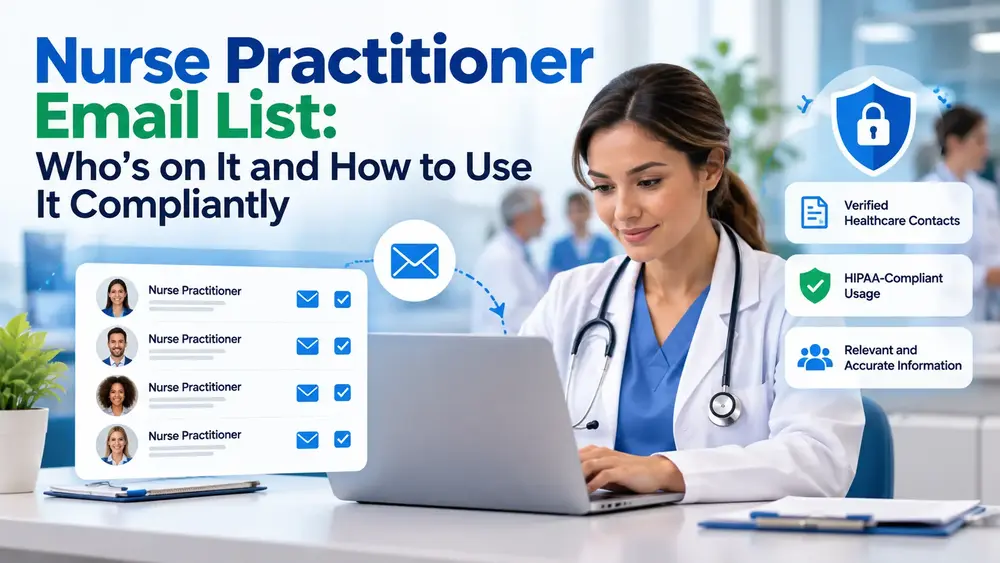
A nurse practitioner email list can help healthcare marketers reach clinicians who assess patients, prescribe within their state authority, and influence purchasing decisions at their practices. But a file labeled “NP contacts” tells you little about its accuracy or whether you may use each address for outreach. A practitioner may have moved employers, changed specialties, or used a personal address that was never intended for unsolicited campaigns.
For healthcare professional email database buyers, the useful question is who is actually in the file, where the contact details came from, and which messages can lawfully reach them. That matters for companies offering clinical education, equipment, recruiting services, research invitations, or software to healthcare organizations. A carefully scoped nurse practitioner email list can support relevant communication; a poorly sourced one creates privacy concerns and wasted effort.
TL;DR
A nurse practitioner email list usually contains professional contact details for licensed or credentialed nurse practitioners, along with fields such as specialty, location, employer, and practice setting. Coverage and permission vary by source. Check the practitioner’s current role and the origin of each address before using it. In the United States, commercial B2B email generally falls under CAN-SPAM, which requires truthful headers, a postal address, a functioning opt-out method, and timely suppression of unsubscribers. HIPAA is mainly relevant when protected patient information is involved, while other countries may require consent before marketing. Start with a small, relevant segment, respect objections, and measure meaningful replies rather than the size of the file.
What a Nurse Practitioner Email List Actually Contains
A nurse practitioner email list is a collection of contact records associated with advanced practice clinicians who work as nurse practitioners. It may be built from professional directories, healthcare organization websites, direct registrations, event signups, or information supplied by the clinicians themselves. The same title on a vendor’s website can refer to very different data: a list of named clinicians with verified work emails, a directory of practices with generic inboxes, or an older database assembled from several sources.
A useful record states both identity and context. Nurse practitioner contacts need both details to make a relevant message possible. Name, professional designation, organization, practice location, and email address help identify a person. A specialty, practice setting, or job role makes it possible to decide whether the proposed message belongs in that person’s workday. A healthcare professional email database should also record when information was last checked and how its origin can be explained.
Typical Contact Fields
Common fields include full name, work email, organization name, city, state, postal code, practice address, phone number, specialty, and NPI when available. Some datasets add clinical focus, employer type, estimated seniority, or a link to the public source. These additions are useful only if the supplier can explain how they were determined and how often they change.
In a healthcare professional email database, an email field deserves special attention. A practice-level address such as info@clinic.example is different from a verified address used by a named practitioner. A guessed pattern based on a colleague’s email address may never have been confirmed. A personal mailbox might be accurate but still be inappropriate for business outreach, depending on applicable law and expectations. Treat those distinctions as part of the record, rather than hiding them behind a single “valid” label.
You also need to know what the list excludes. A nurse practitioner email list shouldn’t quietly mix registered nurses, physician assistants, nurse anesthetists, and nurse midwives merely to increase its apparent count. Those roles overlap in clinical settings but have different training paths and responsibilities. The registered nurse profile describes the separate RN occupation, which helps prevent loose title matching. An inclusive advanced practice nursing directory is useful for some campaigns; it is not equivalent to a file limited to NPs.
Who Is on the List and Why Roles Matter
Nurse practitioners provide primary or specialty care across many settings. The BLS occupation profile describes their work in assessment, diagnosis, and treatment, while noting that scope of practice varies across states. The employment projections also put NP hiring among occupations with substantial projected job additions. The role affects which messages are relevant. A clinical education invitation may fit a practicing specialist, while a scheduling platform may be reviewed by the practice administrator rather than the NP alone.
Primary Care and Population-Focused Roles
Family nurse practitioners often care for patients across age groups, while adult-gerontology practitioners focus on adult or older populations. Pediatric and women’s health practitioners work with different patient groups. Psychiatric-mental health NPs assess and manage mental health conditions within their training and state authority. An NP working in acute care may have very different needs from one working in a retail clinic or independent outpatient practice.
Do not infer someone’s current specialty from an old certification record alone. Credentials, public profiles, and actual practice responsibilities can differ. A clinician may hold multiple credentials, teach part-time, or move from clinical work to an operational role. When nurse practitioner contacts are split by specialty, the selection criteria should be transparent enough for a reviewer to challenge an incorrect label.
Decision Makers and Clinical Influencers
A list may contain employed clinicians, practice owners, medical directors, educators, and NPs who participate in purchasing committees. The presence of a professional title does not prove budget authority. A hospital-employed NP may help evaluate patient care tools but have no role in signing the contract. For expensive products, use organization data to identify the actual purchasing path rather than calling every practitioner a buyer.
The AANP overview explains the breadth of NP practice across primary, acute, and specialty care. That breadth is the reason a single campaign sent to the entire file often feels misplaced. Segment by a genuine reason for contact, not by title alone. A more focused nurse practitioner email list is easier to review for relevance and less likely to burden people outside the intended audience.
How Nurse Practitioner Contacts Are Collected
Healthcare contact data can begin with first-party registrations, publicly available professional profiles, licensed directory feeds, or manually researched practice websites. It can also pass through resellers that combine sources. These collection paths differ in accuracy and permission. A vendor’s statement that an address is “publicly available” does not establish that the recipient expects promotional email or that all uses are lawful.
For healthcare email marketing, a first-party signup is comparatively easy to explain when the clinician knowingly provided a work address for a stated purpose. Even there, record the wording presented at signup and whether the request covered marketing. A webinar registration for a single educational session shouldn’t automatically be treated as permission for an unrelated series of product advertisements in every market.
Public directories serve another purpose. CMS makes NPI records available through its data dissemination program, which explains that listed information is publicly disclosed under federal records rules. Public disclosure helps users identify providers; it doesn’t automatically authorize every form of marketing outreach. A compliance review still needs to address the source, destination country, purpose, and data use.
NPI Information Is Not an Email Permission Record
An NPI identifies a healthcare provider for administrative transactions. Its presence can support identity matching but should never be used as proof of a current license, clinical specialty, permission to email, or active employment. CMS specifically warns in its NPI file guidance that receiving an NPI does not itself validate licensure or credentials. The public files and related endpoints also aren’t a substitute for a confirmed promotional email address.
Ask a supplier whether addresses came directly from practitioners, practice sites, licensed partners, inferred patterns, or previous buyers. If it cannot distinguish those origins, you cannot make a meaningful risk decision. A healthcare professional email database with fewer records and known provenance is often more usable than an unexplained bulk export.
Which Fields Make a List Useful for Targeting
A good segment starts with a clear topic and the clinical or business context that makes the topic relevant. Geographic location matters when a service is offered only in certain states. Specialty matters when training or equipment addresses a defined clinical area. Practice setting matters when a product works only in a hospital, outpatient office, or telehealth operation. For an NP mailing list, each field should help explain why that recipient belongs in a campaign.
Work email is an operational field, but it isn’t sufficient by itself. Collect practice domain, organization type, employment status when reasonably verified, professional focus, and the last confirmed source. Separate mailing address from practice location when they differ. A person may work across 2 facilities and receive correspondence through one central office.
Segment by a Real Use Case
For an educational event about pediatric assessment, begin with practitioners whose current work involves pediatrics. For staffing outreach, identify candidates who have shown interest in opportunities instead of assuming all employed NPs want recruiting messages. For a practice administration product, connect the NP’s role to the relevant employer and seek the proper operational decision maker. Each choice reduces irrelevant messages.
Avoid sensitive inferences. A nurse practitioner’s professional specialty does not reveal a particular patient’s diagnosis, and a marketer should not build a segment from patient lists or treatment histories without a lawful basis. Keep contact profiles focused on professional attributes required for the stated purpose. That limit also reduces the risk of storing information you cannot defend later.
How to Check Accuracy Before Using the Data
Accuracy for nurse practitioner contacts needs more than a one-time mailbox test. An address can accept mail while the practitioner has left the organization. A valid domain can belong to an entirely different practice. An NP mailing list might name a clinician twice under maiden and current names. Checking a nurse practitioner email list means verifying the person, the organization, the professional context, and the address’s status separately.
Start by deduplicating records using several fields. Exact email matches are useful, but they miss changed domains. Name plus NPI and practice details can help identify possible duplicates, with manual review when records conflict. Do not merge 2 people merely because they have similar names and work in the same city.
Review a sample from every major source and segment. Inspect current practice pages or other authoritative professional records, note out-of-date employers, and distinguish confirmed addresses from inferred ones. The sample should include rural and small practices if the full file claims national coverage. A database that performs well for large health systems may be weak for solo practices.
Ask What “Verified” Means
Vendors use the word verified for different checks. Some confirm only that email syntax and domain records look plausible. Others test whether an address can receive a message. A stronger check ties the address to a current named professional and explains when that connection was last observed. None of these checks amounts to consent.
Obtain a written field dictionary and an update policy. Ask how bounced addresses, job changes, departures, and objections are removed. If the nurse practitioner contacts are advertised as recent, request the date of the latest actual verification rather than the export date. A fresh download of old records is still old data.
Keep a reject category for nurse practitioner contacts that aren’t safe to use. Missing provenance, personal email where inappropriate, inconsistent identity, previous opt-out, or a doubtful role should block automatic upload. Trying to rescue every record can cost more than excluding a small uncertain portion.
What U.S. CAN-SPAM Rules Require
In healthcare email marketing, the United States generally does not require prior opt-in for every commercial B2B email, but that doesn’t make bought contacts unrestricted. The FTC’s CAN-SPAM compliance guide states that the law applies to business-to-business commercial messages and not only mass campaigns. One promotional email to a nurse practitioner can qualify. The purpose and content of the message determine whether it is commercial.
Commercial messages must use accurate header information and subject lines that reflect their content. The sender needs a valid physical postal address, an accessible way to stop future marketing, and clear identification of advertising when required. Opt-out requests must be honored within 10 business days. The mechanism must stay operational for at least 30 days after sending, and recipients must not be forced through multiple steps or asked for extra personal details to unsubscribe.
A purchased healthcare email marketing list is not a shield against these duties. The organization promoting the product can remain responsible even when an agency writes and sends the campaign. Contracts should state who maintains suppression records, handles replies, and processes opt-outs, but responsibility cannot simply be assigned away.
Commercial Versus Transactional Messages
An appointment confirmation sent as part of an existing relationship is different from an unsolicited product pitch. A marketing email doesn’t become transactional because it contains a useful article. The FTC’s primary-purpose explanation looks at how recipients would reasonably understand the subject and the content. Treat invitations that mainly promote a product, trial, or purchase as commercial outreach.
Make the sender identity plain. If a vendor reaches a clinician on behalf of a software company, don’t imply that the message came from the clinician’s employer or a professional association. An accurate sender name and clear relationship help recipients judge the email without opening attachments or investigating an unknown domain.
State and other privacy laws may add obligations depending on the data and parties involved. CAN-SPAM is a federal email framework, not a universal authorization to collect or process any professional address in any way. For cross-border contact files, the next layer of review is essential.
Related reading: B2B Email Bounce Rate Benchmark: Data From 350 Million Records
Where HIPAA Applies and Where It Does Not
A professional contact record for an NP is generally different from protected health information about a patient. HIPAA doesn’t automatically prohibit a business from emailing a clinician at a work address. Yet invoking HIPAA as a blanket endorsement for a nurse practitioner email list would be equally wrong. Its scope depends on who holds the information, what it identifies, and how it is used or disclosed.
The HHS Privacy Rule summary describes the framework for protected health information held by covered entities and their business associates. An NP’s public work email, by itself, isn’t a patient’s treatment record. A patient name combined with diagnoses or treatment details is a very different category and should not be transferred into marketing contact systems merely because a clinician appears in both environments.
Avoid Patient-Derived Marketing Lists
Consider a manufacturer that wants to contact providers who treat a particular condition. Identifying relevant clinicians from their published specialty and practice information is different from using a hospital’s identifiable patient records to identify which providers treat named patients. The latter can involve protected information and disclosure limits. A commercial contact supplier should be able to explain that patient records weren’t used improperly to construct its audience. The HHS patient marketing example makes clear why selling a patient-derived contact list can raise authorization issues.
HHS’s HIPAA marketing guidance explains that uses or disclosures of protected health information for marketing generally need authorization unless an applicable exception applies. Don’t confuse a provider’s permission to receive professional email with a patient’s authorization for use of health information. These are separate legal questions.
Healthcare campaigns also need careful content practices. Never put patient names, appointment details, or case-specific health information into a promotional email or tracking field unless there is a separately reviewed lawful reason. Educational scenarios should be fictional or properly de-identified. When a message requests patient referrals or clinical data, privacy review becomes more urgent than list quality.
International Rules for Healthcare Email Outreach
Cross-border healthcare email marketing needs a jurisdiction-specific review. The recipient’s location matters, and rules may also depend on the sender’s establishment, organization type, and how the address was obtained. An NP mailing list assembled for the United States shouldn’t be reused unchanged for Canadian or British recipients simply because the language of the message is the same.
In Canada, commercial electronic messages usually require consent, sender identification, and an unsubscribe mechanism. The CRTC’s CASL consent guidance explains express and implied consent and the limits on relying on them. A business relationship or publicly posted address may create a narrow basis in specific circumstances, but those exceptions have conditions. A broker’s broad claim that an entire Canadian file has “implied consent” needs evidence for each relevant category.
In the United Kingdom, electronic marketing rules distinguish certain corporate subscribers from individual subscribers, while privacy law still applies when an address identifies a person. The ICO’s updated email marketing guidance explains the PECR framework and the need to consider wider data protection duties. Don’t treat an NP’s named work address as outside privacy rules merely because the domain belongs to an employer.
For European Economic Area contacts, GDPR obligations may arise when processing identifiable professional information, including transparency and lawful-basis requirements. Consent isn’t the only possible basis for processing, but email-marketing rules still need to be considered separately. A cross-border campaign should document the relevant countries, permissible channels, collection notices, and suppression choices before launch.
When legal review doesn’t support outreach to a segment, exclude it. Sending a test batch to see whether recipients object isn’t a legal assessment. Store a jurisdiction field in the healthcare professional email database so downstream teams can’t accidentally combine incompatible contact groups.
How to Choose a Data Supplier Responsibly
The strongest supplier is the one that answers specific questions with evidence. Ask where the records originated, which source categories are used, whether addresses were provided directly, and whether the seller has rights to provide the data for your intended use. A sample file should reflect the actual segment you plan to purchase, not a handpicked group from unrelated specialties.
Request a clear contract that identifies permitted uses, prohibited onward transfers, data update commitments, security controls, and deletion requirements. A vague promise of “compliance” isn’t sufficient. Ask how complaints are handled and whether the supplier maintains a suppression program that prevents a person who objected to future use from being sold again through another export.
Review These Questions Before Purchase
· Does the file contain named NPs rather than mixed nursing roles?
· Which fields were directly observed, inferred, or purchased from another source?
· When were identity, employer, and address last checked?
Related reading: HR Decision Makers Email List: CHROs, HR Directors, and Benefits Leaders
· Can the supplier identify records that came from direct registrations?
· Are personal mailboxes separated from work addresses?
· How are duplicates, departures, and previous objections handled?
· What uses does the contract permit in each destination country?
· Can records be deleted and later excluded from replacement deliveries?
Compare healthcare professional email database suppliers using a small, representative quality review rather than total advertised contacts alone. Consider the percentage with a confirmed specialty, current employer, and usable professional address. Don’t accept an unexplained deliverability guarantee as proof that a nurse practitioner email list has valid permission for your campaign.
Also define ownership after purchase. Your team needs to secure the file, limit access, enforce deletion periods, and carry suppression records forward. If a partner or agency changes, the opt-out history must not disappear with it. Procurement and campaign operations should agree on these controls before importing the contacts.
How to Use the List for Relevant Campaigns
A nurse practitioner email list is most useful when the message matches a specific professional need. A continuing education provider might invite pediatric NPs to a clearly described program. A clinical software company might share a short explanation of a workflow change with practitioners working in settings where the tool applies. A research group may invite qualified clinicians to consider a survey, subject to its research and contact rules.
Do the targeting work before writing the email. Select a narrow audience, document why it fits, and make the recipient’s likely role clear. When nurse practitioner contacts include both independent practice owners and hospital employees, different buying paths may require different messages. Don’t imply budget authority, current specialty, or clinical preference that you haven’t confirmed.
Write a Message a Clinician Can Assess Quickly
Use a truthful subject line that names the topic without false urgency. Identify the sender and why the message is relevant to the recipient’s professional role. State what the material contains and what action, if any, is involved. Avoid unsupported claims that a product improves patient outcomes, reduces clinical risk, or meets a regulatory standard. Clinical claims may create obligations beyond email law.
A useful outreach message may be short: it can describe a published education session, state the audience for whom it was designed, and provide a way to decline future messages. An NP mailing list should never be treated as permission to bombard the same clinician with reminders when there is no response. Set a reasonable contact limit and stop when someone objects.
For recruitment messages, make the job location, clinical setting, and employment model clear before asking for a conversation. Don’t assume that clinicians are actively seeking work. For survey invitations, disclose who sponsors the study, what participation involves, and how responses will be treated. If a professional incentive is offered, review the applicable organizational policies and industry rules before promising it.
Avoid routing recipients to forms that collect patient details or unnecessary sensitive information. Keep campaign landing pages focused on professional interest. A healthcare professional email database should support a clear business purpose, not become a bridge into confidential clinical systems.
Run a Controlled Pilot and Measure Useful Outcomes
A small healthcare email marketing pilot helps identify bad targeting before a whole file is used. Select records whose source and role have been reviewed, apply the jurisdiction rules, and exclude anyone already on the suppression list. Record the audience definition, sender identity, message version, and date. Use a reasonable volume for the NP mailing list and the sender’s domain and infrastructure without treating technical inbox acceptance as consent.
Track delivery failures and direct replies. A hard bounce may signal an outdated mailbox; a complaint indicates a message that shouldn’t be repeated to that recipient. Replies saying “wrong specialty” or “no longer at this practice” are valuable correction signals. Update the contact record instead of leaving the same error for the next campaign.
Measure the Right Outcome
Open rates are a weak guide because privacy tools and mailbox behavior can affect tracking. A click also doesn’t prove professional fit. Look for informed replies, relevant registrations, qualified discussions, and explicit reasons for rejection. Review outcomes by specialty and source category. If one source causes most of the failures, pause it rather than changing the wording for every other audience.
Separate sales value from operational risk. A campaign that creates a few meetings but generates many complaints may damage future sender trust and burden clinicians. The goal is to reach the right professionals with an appropriate message while preserving their ability to say no. That is a more durable measure than the number of addresses uploaded.
Document lessons after each pilot: which fields were accurate, which segment had a genuine reason to receive the content, and which source needs attention. Use those findings to revise the audience definition, not to create ever more speculative personal attributes.
Keep Records Current and Respect Opt-Outs
Maintaining a nurse practitioner email list is an ongoing responsibility. Practitioners change employers, take new roles, retire, and move between settings. Create a schedule for reviewing important fields in the healthcare professional email database and prioritize records associated with bounced messages or complaints. The objective is a current professional directory with clear use limits, not a file that grows indefinitely.
For healthcare email marketing, suppression is different from ordinary deletion. If a recipient opts out, keep the minimum information necessary to prevent accidental future marketing, handled in line with the applicable rules. Removing every trace of the address from one campaign system without preserving an exclusion record can cause the same person to be contacted again after the next data purchase.
The FTC explains in its unsubscribe requirements that senders must honor opt-outs promptly and cannot sell or transfer opted-out addresses except for limited compliance purposes. Build a process that applies objections across connected tools and agencies. An email preference center is useful only when its choices actually reach every sending system involved.
Set appropriate NP mailing list retention periods and access controls. Contact data should be available only to teams with a defined purpose. Store provenance and suppression status separately from unnecessary personal notes. If someone challenges the source of an address, your staff should be able to answer without guessing or revealing unrelated records.
What Compliant Use Looks Like in Practice
In healthcare email marketing, a nurse practitioner email list is a starting set of professional contacts, not an automatic audience for every healthcare product. The strongest approach connects a verified role to a relevant message, then checks the legal requirements for that recipient and channel. It also recognizes when a generic clinic inbox or another decision maker is more appropriate than a named clinician.
The list’s value comes from current records, known provenance, restrained use, and a reliable way to stop future outreach. If those basics cannot be established, buying more contacts won’t fix the underlying problem. A smaller NP mailing list with a defensible purpose can be a better business asset than a large file that nobody can explain.
FAQs
What Is a Nurse Practitioner Email List?
It is a collection of professional contact records associated with nurse practitioners. Depending on the source, records may include names, work emails, employers, practice locations, and specialties. The list label alone doesn’t establish accuracy or permission to send marketing messages.
Are Nurse Practitioners Different From Registered Nurses?
Yes. Nurse practitioners are advanced practice registered nurses with graduate-level preparation and additional licensure requirements. A general RN directory shouldn’t be presented as an NP-only audience. Confirm professional designations before targeting a clinical specialty.
Does an NPI Prove That an Email Address Is Valid?
No. An NPI helps identify a healthcare provider but doesn’t confirm that a mailbox is current or associated with that person. It also doesn’t prove present licensure, employment, or marketing consent.
Related reading: How much does B2B SEO cost in 2026: retainer pricing by company size
Can I Buy a Nurse Practitioner Email List Legally?
Purchasing professional contact data isn’t automatically prohibited in the United States, but the collection, transfer, and intended use must satisfy applicable laws and contracts. Ask for source evidence and review recipient jurisdictions before sending commercial email.
Does CAN-SPAM Apply to B2B Healthcare Emails?
Yes. The US CAN-SPAM Act applies to commercial B2B email. Use accurate headers and subjects, include your postal address and an effective unsubscribe method, and honor opt-out requests within the required period.
Do I Need Consent Before Emailing US Nurse Practitioners?
CAN-SPAM generally doesn’t require prior opt-in for every US commercial B2B email. Other privacy rules, source restrictions, state laws, or contractual commitments may matter. An available address doesn’t establish unrestricted permission.
Does HIPAA Ban Emails to Nurse Practitioners?
No. A clinician’s professional email address isn’t automatically protected patient information. HIPAA may apply when covered entities or business associates use or disclose protected health information, particularly patient-derived marketing data.
Can I Use Patient Data to Find NPs Who Treat a Condition?
Don’t use identifiable patient records for marketing research without a separately established lawful basis and appropriate authorization where required. Publicly documented professional specialties are different from confidential patient treatment histories.
What Specialties Can Be Included?
Common categories include family practice, adult-gerontology, pediatrics, psychiatric-mental health, women’s health, and acute care. Check the source and date of every specialty label because professional roles can change.
How Do I Know Whether a Supplier’s Data Is Accurate?
Request a field dictionary, sourcing explanation, verification dates, and a representative sample. Check whether work emails connect to current clinicians and organizations. A successful technical email check alone doesn’t prove identity or consent.
Is a Work Email Safer to Use Than a Personal Email?
A work address is often more suitable for relevant professional communication, but it isn’t exempt from marketing or privacy rules. A personal mailbox requires added caution, especially when its collection source or intended use is unclear.
Can the Same List Be Used in Canada or the UK?
Not without separate review. Canada generally requires consent for commercial electronic messages subject to defined exceptions. UK marketing rules distinguish subscriber categories and work alongside data protection requirements. Assess each country before mailing.
How Should I Segment NP Contacts?
Use current professional attributes that connect directly to the message, such as specialty, practice setting, location, and verified role. Avoid unrelated personal inferences and don’t assume every NP has purchasing authority.
What Should Happen When Someone Unsubscribes?
Stop the affected marketing messages within the applicable deadline and keep a minimal suppression record so the address isn’t reintroduced through another file. Apply the choice across agencies and sending platforms.
Which Results Matter More Than Email Opens?
Measure relevant replies, qualified registrations, accurate role matches, complaint patterns, and corrected records. Open tracking is imperfect and isn’t a reliable measure of a clinician’s interest on its own.


1 thought on “Nurse Practitioner Email List: Who’s on It and How to Use It Compliantly”