What should A Nurses Email List Actually Include
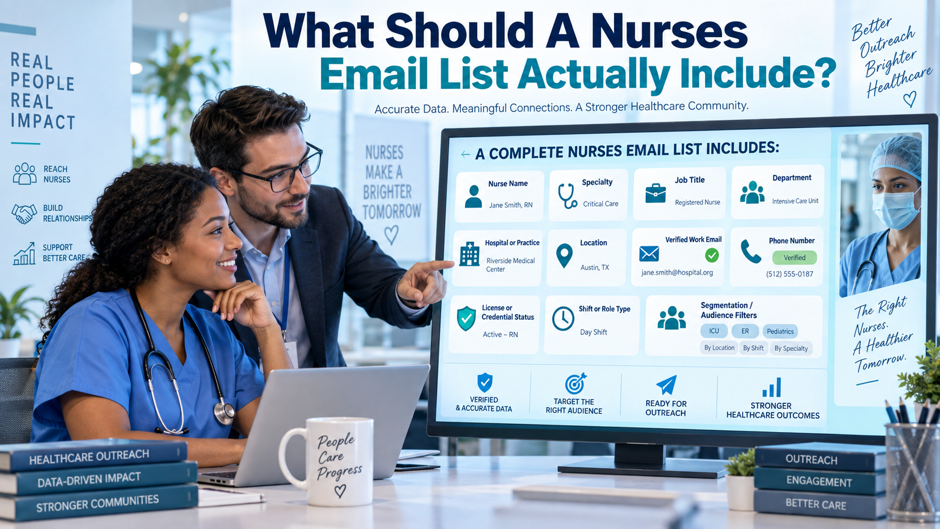
A nurses email list with just a name, a job title, and an email address looks complete until the first campaign runs and half the sends land on Licensed Practical Nurses when the offer was built specifically for Nurse Practitioners with prescribing authority, or on retired license holders who haven’t worked a shift in years. The US nursing workforce is genuinely enormous and genuinely fragmented: nearly 7 million people hold an active nursing license across the country, but the employed workforce sits closer to 4.4 million, spread across credential types with fundamentally different scopes of practice, prescribing authority, purchasing influence, and professional interests. A list that flattens all of that into a single undifferentiated “nurse” category isn’t really a targeting asset. It’s a mailing list that happens to be accurate at the postal code level and useless at every level that actually matters for a campaign.
This guide breaks down exactly what fields a genuinely usable nurses email list needs to include, why each one matters for a specific kind of campaign, and how to tell the difference between a data file with real depth and one that’s been padded with columns that look impressive but don’t actually support meaningful segmentation. The goal isn’t an exhaustive checklist for its own sake. It’s a clear standard for what “complete” should actually mean before a nurses list gets treated as ready to use.
TL;DR
| Field category | What it covers | Why it matters |
| Core identity | Full name, credential type, verified professional email | The baseline that makes a record usable at all |
| Licensure and credentials | RN, LPN, NP/APRN, CRNA, CNS, CNM designation, state of licensure, NPI where applicable | Determines scope of practice, prescribing authority, and regulatory relevance |
| Degree and certification | ADN, BSN, MSN, DNP; specialty board certifications like CCRN, OCN, CEN | Signals seniority, specialisation, and continuing education receptiveness |
| Specialty and clinical focus | ICU, oncology, pediatrics, cardiac, mental health, and similar clinical areas | The single biggest driver of message relevance for clinical products |
| Practice setting | Hospital, outpatient clinic, long-term care, home health, school, independent practice | Shapes purchasing authority and the kind of products actually relevant |
| Employer and facility data | Organisation name, facility type, bed count or size, technology stack | Enables account-based approaches and organisational-level targeting |
| Location | City, state, region | Required for territory assignment, state-specific licensure rules, and event invitations |
| Verification metadata | Source, verification method, date last confirmed | The difference between a defensible record and an unverifiable guess |
| Compliance flags | Opt-out status, consent source where applicable, suppression history | What keeps outreach on the right side of CAN-SPAM, CCPA, and GDPR where relevant |
A list missing any single category above isn’t necessarily unusable, but it’s incomplete for a defined purpose, and understanding which categories matter most for a specific campaign is what separates a genuinely useful nurses list from one that simply looks thorough on a sales page but underperforms once a real campaign actually runs against it.
Why Credential Type Is the Field That Changes Everything Else
Before covering every field in detail, it’s worth understanding why credential type sits at the centre of everything else on this list, because getting this one field wrong undermines the value of every other field around it, no matter how detailed or well-organised the rest of the record happens to be.
Nursing credentials aren’t a single professional category with minor title variations. They represent genuinely different scopes of practice, different levels of formal education, and in the case of advanced practice roles, different prescribing authority that fundamentally changes what kind of outreach is even relevant to send.
The Core Credential Types a List Needs to Distinguish
Registered Nurses (RNs) make up the largest single group in the nursing workforce, accounting for roughly 77% of the employed nursing population, and typically hold an Associate Degree in Nursing (ADN) or a Bachelor of Science in Nursing (BSN). RNs provide direct patient care across virtually every clinical setting and, while they don’t prescribe medication independently, they hold substantial influence over product selection, workflow tools, and patient care equipment used at the bedside.
Licensed Practical Nurses (LPNs, called LVNs in some states) work under RN or physician supervision and typically hold a diploma or certificate rather than a degree.
Nurse Practitioners (NPs) and other Advanced Practice Registered Nurses (APRNs), including Certified Registered Nurse Anesthetists (CRNAs), Clinical Nurse Specialists (CNSs), and Certified Nurse Midwives (CNMs), hold graduate-level education and practice in expanded clinical roles. Their prescribing authority and clinical responsibilities can make them a distinct audience for pharmaceutical, medical device, and clinical education outreach.
Why This Distinction Determines List Quality More Than Any Other Field
A list that lumps every credential type into a single “Nurse” category forces every campaign into the lowest common denominator of relevance, since a message calibrated for an NP’s prescribing decisions is largely irrelevant to an LPN with no prescribing authority at all, and a message built around bedside care equipment is only partially relevant to an NP whose role increasingly resembles a physician’s more than a traditional nursing role. Credential-type segmentation is the single field that, more than any other, determines whether a list can actually support differentiated, relevant messaging rather than a single generic blast sent identically to a genuinely diverse professional population.
Licensure and NPI Data: What Actually Needs Verification
Licensure data is where a nurses email list either establishes real credibility or reveals that it was compiled from loosely sourced, unverified records padded to look more authoritative than the underlying data actually supports, which makes it one of the more revealing categories to scrutinise closely before committing budget to any purchase.
The licensure and identifier fields a complete record should carry:
- State of licensure, since nursing licenses are issued and regulated at the state level, and a nurse’s specific state matters for both message relevance and for confirming the record reflects a genuinely active credential
- License status, distinguishing active from lapsed, retired, or inactive licenses, given that roughly 2 million individuals currently hold a nursing license without actually working in an active nursing role at present
- NPI (National Provider Identifier), most relevant for nurse practitioners, certified nurse midwives, and other APRNs who bill directly for services, though not a universal requirement for every RN or LPN record
- Credential verification date, marking when the license or NPI status was last actually confirmed against an authoritative source, rather than when the record was first compiled
For healthcare databases that need missing identifiers added or checked, NPI data appending services can support the process of matching and verifying these identifiers against healthcare records rather than leaving NPI fields incomplete.
The Authoritative Sources Behind Genuine Verification
The NPPES NPI Registry can be used to verify applicable NPI information. Nursys can be used for license status verification where applicable. The required verification source depends on the credential type and the purpose of the record.
A vendor claiming license or NPI fields are “verified” without being able to describe the specific method, whether that’s a direct Nursys cross-reference, an NPI registry match, or something else entirely, is making a claim that’s difficult to evaluate on its face value alone. This is a reasonable point for a buyer to push for specifics before treating a verification claim as meaningful, since the word “verified” carries no regulated or standardised meaning in this market and gets applied inconsistently across vendors with very different actual verification processes behind it.
Degree Level and Specialty Certifications
Beyond the base credential type, degree level and specialty board certifications add a further layer of precision that matters enormously for certain campaign types, even though it’s frequently the first thing a lower-quality list leaves out entirely in favour of simpler, cheaper-to-compile fields that require far less ongoing maintenance to keep current.
| Field | What it captures | Where it matters most |
| Degree level (ADN, BSN, MSN, DNP) | Educational attainment beyond the base credential | Continuing education, career advancement content, faculty and academic outreach |
| Specialty board certification (CCRN, OCN, CEN, etc.) | Formal certification in a specific clinical specialty | Clinical product marketing, specialty-specific conferences, professional development |
| ANCC certification status | Certifications maintained through the American Nurses Credentialing Center | Advanced practice and specialty-focused campaigns requiring board-certified targeting |
| Certification expiration or renewal window | When a certification needs to be renewed | Timing continuing education outreach around actual renewal deadlines |
Degree level matters for reasons that go beyond simple seniority signalling. A BSN-prepared RN and a DNP-prepared nurse practitioner are pursuing genuinely different career trajectories, and content built around advancing from an associate to a bachelor’s degree is largely irrelevant to someone who already holds a doctoral-level nursing degree and is well past that stage of their career.
Specialty board certifications, covering areas like critical care (CCRN), oncology (OCN), and emergency nursing (CEN) among dozens of others maintained through bodies like the American Nurses Credentialing Center, indicate a level of formal specialisation that generic job-title data alone doesn’t capture. A record that simply says “RN, Oncology” without indicating whether that nurse actually holds board certification in oncology nursing is working from a weaker signal than one that can confirm the certification directly, and the difference matters particularly for continuing education providers and clinical product companies whose entire value proposition depends on reaching genuinely specialised, board-certified practitioners rather than anyone whose job title happens to loosely mention the right department without any formal certification or credential behind it at all.
Specialty and Clinical Focus Areas
Clinical specialty is arguably the single most commercially important segmentation field on a nurses list, because it’s the field that most directly determines whether a given product, service, or piece of content is actually relevant to the specific person receiving it, rather than simply relevant to nursing in the abstract.
Common clinical specialty categories that a well-built list should distinguish:
- Critical care and ICU nursing, covering medical, surgical, cardiac, and neonatal intensive care settings
- Oncology nursing, spanning inpatient, outpatient infusion, and radiation oncology settings
- Emergency and trauma nursing
- Pediatric nursing across both inpatient and outpatient settings
- Cardiac and cardiovascular care nursing
- Mental and behavioural health nursing
- Perioperative and surgical nursing
- Obstetric, labour and delivery, and neonatal nursing
- Geriatric and long-term care nursing
- Ambulatory and outpatient clinic nursing
- Home health and hospice nursing
- Nursing informatics and clinical technology roles
A single nurse frequently sits at the intersection of more than one of these categories, which is exactly why specialty needs to be captured as a genuine data field rather than inferred loosely from a job title string that might read something as generic as “Staff Nurse” with no further detail attached. A pharmaceutical company launching a cardiac medication needs cardiac and critical care nurses specifically, not the entire RN population indiscriminately, and a list that can’t make that distinction forces the buyer to either accept enormous waste in their targeting or attempt manual research to fill the gap the purchased data should have covered in the first place.
Practice Setting and Employer Data
Where a nurse actually works shapes both their purchasing influence and the kind of outreach that’s genuinely relevant to their day-to-day role, which makes practice setting one of the more commercially significant fields a list can include, distinct from both the specialty and credential type fields covered above in the preceding 2 sections.
The Practice Setting Categories That Matter
Hospital-based nursing remains the largest single setting, but within it, the distinction between a large academic medical centre and a small community hospital changes purchasing dynamics substantially, since larger institutions typically have more formal procurement processes and more institutional decision-makers involved in any purchase above a modest threshold. Outpatient and ambulatory clinic settings represent a genuinely different buying environment, often with faster, less bureaucratic decision cycles than a large hospital system. Long-term care and skilled nursing facilities face their own specific regulatory and staffing pressures, reflected in the fact that LPNs remain disproportionately concentrated in this setting even as their overall numbers decline elsewhere in the workforce. Home health and hospice nursing represents a growing segment as care continues shifting away from inpatient settings, and school nursing, occupational health nursing, and correctional facility nursing each represent smaller but genuinely distinct practice environments with their own specific needs.
Employer and Facility-Level Fields
Beyond the practice setting category itself, a genuinely useful list includes the specific employer or facility name, the facility type, an indication of organisational size such as bed count for a hospital or employee count more broadly, and in more sophisticated datasets, the technology stack a facility uses. This last field matters increasingly for healthcare software and EHR vendors specifically, since knowing which electronic health record system a facility already runs directly shapes both message relevance and the technical feasibility of any proposed integration a vendor might eventually need to build.
Facility-level data also enables account-based approaches that individual contact data alone can’t support: identifying every nurse contact within a specific target health system, coordinating outreach across multiple contacts at the same institution, and connecting nursing-level engagement back to broader healthcare data services a sales team may already be using through other channels entirely, giving marketing and sales a shared, coordinated view of the same target account.
Contact Fields and Deliverability Data
The most basic layer of a nurses list, the actual contact information itself, still carries more nuance than it might initially appear, and the specific fields included here directly determine whether a campaign can actually reach its intended audience at all, regardless of how well-targeted the underlying segmentation happens to be.
The contact and deliverability fields a complete record needs:
- Verified professional email address, distinct from a personal email that may be inconsistently monitored or entirely inappropriate for professional outreach
- Direct or office phone number where available, supporting multi-channel outreach beyond email alone
- Mailing address, still relevant for direct mail campaigns, conference invitations, and physical sample delivery in categories like medical devices and pharmaceuticals
- LinkedIn or other professional profile URL, enabling social selling and multi-touch campaign coordination across channels
- Deliverability status or confidence score, indicating whether the email address has been genuinely confirmed to accept mail rather than simply matching an expected format pattern that only looks plausible on the surface
A list without genuine deliverability verification behind its email addresses can look complete on paper while producing bounce rates high enough to damage a sender’s domain reputation within the first few campaign sends, an outcome that affects every future campaign run from that same sending infrastructure, not just the one that used the problematic list. Where existing records contain missing or outdated addresses, email appending services can be used to update contact information rather than treating every incomplete record as unusable. Reputable vendors typically cite deliverability guarantees somewhere in the 85 to 90% range, and a buyer evaluating a list should ask specifically what guarantee, if any, backs the email addresses being purchased.
Accurate email data is only one part of multi-channel contact coverage. Where telephone outreach matters, phone number appending services can add or update direct contact numbers in existing records, supporting campaigns that need a second contact route alongside email rather than relying on one channel alone.
Professional profile data can serve the same purpose for social outreach. When LinkedIn or similar profile information is missing, social media appending services can help connect existing contact records with relevant professional profiles, giving sales teams additional context and another channel for coordinated engagement.
Compliance and Verification Metadata
The fields covered so far describe who’s in the list and how to reach them. This final category covers something different but equally essential: whether the list can actually be used lawfully and responsibly, and whether the buyer can demonstrate that clearly if ever asked to by a regulator, a platform, or an internal compliance review.
What Regulatory Frameworks Actually Apply
Nurse professional contact information, including name, credential, specialty, employer affiliation, and professional email address, is not classified as protected health information under HIPAA, since HIPAA governs patient data rather than the professional business details of healthcare providers themselves. CAN-SPAM does apply directly to commercial email sent to nurses in the United States, requiring accurate sender identification, a non-deceptive subject line, a physical mailing address in every message, and a functional one-click unsubscribe mechanism. State-level privacy laws including California’s CCPA extend additional rights, including the right to opt out of data sales, and any vendor selling into these states should be able to confirm sourcing and opt-out handling meets the specific state-level requirements involved. GDPR applies specifically to outreach targeting nurses based in the European Union, a consideration relevant to any organisation running campaigns beyond the US market.
The Metadata Fields That Support Defensible Use
Source documentation, indicating where and how a given record was originally sourced, whether through licensed data partnerships, public licensure records, opt-in professional platform registrations, or another method entirely. Consent status, where applicable, particularly relevant for any communication channel or jurisdiction where opt-in consent carries specific legal weight. Suppression and opt-out history, confirming that a record hasn’t been added back into active circulation after a nurse has previously opted out through any campaign using the same underlying dataset. Last verification date, distinct from the original source date, indicating when the record’s core details were most recently reconfirmed rather than simply carried forward unchanged from an earlier compilation.
A vendor unable to speak specifically to any of these metadata categories, falling back instead on a generic assurance of full compliance without describing the actual mechanism behind that claim, is providing meaningfully weaker assurance than the confident language on their sales page might initially suggest to a buyer reading it quickly.
What a Genuinely Complete Record Looks Like Versus a Padded One
Not every field discussed above needs to appear in every list for every use case, but understanding the difference between a record with genuine depth and one padded with columns that don’t actually add targeting value matters before evaluating any specific vendor’s offering against the standard this guide has laid out.
Signs of a genuinely complete, usable record:
- Credential type is specific and consistently applied, distinguishing RN from LPN from NP rather than defaulting to a generic “Nurse” or “Healthcare Professional” label across every entry
- Specialty is captured as a structured field rather than inferred from an inconsistent, free-text job title string
- Licensure state and status are present and, ideally, described with a specific verification method rather than an unqualified claim
- Practice setting and employer data are populated for the substantial majority of records, not just a small sample used to demonstrate the format during a sales conversation
- Verification and last-updated dates are visible and recent, rather than absent or suspiciously uniform across every single record in the file
Signs of a padded or superficially thorough record:
- Dozens of column headers exist in the data dictionary, but a meaningful share sit empty or populated with placeholder values across most actual records
- Specialty fields default overwhelmingly to broad, generic categories like “General” or “RN” with almost no genuine sub-specialty differentiation across the file
- License and NPI fields are present as columns but carry no accompanying explanation of how or when they were actually verified
- Deliverability claims are stated as a single confident percentage with no explanation of the underlying verification methodology behind that number
- The same generic compliance language appears regardless of which specific jurisdiction or campaign type a buyer is asking about, suggesting a templated response rather than a genuinely considered answer
Running through both lists side by side before committing to a purchase is a genuinely quick exercise, and it consistently reveals more about actual data quality than any amount of time spent reading a vendor’s marketing copy or comparing headline record counts alone, since count and quality are frequently unrelated to each other.
Matching Field Depth to Buyer Type
Different organisations buying nurses email lists genuinely need different field depth, and understanding which fields matter most for a specific buyer type helps translate the full checklist above into a practical purchasing decision rather than an undifferentiated wish list applied identically regardless of who’s actually doing the buying and why.
| Buyer type | Fields that matter most | Fields that are often genuinely optional |
| Pharmaceutical and biotech marketers | Credential type, NPI, prescribing authority, specialty, licensure state | Facility technology stack, organisation size |
| Medical device companies | Specialty, practice setting, facility type and size, procedure-relevant clinical focus | Degree level, ANCC certification status |
| Healthcare software and EHR vendors | Facility technology stack, organisation size, nursing leadership titles, practice setting | Individual specialty board certifications |
| Continuing education and certification providers | Degree level, specialty certification status and renewal windows, credential type | Facility-level technology and organisation size |
| Healthcare staffing and recruitment firms | Credential type, specialty, licensure state, experience level, employment status | Facility technology stack |
| Professional associations and membership organisations | Broad credential and specialty coverage, geographic distribution | Deep facility-level enrichment, NPI |
This table isn’t a rigid rule, since plenty of campaigns benefit from fields outside their typical core set, but it offers a useful starting point for prioritising which gaps in a vendor’s data actually matter for a specific use case and which gaps can reasonably be tolerated without meaningfully undermining campaign performance.
A pharmaceutical company evaluating 2 competing lists, for instance, should weight missing NPI or prescribing authority data far more heavily than missing facility technology stack information, since the first gap directly undermines the core targeting logic the entire campaign depends on, while the second is simply a nice-to-have enrichment field that a strong pharma campaign can generally succeed without. The reverse prioritisation applies almost exactly for an EHR vendor evaluating the same 2 lists, which is precisely why a generic, one-size-fits-all field checklist is less useful in practice than mapping the specific fields that matter back to the specific buyer type doing the evaluation.
FAQs
Does a nurses email list need to include every field covered in this guide?
No, and requiring every field for every use case would be unrealistic given how the market actually works. A one-time conference invitation campaign can function reasonably well with core identity, credential type, specialty, and verified contact fields alone, while an ongoing pharmaceutical territory programme targeting prescribing nurse practitioners genuinely benefits from the full depth covered here, including NPI verification, degree level, and facility-level enrichment. The right field depth depends on the specific campaign’s requirements, not a universal standard applied identically regardless of use case, and the buyer-type table earlier in this guide is a useful starting point for figuring out which fields actually matter for a given purchase.
Why do some nurses email lists cost significantly more than others with a similar record count?
Field depth and verification rigour are 2 of the biggest drivers of price difference in this market, similar to patterns seen across healthcare professional data more broadly. A list built from loosely sourced, unverified public data with minimal segmentation costs meaningfully less to produce and maintain than one built on licensed data partnerships, continuous NPI and Nursys cross-referencing, and rich specialty and facility-level enrichment, and that difference in underlying production cost shows up directly in the price charged to the eventual buyer, in much the same way sourcing and verification depth drive price differences across other categories of healthcare professional contact data more broadly.
Is NPI data necessary for every nursing credential type, or only for certain roles? NPI is most relevant for nurse practitioners, certified nurse midwives, and other advanced practice roles that bill directly for services rendered, since the NPI system exists specifically to identify providers within billing and claims contexts. It’s a recommended field for advanced practice segments specifically rather than a universal requirement across every RN or LPN record, and a list missing NPI data for standard RN or LPN contacts isn’t necessarily incomplete, since that field simply doesn’t apply to those roles in the same way it applies to prescribing advanced practice providers whose billing and claims activity the NPI system was specifically built to track.
How often should the specialty and employer data in a nurses list be refreshed? Given how frequently nurses change employers, specialties, and practice settings, particularly amid the elevated turnover the broader nursing workforce has experienced in recent years, a list intended for use beyond a single immediate campaign should be refreshed at least every 6 months, with quarterly refresh representing a stronger standard for any organisation running sustained, ongoing outreach. A static list purchased once and reused across an extended campaign timeline without any re-verification will have degraded meaningfully by the later stages of that campaign, particularly on fast-moving fields like current employer and practice setting.
What’s the difference between a nurses email list and a general healthcare professional email list that happens to include nurses?
A general healthcare professional list often treats nurses as one undifferentiated category alongside physicians, physician assistants, and other clinical roles, typically without the credential-level, specialty-level, and licensure-level depth that a purpose-built nurses list should carry. A dedicated nurses list, built specifically around the structure of the nursing workforce, is far more likely to distinguish RN from LPN from NP, capture genuine specialty and certification data, and include the practice-setting nuance that a broader, less specialised healthcare list frequently treats as a secondary consideration rather than a core organising principle of the dataset itself.
Should facility-level technology stack data be considered essential or optional for most buyers?
This depends heavily on what’s being sold. For healthcare software, EHR-adjacent tools, or clinical technology vendors, facility-level technology stack data is close to essential, since it directly determines both message relevance and technical feasibility before a conversation even begins. For medical device companies, pharmaceutical marketers, or continuing education providers whose offering doesn’t depend on existing technology infrastructure, this field adds useful context but isn’t a critical gap if it’s absent, making it a genuinely optional enrichment field for a meaningful share of buyers in this market rather than a universal requirement.
How can a buyer verify a vendor’s compliance and verification claims before committing to a purchase?
Request a small sample file before committing to the full purchase, and independently spot-check a portion of the licensure and NPI data against the free public NPPES NPI Registry and, where feasible, against Nursys for license status confirmation. Ask the vendor directly and specifically how source documentation, consent tracking, and suppression list management work across their broader customer base, not just within a single isolated campaign, since a vendor’s answers to these specific, pointed questions reveal far more about actual data quality than any general marketing claim about accuracy or compliance ever could on its own.