Physician Email Lists: Sourcing, NPI Matching, and Compliance Limits
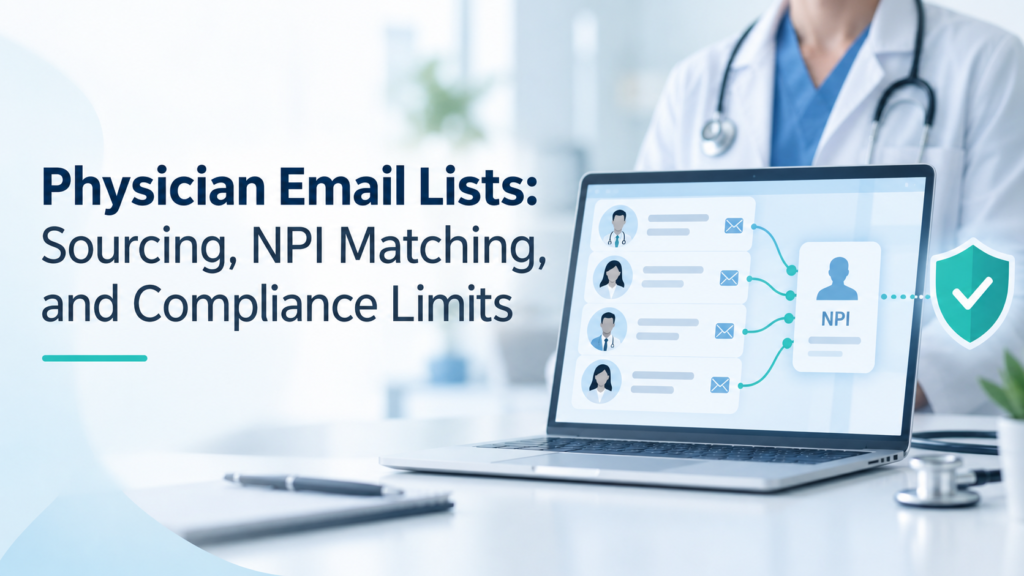
A physician email list looks simple when it arrives as a spreadsheet. Each row may show a doctor’s name, specialty, employer, NPI, business email, phone number, and location. The hard part sits behind those columns. Each field can come from a different source, can age at a different rate, and can carry a different legal or operational limit.
That matters because a usable physician email list is an identity-resolution product before it is an outreach file. A physician may keep the same NPI while moving to a new health system. A hospital directory may show a current practice but no direct email. A state board may confirm licensure while using a mailing address that is poor for account matching. An email can pass a technical check and still belong to the wrong person. Buyers need to know how those pieces were joined.
The safest way to evaluate physician contact data is to separate 4 questions. Where did each field come from? How was the physician matched to the NPI and organization? How recently was the email checked? What rules govern the way the record will be used? This guide answers those questions in order and explains where public data helps, where it stops, and what a buyer should require before importing records into a CRM or sending a campaign.
TL;DR
The file should be judged at the field level, not by one headline accuracy rate. NPI records are useful identity anchors because an NPI is a persistent 10-digit identifier, but the number itself doesn’t encode specialty, state, or employer. Public NPPES data can support name, taxonomy, address, phone, endpoint, and status checks. It doesn’t turn into a verified work email by itself, and an NPI doesn’t prove that a clinician is currently licensed or credentialed.
NPI matching works best when the file keeps source fields separate, standardizes names and locations, distinguishes Type 1 individuals from Type 2 organizations, and assigns a confidence level instead of forcing every row into a match. Email verification should then be handled as its own process because domain status, mailbox behavior, and employment changes create errors that NPI matching can’t resolve.
Compliance also needs separate tests. U.S. commercial email is governed by CAN-SPAM even in B2B campaigns. HIPAA becomes relevant when protected health information is used or disclosed, not merely because a database contains a physician’s professional contact details. California privacy law can reach business contact information, while UK rules distinguish corporate subscribers from sole traders and some partnerships. A sound workflow documents source, match logic, verification date, suppression status, permitted use, and jurisdiction before a record is activated.
What a Physician Email List Actually Contains
The finished file is usually a joined record rather than a single-source record. The NPI may come from a federal dataset, the license status from a state board, the practice address from a hospital or clinic page, and the email from a professional directory or another lawful business source. Treating the whole row as if every field has the same provenance hides the main quality risk: one field can be current while another is stale or incorrectly attached.
A practical record often contains an identity layer, a clinical classification layer, an organization layer, and a contact layer. The identity layer includes name and credentials. Clinical fields can include specialty, subspecialty, taxonomy, and license information. Organization fields may include practice, health system, facility type, or location. Contact fields usually cover business email, phone, and postal address. IInfotanks describes these field groups on its physicians email list page, including NPI and practice information alongside business contact fields, which illustrates why buyers should inspect the complete row rather than judge only the email column.
The physician email database should also carry operational metadata that may not be visible to campaign users. Useful fields include source category, source-observed date, email verification date, match method, confidence band, suppression status, and any limits on permitted use. These fields help RevOps or compliance teams decide whether a row is fit for activation. They also make it possible to trace a mistake without rebuilding the entire sourcing history after a complaint or hard bounce.
Where Physician Contact Data Comes From
Good sourcing starts by assigning the right job to each source. Federal provider data is strong for NPI identity and taxonomy. State medical boards are stronger for license checks. Health-system and practice websites can help with current affiliation. Business directories or permissioned datasets may supply contact details that public provider records do not. No single source is complete enough to answer every question reliably.
The distinction is important for a healthcare email list because public does not mean current, and current does not mean verified for outreach. A practice website can change before a board file catches up. A board can confirm a license while the physician has already moved employers. A directory can show the right employer but an old departmental address. The broader healthcare email list catalog groups physician records with other medical audiences, but a buyer still needs to ask which source type supports each returned field and when that source was checked.
A strong sourcing policy also separates observed data from inferred data. A healthcare email list becomes easier to audit when that distinction is retained in the export. If a work email is published on an employer page, the source is observed. If an address is generated from a company email pattern, it is inferred until independently checked. That difference should survive the export. Calling both values “verified” without showing how they were obtained makes the physician contact data harder to audit and raises the chance that a guessed address will be treated as first-party evidence.
Why NPI Matching Matters
A correct NPI link gives a physician record a stable federal identity anchor. CMS defines the NPI as a unique 10-digit, intelligence-free identifier, which means the digits don’t reveal specialty or geography. The identifier can remain the same when an individual physician changes name, address, or other profile information. That persistence makes it useful for joining records across changing practice settings, but the CMS National Provider Identifier standard also makes clear that the number is an identifier, not a clinical credential or a coded profile.
For outreach data, that distinction prevents a common mistake. A buyer may see an NPI beside a business email and assume the entire row has been validated by CMS. It hasn’t. The NPI link can support the identity of the clinician and connect taxonomy or location information, but it doesn’t validate the mailbox. The NPI data appending page treats NPI enrichment as a separate record-matching function, which is the right conceptual split: NPI enrichment and email verification solve different problems even when they appear in the same physician email database.
The NPI also helps with deduplication. Names are poor unique keys because multiple physicians can share the same name, credentials may be written differently, and surnames can change. A verified Type 1 NPI can reduce those collisions. It still needs context, especially when a source file contains organization records, old aliases, or a practice-level contact mixed into person-level rows.
How NPI Matching Works in Practice
The first step is normalization. Names should be split into consistent fields, credentials removed from comparison strings, punctuation standardized, and locations converted into comparable formats. Existing NPIs should be checked for valid structure before they are trusted. The workflow should also identify whether the target is a person or an organization because Type 1 and Type 2 NPIs represent different entity classes.
Deterministic matching
Deterministic matching uses identifiers that agree strongly enough to support a direct link. A known NPI is the clearest case, but a record without one can still be matched when normalized physician name, taxonomy or specialty, and practice location line up with the same provider. The goal is to use fields that independently narrow identity, then reject rows where the evidence points to more than one plausible provider.
CMS publishes NPPES information through the Registry and downloadable files, and its data dissemination guidance explains that the Registry is query-only while monthly, weekly, and deactivation files support broader data work. A data appending process can use these public records as a reference layer. A broader data appending service may support NPI as one returned field, but a buyer should still ask which matching keys were required before a returned NPI was accepted.
Probabilistic matching
Probabilistic matching is useful when the source record is incomplete, but it needs stricter controls. A close name match plus the same city may be enough to create a candidate, not enough to accept it. Specialty, middle name, organization, and other practice evidence can raise or lower confidence. Ambiguous candidates should stay unresolved rather than being forced into the final dataset simply to improve the reported match rate.
The output should make this visible. A buyer can use bands such as confirmed, probable, ambiguous, and unmatched, with a short reason code for each. The labels matter more than the exact scoring formula because they let downstream users exclude uncertain records from a campaign until someone reviews them.
Match Confidence, False Positives, and Duplicate Records
A false positive is more damaging than an unmatched row because it gives the buyer confident-looking data about the wrong person. Physician names create predictable collision risks. Common surnames, initials, shared practice addresses, and group phone numbers can all make 2 different clinicians look similar. A matching system should therefore be designed to leave some rows unmatched.
Confidence should reflect evidence strength, not database completeness. Exact NPI agreement can be a strong signal when the NPI came from a trusted input. Exact name plus current practice and a compatible taxonomy can also be strong. Name plus city alone is weak. A generic departmental email can belong to a practice even if the row is person-level. These differences should affect whether a record is activated, held for review, or discarded.
Duplicate handling needs the same care. One physician may legitimately have multiple practice locations while keeping one Type 1 NPI. The correct action may be to retain multiple affiliation rows rather than collapse everything into one address. The physician contact data model should distinguish duplicate identities from multiple valid relationships, or a cleanup routine can erase useful affiliation context.
What NPPES Can and Cannot Tell You
NPPES is one of the most useful public sources in U.S. provider data, but it has defined limits. CMS states that an NPI is an identifier and that issuance does not ensure a provider is licensed or credentialed. Buyers should therefore avoid using NPI presence as a substitute for a current state-license check when licensure matters to the campaign or workflow.
As of September 2026, CMS recommends Version 2 of the NPPES monthly and weekly downloadable files. The NPI Files page says Version 1 stopped being supported on March 3, 2026 and notes that the downloadable package includes other-name, practice-location, and endpoint reference files. Those files add useful context for provider identity work, especially when a clinician has more than one practice location or when an organization uses alternate names.
NPPES also should not be treated as a source of verified marketing email. Provider endpoints can represent electronic exchange addresses and other endpoint types, but that is different from proving that a listed mailbox is the current business inbox for commercial outreach. A physician email database therefore needs separate contact sourcing and verification even when its NPI layer is excellent.
Finally, NPPES data is provider-supplied and can lag real-world changes. Covered providers are expected to report changes, but a database buyer should still cross-check current affiliation when employer context affects targeting. The NPI can remain stable while the organization around the physician changes, which is exactly why a persistent identifier is useful and insufficient at the same time.
Email Verification, Deliverability, and Data Freshness
Email quality should be measured after identity quality. A technically valid mailbox attached to the wrong physician is still a bad record. The workflow should first confirm who the person is and where they work, then check whether the email is syntactically valid, whether the domain can receive mail, and whether the mailbox status is usable under the verification method being applied. Catch-all domains and security gateways can limit what automated checks can prove.
Freshness should be field-specific. NPI identity tends to be stable. Practice affiliation can change. Business email can change faster because health systems merge, domains change, or clinicians move. A buyer should ask for the last observed date and the last verification date rather than one generic “last updated” date for the entire physician email list. The physician email list provider checklist published by IInfotanks also focuses on checking source and verification practices before purchase, which is more useful than accepting a single accuracy percentage without a method behind it.
The physician email database should preserve suppression history as well. A mailbox that opted out, complained, or repeatedly hard-bounced shouldn’t be reintroduced merely because a fresh vendor export contains it again. Suppression is a campaign control, while verification is a technical status. Mixing them causes preventable compliance and sender-reputation problems.
Compliance Limits for U.S. Commercial Email
CAN-SPAM applies to commercial email in the United States, including B2B messages. The law does not create a blanket rule that a business recipient must opt in before every commercial email, but it does impose message and opt-out duties. The FTC CAN-SPAM compliance guide requires accurate header information, non-deceptive subject lines, a valid physical postal address, a clear way to opt out, and timely handling of opt-out requests. A purchased dataset does not remove any of those sender obligations.
The practical limit is that list legality and message legality are separate checks. A company can lawfully possess a business contact record and still send a noncompliant campaign. It can also use a vendor that followed its own sourcing rules while failing to maintain its own suppression list. A related article on emailing doctors under CAN-SPAM explains the same separation, and the sender remains responsible for the actual message and campaign process.
CAN-SPAM also makes third-party sending arrangements worth documenting. The FTC warns that a company can’t contract away its legal responsibility by hiring another sender. Procurement should therefore ask who controls headers, unsubscribe processing, suppression storage, and proof that opt-outs are carried forward to later campaigns.
HIPAA, PHI, and Physician Business Contact Data
HIPAA is often used too loosely in discussions about physician lists. A doctor’s professional name, work email, NPI, specialty, and business address do not become protected health information merely because they concern healthcare work. HIPAA’s Privacy Rule focuses on protected health information held or used by covered entities and business associates in regulated contexts. That is a different question from whether a B2B physician contact record can be used for commercial email.
The boundary changes when patient information enters the workflow. HHS explains in its HIPAA marketing guidance that, with limited exceptions, a covered entity generally needs an individual’s authorization before using or disclosing that person’s PHI for marketing. A physician email list used to promote software to cardiologists is therefore a different compliance problem from a hospital disclosing a patient list so a third party can market a product to those patients.
That distinction is why broad claims such as “HIPAA-compliant physician database” can mislead. Compliance depends on the data involved, the parties, and the use. A better buyer question is whether the file contains any patient-derived information, whether a covered entity or business associate supplied it, and whether the proposed processing creates HIPAA duties. Legal review should follow the actual data flow instead of a label printed on a vendor page.
State and International Privacy Limits
U.S. federal email rules are only one layer. California privacy law can matter when a business processes personal information about California residents and meets the law’s coverage thresholds. The California Attorney General’s CCPA overview confirms that the former business-to-business exemption expired on December 31, 2022. It also explains that publicly available information is treated differently from other personal information, which means source classification matters when physician contact data combines public records with nonpublic enrichment.
A California workflow may need privacy notices, request handling, deletion or correction processes, and sale or sharing analysis depending on the business and the data. Public professional-license information can fall within the public-information exclusion, but that doesn’t automatically make every appended email or inferred attribute public. Buyers should map each field to its source and legal basis rather than treating the row as one undifferentiated object.
International campaigns require their own country review. In the UK, the ICO guidance on B2B marketing distinguishes corporate subscribers from sole traders and some partnerships. PECR’s consent rule for electronic mail generally doesn’t apply to corporate subscribers, but UK GDPR can still apply when named business contacts are personal data, and recipients retain objection rights. That is one reason a global healthcare email list shouldn’t be activated under a single U.S. rule set.
For EU markets, national rules implementing the ePrivacy framework can differ, so campaign teams should review the target country rather than copy the U.S. process. The practical control is jurisdiction tagging: store country, organization type where relevant, lawful-basis notes, and suppression status before sending.
Pricing, Licensing, and Vendor Due Diligence
Physician data is sold under several commercial models, and the cheapest row is not always the cheapest usable record. Vendors may price by record, segment, one-time file, subscription, append project, or licensed access. Some charge only for matched records. Others quote on the full requested audience. Because public prices change and custom filters can materially alter cost, a buyer should compare acceptance rules before comparing headline totals.
The physician email database contract should state what counts as a billable record. A row with an NPI but no verified work email may be useful for research but useless for an email campaign. A row with a working email and an ambiguous identity match may be worse. Define required fields, confidence thresholds, verification age, replacement terms, and whether suppressed records count toward the delivered quantity.
Vendor due diligence should also ask where direct emails come from, how inferred emails are labeled, how often affiliations are rechecked, and what happens when public sources conflict. Ask whether the provider can return source categories and verification dates for a sample. A sample that exposes those details is more informative than a glossy field list because it shows whether the supplier can explain its own physician contact data.
Licensing terms deserve equal attention. Clarify whether the file can be used once or repeatedly, whether affiliates can use it, whether enrichment can be written back into a CRM, and what deletion duties apply at the end of the term. Those restrictions can change the real cost of the data even when 2 vendors quote similar per-record prices.
A Defensible Workflow From Source to Send
A defensible process keeps identity, contact, and campaign controls separate until each one has passed its own check. Start with the audience definition, such as specialty, geography, practice setting, or account list. Then collect approved source fields and normalize them. Run provider matching with confidence bands. Add or verify business contact fields only after the identity record is stable. Finally, apply legal and suppression rules before the row reaches the sending platform.
The workflow can be summarized in 7 gates:
1. Define the exact physician segment and the fields required for use.
2. Record the source category and observed date for each material field.
3. Resolve person versus organization identity before accepting an NPI.
4. Assign a match confidence level and hold ambiguous records for review.
5. Verify the business email separately from the NPI match.
6. Apply jurisdiction rules, permitted-use limits, and suppression history.
7. Export only rows that pass the campaign’s acceptance policy.
A pilot is useful before a large purchase or append. IInfotanks describes an NPI-based validation pilot in its LifeScan HCP database case study, where the submitted NPI records were matched and enriched before a wider project. The broader lesson is procedural: test the matching method on a controlled sample, review exceptions, and agree on acceptance rules before scaling the file.
After activation, feedback should return to the data layer. Hard bounces, opt-outs, wrong-person replies, and confirmed job changes should update the suppression or correction record. That feedback loop keeps the next campaign file from repeating errors already discovered by the campaign team.
Conclusion
A physician email list is only as trustworthy as the joins behind it. NPI data can provide a durable identity anchor, but it doesn’t prove licensure, current employment, or email ownership. Public registries help with identity and classification. State boards can support license checks. Employer sources can improve affiliation context. Email verification still needs its own process, and uncertain matches should remain uncertain instead of being forced into a finished row.
The same separation makes compliance easier to reason about. CAN-SPAM governs U.S. commercial email duties. HIPAA becomes relevant when PHI and regulated parties enter the data flow. California privacy rules can apply to business contact information, and international outreach can trigger different electronic-marketing requirements. No single “compliant” label answers all of those questions.
For buyers, the practical standard is traceability. A physician email database should tell you where key fields came from, when they were checked, how the NPI was matched, how the email was verified, and what limits apply to activation. When those facts are visible, teams can judge whether a record is fit for a campaign. The same standard should apply when a healthcare email list mixes physicians with other clinical or administrative contacts. When they are hidden, a high record count offers little evidence about the quality of the file.
FAQs
What is a physician email list?
A physician email list is a structured B2B contact file that connects physician identity information with professional contact details and practice context. It may include name, specialty, NPI, organization, business email, phone, and location. The useful question is how each field was sourced and verified. Strong files preserve source and date information so buyers can distinguish public provider data from contact enrichment and can see which fields may need another check before outreach.
Is an NPI the same as a physician license number?
No. An NPI is a federal 10-digit identifier used in standard healthcare transactions. It doesn’t replace a state medical license and doesn’t prove that a physician is currently licensed or credentialed. A licensing check should use the appropriate state board or another authoritative licensing source. Provider identity resolution is useful, but it shouldn’t be treated as a substitute for license verification when licensure matters to the business use.
Does NPPES provide physician email addresses?
NPPES provides public provider information and related reference files, but it shouldn’t be treated as a ready-made source of verified marketing email addresses. Provider endpoint data can include electronic exchange information, which serves a different purpose from proving a current business inbox for outreach. A physician email database needs separate email sourcing and verification even when NPPES supplies a strong NPI and taxonomy layer.
What is NPI matching?
NPI matching is the process of linking a physician record to the correct National Provider Identifier. The process may use an existing NPI or compare fields such as normalized name, specialty or taxonomy, location, and current practice context. Good NPI matching assigns a confidence level and leaves ambiguous rows unresolved. It shouldn’t force a match simply to increase coverage because a false positive can attach the wrong specialty, organization, or email to a physician.
Why can a physician have several practice locations under one NPI?
A Type 1 NPI identifies the individual clinician, so the same physician can practice at more than one location while keeping the same NPI. NPPES downloadable data includes practice-location reference information that can help represent this. A data model should therefore separate identity from affiliation. Treating every additional location as a duplicate can remove valid practice relationships and reduce the usefulness of physician contact data for geographic or account-level targeting.
What is the difference between Type 1 and Type 2 NPIs?
Type 1 NPIs are assigned to individual healthcare providers, including physicians. Type 2 NPIs are assigned to organizations such as hospitals, group practices, or other eligible provider entities. Matching a person-level email record to an organization NPI can create a misleading row. A physician email list should keep the entity type visible so users know whether the NPI identifies the individual clinician or an organization connected with the clinician.
How should a physician business email be verified?
Verification should occur after the physician’s identity and employer are reasonably established. Basic checks include syntax and domain status, followed by mailbox-level testing where the method is appropriate. Catch-all domains and mail-security systems can limit certainty, so results should allow statuses such as valid, invalid, unknown, or catch-all rather than forcing a yes-or-no label. The verification date should travel with the record because email status can change quickly.
How often should physician email data be refreshed?
There is no single refresh interval that fits every field. NPI identity is relatively stable, while practice affiliation and business email can change more often. A better policy uses field-level dates and refresh triggers. Recheck a record when the employer changes, the domain changes, a message hard-bounces, or a trusted source reports a new affiliation. High-risk or high-value segments may justify more frequent review than a dormant research file.
Is it legal to buy a physician email list in the United States?
Buying business contact data isn’t automatically unlawful in the United States, but legality depends on sourcing, privacy obligations, contract terms, and how the data is used. Sending commercial email creates separate CAN-SPAM duties. State privacy laws can add more requirements, and a vendor’s compliance claim doesn’t transfer responsibility to the buyer. Legal review should focus on the actual data sources and campaign design instead of assuming that purchase alone authorizes every downstream use.
Does CAN-SPAM apply to B2B physician outreach?
Yes. CAN-SPAM covers commercial email and doesn’t exclude B2B messages. Senders need accurate transmission information, non-deceptive subject lines, a valid postal address, an opt-out method, and a process for honoring opt-outs within the required period. The rule applies to the campaign even when the contact came from a third-party physician email list. Senders should also maintain their own suppression file so opted-out contacts are not reintroduced by later data purchases.
Is a physician email list subject to HIPAA?
A physician’s professional contact details aren’t automatically PHI. HIPAA becomes relevant when protected health information is used or disclosed by a covered entity or business associate in a regulated context. The key question is whether patient-related information enters the workflow and how it is used. A healthcare email list used for B2B outreach to doctors is therefore different from a patient list disclosed for third-party marketing.
Does CCPA cover physician business contact data?
It can. California’s former business-to-business exemption expired at the end of 2022, so covered businesses should assess named professional contact information under the current CCPA framework. Publicly available government-record information can be excluded from the definition of personal information, but enriched or nonpublic fields may require a different analysis. A buyer should classify data by source and maintain processes for applicable privacy rights and opt-out duties.
Can I use the same physician list rules for UK outreach?
No. UK PECR treats electronic marketing to corporate subscribers differently from marketing to individual subscribers such as sole traders and some partnerships. A healthcare email list used in the UK needs those recipient-type checks before activation. UK GDPR can still apply when a named business contact is personal data. A global physician email list therefore needs jurisdiction and organization-type controls. A U.S. CAN-SPAM process alone is not enough for a UK campaign, and other countries can impose their own requirements.
What should I ask a physician data vendor before buying?
Ask for the source categories behind the NPI, specialty, affiliation, and email fields. Request the last-observed and last-verified dates, the provider identity rules, confidence labels, suppression process, replacement terms, and a sample that includes operational metadata. Also ask how inferred emails are labeled and what happens when sources disagree. These answers reveal more about a physician email database than a single accuracy or deliverability claim.
What should be tested in a sample before a full order?
Test identity first. Confirm that physician names, NPIs, specialties, and current organizations belong together. Then review email status and whether the address is personal, departmental, or practice-level. Check for duplicates, stale affiliations, and ambiguous matches. Finally, compare the sample against the contract’s acceptance rules. A small test should expose how exceptions are handled, not simply demonstrate that the easiest records can be matched.