Why Meta Ads Underperform for B2B Lead Generation
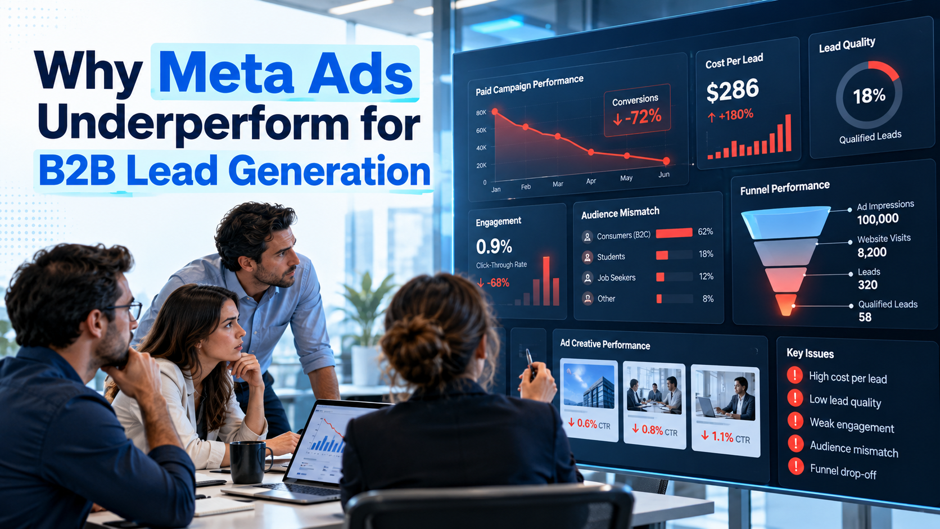
Meta Ads can produce impressive B2B dashboard numbers and still disappoint sales. Clicks are often inexpensive, forms can fill quickly, and cost per lead may look better than channels built around professional identity or active search. The problem usually appears later, when sales checks company fit, seniority, buying need, response rate, and opportunity creation. A campaign can therefore look efficient at the lead stage while becoming expensive once the business measures qualified pipeline.
That gap matters because Meta is built to find people likely to complete the conversion event advertisers choose. If the campaign rewards form submissions, Meta can become very good at finding form submitters. B2B teams need a smaller outcome: the right person, at the right company, with a relevant problem and enough intent to enter a buying process. That difference explains most cases where Meta Ads appear to underperform for B2B lead generation.
TL;DR
Meta Ads often underperform for B2B lead generation after the lead is created rather than at the click or form stage. Facebook and Instagram can deliver relatively low-cost traffic and form fills, but those advantages matter less when the people entering the CRM have weak company fit, limited buying authority, low intent, or poor progression into opportunities. The core issue is usually the difference between what Meta is asked to find and what the business ultimately needs.
| Where Meta Can Look Strong | Where B2B Underperformance Appears |
| Low CPC | Weak buyer intent |
| Relatively low CPL | Low MQL-to-opportunity conversion |
| High form volume | Irrelevant or low-fit submissions |
| Large audience reach | Weak firmographic precision |
| Fast Instant Form completion | Low commitment from the submitter |
| Strong retargeting economics | Weak cold-audience pipeline |
| High engagement | Engagement that never becomes demand |
| Broad delivery pool | Too few people inside the actual buying committee |
A stronger B2B Meta program measures cost per qualified lead, opportunity creation, sourced pipeline, and revenue instead of stopping at CPL. It also separates cold prospecting from retargeting, distinguishes educational leads from sales hand-raisers, and feeds reliable CRM outcomes back into campaign decisions. Meta can contribute to B2B growth, but the channel needs a job that matches the signals it can actually identify.
Cheap Leads Can Hide Expensive Pipeline
Cost per lead is one of the easiest Meta metrics to improve and one of the easiest B2B metrics to misread. A campaign can lower CPL by making the form easier, broadening delivery, using a more attractive content offer, or finding people who frequently respond to advertising. Each of those actions can increase lead count without increasing the number of companies entering an active buying process. The dashboard improves while pipeline quality stays flat or gets worse.
Recent B2B benchmark data shows why this distinction matters. Metadata’s 2025 paid-social dataset reported lower average lead costs on Facebook and Instagram than on LinkedIn, while LinkedIn produced a much stronger sourced-pipeline return in the same dataset. The exact numbers will vary by company, market, offer, and attribution method, but the directional lesson is useful: cheaper leads can coexist with weaker business outcomes. CPL is therefore a delivery metric, not a complete measure of channel efficiency.
| Channel | Average B2B CPL in Metadata’s 2025 Dataset | Click-to-Lead Rate | Sourced Pipeline per $1 of Lead-Gen Spend |
| $145 | 2.6% | $3.11 | |
| $138 | 4.0% | $1.80 | |
| $202 | 5.9% | $10.20 |
A B2B team should define what a useful lead means before it celebrates a cheap one. A $145 contact that never meets qualification criteria is more expensive than a $250 contact that frequently creates an opportunity. The economics become clearer when the business tracks cost per sales-accepted lead, cost per opportunity, and pipeline generated from each campaign cohort.
Meta Has a B2B Audience Signal Problem
Meta knows a great deal about behavior, engagement, interests, devices, content consumption, and broad demographic patterns. Those signals are extremely useful for many consumer campaigns and broad professional markets. B2B demand generation often needs a different form of precision, including company size, industry, current employer, seniority, department, buying role, technology environment, and whether the person is involved in a specific business problem. The narrower the market, the more important those distinctions become.
A cybersecurity company selling to large regulated enterprises may care about a small group of CISOs, infrastructure leaders, security architects, and procurement stakeholders. A Salesforce consultancy may care about CRM owners at companies with a particular level of complexity. A payroll provider may need HR, payroll, finance, and IT stakeholders inside employers of a certain size. Broad behavioral relevance is useful, but it is not the same as verified professional fit.
This does not make Meta unsuitable for B2B. It means cold targeting needs stronger support from first-party data, account lists, website behavior, engagement audiences, creative qualification, and CRM feedback. The platform tends to work better when the advertiser gives it a clearer signal about who already matters instead of expecting broad interest data to identify a small buying committee from scratch.
The Platform Learns From the Conversion Event You Give It
Meta’s delivery system needs a measurable event that tells it what success looks like. In many lead-generation campaigns, the easiest event to use is a submitted form. That creates a B2B problem when the company actually cares about a much later event such as a sales-accepted lead, booked meeting, opportunity, or closed customer. The campaign can become highly efficient at generating an event that has only a weak relationship with revenue.
The difference is easier to see through a simple funnel comparison:
| Funnel Stage | Campaign A | Campaign B |
| Ad spend | $10,000 | $10,000 |
| Leads | 100 | 60 |
| CPL | $100 | $167 |
| Sales-qualified leads | 5 | 15 |
| Cost per qualified lead | $2,000 | $667 |
| Opportunities | 2 | 8 |
| Cost per opportunity | $5,000 | $1,250 |
Campaign A wins if marketing stops at CPL. Campaign B wins once the CRM stages are included. The business therefore needs a success event that reflects lead quality closely enough to guide budget and, where possible, campaign learning. A raw form submission is often too early to carry that responsibility on its own.
For B2B advertisers, a deeper signal can be more useful when it occurs consistently enough to measure. Sales-qualified lead, accepted meeting, or opportunity creation may be better than closed-won revenue when the sales cycle is long and deal volume is low. The important point is that the event must be reliable, clearly defined, and connected to actual business value.
Instant Forms Can Remove Too Much Friction
Meta Instant Forms reduce conversion friction by allowing people to submit information without leaving Facebook or Instagram. That convenience can improve form completion because the user does not need to wait for another page, navigate an unfamiliar website, or manually enter every field. For high-volume consumer campaigns, that can be a major advantage. In B2B, the same convenience can also lower the amount of commitment required from the person submitting the form.
A user may see a relevant headline while scrolling, tap the ad, find several fields already populated, and submit before fully considering whether they want a sales conversation. The lead is technically valid, but the person’s intent may be much weaker than someone who visits a product page, reads the offer, reviews pricing or service details, and completes a website form. This difference becomes more important as average deal size and sales complexity rise.
A stronger form strategy uses friction selectively. Company size, business email, role, current system, purchase timing, or primary challenge can help when those answers change qualification or follow-up. The goal is not to make the form difficult. It is to ensure the conversion requires enough thought to separate people who are merely curious from people who plausibly fit the buying process.
The CRM Feedback Loop Is Often Missing
The CRM is where B2B lead quality becomes visible. It records whether the contact matched the target account profile, responded to sales, attended a meeting, became an opportunity, influenced pipeline, or eventually became a customer. When that information stays inside Salesforce, HubSpot, or another CRM and never reaches campaign analysis, Meta is judged using only the earliest part of the funnel. The advertising team then spends money based on a signal that sales may consider incomplete.
A useful CRM feedback loop needs several things to work together:
- Consistent lead-stage definitions: Marketing and sales need the same meaning for MQL, sales-accepted lead, SQL, opportunity, and disqualified lead. A downstream event is weak if different people apply the label differently.
- Reliable source capture: The CRM should retain campaign and source information long enough to connect later pipeline back to the original acquisition effort. If source data disappears during routing or opportunity creation, the channel cannot be judged accurately.
- Timely sales updates: Sales teams need to mark outcomes while the information is still useful. Hundreds of untouched leads create an incomplete dataset and make campaign quality look unknowable.
- A usable campaign event: The team should identify the deepest stage that is both meaningful and frequent enough for analysis. Closed revenue may be too sparse for many campaigns, while raw leads may be too shallow.
A technical connector cannot repair a broken qualification process. The company needs clean lifecycle definitions and disciplined CRM updates before downstream data can improve media decisions.
The Offer Often Attracts the Wrong Kind of Lead
Many Meta campaigns attract the wrong lead before targeting or form design becomes the main issue. The offer itself determines who has a reason to respond. An ebook, checklist, benchmark report, webinar, calculator, or free template naturally appeals to a broader audience than a demo, pricing request, assessment, or evaluation conversation. The campaign may therefore generate exactly the people the offer was built to attract while sales expects a completely different level of intent.
Educational Offers Create Attention
Research reports, guides, checklists, and educational webinars can work well on Meta because users are not usually browsing Facebook or Instagram with an active vendor shortlist. These offers can introduce a problem, teach a category, and give the advertiser a reason to continue the relationship. Their value should be measured through engagement, account progression, nurture response, and later pipeline rather than by immediate sales conversion alone.
Sales Offers Require More Existing Intent
Demo requests, pricing conversations, audits, and consultations ask for more commitment. They work better when the person already knows the problem, recognizes the vendor, or has interacted with related content. Cold audiences can still convert, but the conversion rate and lead quality depend heavily on how broad the market is and how clearly the ad qualifies the buyer.
Mixing Both Creates False Lead-Quality Problems
The trouble begins when every educational form fill is routed to sales as though the person explicitly asked for a conversation. Sales contacts someone who wanted a benchmark report and concludes that Meta produces poor leads. Marketing then blames sales follow-up, even though the original conversion never represented purchase intent. Separating content demand from sales demand prevents that argument and gives each lead type a more appropriate next step.
B2B Creative Often Fails to Qualify the Viewer
B2B Meta creative needs to attract attention and filter the audience at the same time. Many campaigns do the first task and ignore the second. Generic statements such as “Generate More Leads,” “Transform Your Sales,” or “Improve Business Performance” can earn clicks from a wide range of people, including freelancers, students, small companies, agencies, job seekers, and buyers far outside the intended market.
Specificity improves both message clarity and qualification. A headline aimed at “B2B SaaS teams spending $50K+ per month on paid acquisition” will appeal to fewer people than “Get Better Leads,” but the smaller audience is more useful if the product is designed for that exact segment. The ad can also name the problem, current system, company type, or operating context that makes the offer relevant.
Creative should also reflect the stage of demand. A cold buyer may respond to a recognizable problem, useful benchmark, or practical explanation before they care about a product feature. A retargeted buyer who already visited a service or pricing page can receive a more direct message. Using the same creative for every stage makes the channel look weaker because the message ignores how much the audience already knows.
The format itself should be tested rather than assumed. Image, carousel, short video, customer evidence, founder-led clips, and document-style creative can all work in different contexts. The best format is the one that communicates the problem clearly and gives the intended buyer enough information to decide whether the next step is relevant.
Cold Prospecting and Retargeting Need Different Expectations
Meta’s broad reach makes it tempting to judge cold prospecting and retargeting under one channel average. That hides important differences because the 2 tactics begin with different levels of audience knowledge. A person seeing the company for the first time has no prior context, while a visitor to a pricing page, webinar attendee, or repeat content reader has already shown some form of interest.
| Audience Type | Main Job | Better Success Measure |
| Broad cold prospecting | Create awareness and identify initial interest | Qualified engagement and early-stage leads |
| First-party/lookalike prospecting | Find people similar to known buyers or customers | Qualified lead rate |
| Content retargeting | Continue education | Return visits and deeper engagement |
| High-intent retargeting | Convert known interest | Meetings, opportunities, pipeline |
| Known-account reinforcement | Maintain visibility in target accounts | Account engagement and influenced pipeline |
Retargeting often looks stronger because the audience signal is already better. Website behavior, prior engagement, event attendance, or another first-party action gives Meta more context than a broad cold audience. The advertiser also knows more about what the person has already seen and can write a message that advances the relationship rather than introducing the category from the beginning.
This distinction can change budget decisions. A company may find Meta weak for cold enterprise opportunity creation and strong for retargeting or account reinforcement. Turning the whole channel off would remove the useful part along with the weak part, while one blended CPL would never reveal the difference.
Long B2B Sales Cycles Make Meta Look Better Too Early
Meta can record a lead minutes after a form is submitted, while B2B pipeline may take weeks or months to become visible. That timing difference encourages teams to declare success before the leads have had enough time to move through qualification and sales. A campaign launched last month can look excellent on CPL while the sales team is still learning that most of the contacts will never become opportunities.
Long cycles also complicate attribution. A buyer might see a Meta ad, search the company later, visit the website directly, read a comparison page, attend a webinar, speak to a salesperson, and create an opportunity several weeks after the original ad exposure. Last-click reporting can assign most value to the final interaction, while platform reporting can give more influence to the Meta touch. Neither view should be treated as the only truth.
B2B teams need cohort-based analysis. Leads generated in January should be evaluated after enough time has passed for a normal January lead to reach qualification, opportunity, and revenue stages. Early delivery metrics can still identify technical problems, but pipeline conclusions should wait until the sales cycle has had time to mature.
The more expensive and complex the product, the more important this becomes. A 6-month enterprise sales cycle cannot be judged fairly using 2 weeks of lead data.
Sales Follow-Up Can Turn a Media Problem Into a Process Problem
Some Meta leads are weak because the targeting, offer, or conversion event is wrong. Others become weak because sales follow up slowly or use the same approach for every conversion. A direct demo request and a downloaded industry report represent different levels of intent and should not enter identical sequences.
High-intent leads need fast context-aware contact. Sales should know which ad, landing page, form, and qualification responses produced the lead before reaching out. The first conversation should continue the context the buyer already saw instead of forcing the person to explain why they responded.
Educational leads need a different path. Someone who downloaded a benchmark report may be valuable but early. A nurture sequence, additional content, account scoring, retargeting, or later sales contact can be more appropriate than an immediate call framed as though the person requested a demo.
Lead routing should preserve qualification data. If the form asks company size, current system, role, or challenge, that information should reach the salesperson. Asking the prospect to repeat data they already supplied creates unnecessary friction and signals that marketing and sales are disconnected.
Meta lead quality is therefore partly a media issue and partly an operating issue. The campaign should be held accountable for who it attracts, while the business should be held accountable for what happens after a relevant lead enters the CRM.
Landing Pages Can Undo Good Targeting
A well-targeted Meta campaign can still underperform when the landing page fails to continue the same message. The user clicks because the ad describes one problem, then arrives on a generic page that talks about the company, lists several services, and gives no clear reason to continue. The resulting low conversion rate is often blamed on Meta even though the handoff between ad and page created the friction.
Message continuity matters in B2B because buyers need reassurance that the offer is meant for them. The landing page should repeat the problem, audience, and outcome introduced in the ad, then add the detail required to support the next step. If the ad speaks to HR leaders struggling with fragmented workforce data, the page should not suddenly become a broad company overview.
Proof should also match the buyer’s concern. Relevant customer stories, implementation detail, product screenshots, workflow examples, or specific results can reduce uncertainty more effectively than generic social proof. The page needs enough information for the buyer to decide whether the offer fits without turning into a long corporate brochure.
Form placement should follow intent. A low-intent educational offer may need only a short form, while a direct sales request can justify a few qualification fields. The page should support the level of commitment the advertiser is asking the visitor to make.
Small B2B Audiences Can Make Learning Unstable
Many B2B companies sell into markets that are simply too small to behave like broad consumer audiences. The total addressable market may contain only a few thousand relevant people, and the campaign can reach the same individuals repeatedly before generating enough conversion data to learn consistently. This can produce rising frequency, creative fatigue, unstable CPL, and large performance swings from a small number of conversions.
A narrow market becomes even smaller after the advertiser adds several filters. Company size, geography, industry, department, seniority, existing technology, and buying role can reduce the realistic audience sharply. If the offer also requires immediate purchase intent, the number of people who qualify at any one moment may be tiny.
In that situation, Meta may work better as part of an account-based or multi-channel plan. Search, LinkedIn, email, outbound sales, events, partner activity, and Meta retargeting can each contribute different signals. Expecting one Meta prospecting campaign to identify and convert the entire buying committee puts too much responsibility on one channel.
Budget should also reflect audience size. Spending faster than the market can absorb often increases frequency rather than creating proportionally more qualified demand. A smaller budget with stronger audience and CRM signals can be more useful than forcing scale into a market that cannot support it.
Attribution Can Overstate or Understate Meta’s Real Contribution
B2B buyers move across channels, devices, and sessions before a deal is created. That means Meta can contribute to a buying journey without appearing as the final source, and it can also receive platform credit for a conversion that other channels strongly influenced. Both situations are normal in multi-touch marketing.
The practical response is to compare several views:
- First-touch source: Shows where the known journey began and helps evaluate initial demand creation.
- Lead-source reporting: Shows which channel generated the conversion that entered the CRM.
- Opportunity-source reporting: Connects channels with opportunities rather than raw leads.
- Influenced pipeline: Shows whether Meta touched accounts or people that later became pipeline.
- Closed revenue: Gives the final business result after enough time has passed.
- Account-level engagement: Helps when several contacts and channels influence one B2B buying group.
No single attribution model resolves every question. The goal is to see whether Meta consistently appears around accounts and opportunities that matter and whether additional spend changes business outcomes in a credible way. A platform-reported conversion count should therefore sit beside CRM and pipeline evidence rather than replace it.
How to Fix B2B Meta Lead Generation
Improving Meta performance starts by changing the business signal, not by endlessly rotating audiences and creative while keeping the same shallow success metric. The team should identify where quality is being lost and then apply the fix to that stage.
| Problem | Better Response | Metric to Watch |
| Cheap leads, weak opportunities | Use deeper CRM stages in reporting and feedback | Cost per qualified lead |
| Too many irrelevant people | Tighten audience and creative qualification | ICP-fit rate |
| Instant Form volume is low quality | Test higher-intent form or website path | Qualified rate by form type |
| Cold audience performs poorly | Separate prospecting from retargeting | Pipeline by audience |
| High CTR, low quality | Make creative more role-specific | Qualified leads per 1,000 clicks |
| Content leads overwhelm sales | Separate nurture from hand-raisers | Sales acceptance rate |
| Sales says leads are poor | Create shared qualification rules | MQL-to-SQL rate |
| CPL looks good but revenue is weak | Report opportunity economics | Cost per opportunity |
| CRM outcomes never reach media analysis | Improve lifecycle and source data | Downstream event coverage |
| One campaign covers every stage | Split objectives and offers by intent | Stage conversion by campaign |
The first correction should usually be measurement. Once marketing can see which campaigns create qualified leads and opportunities, it can make better decisions about audience, offer, and creative. Without that visibility, teams often cut the wrong campaign because a higher CPL looks expensive even though the leads convert better.
The second correction is qualification. Ads, forms, and landing pages should make it easier for the right person to recognize themselves and easier for the wrong person to decide the offer is not relevant. Smaller lead volume is acceptable when the removed leads were unlikely to create pipeline.
When Meta Ads Can Work Well for B2B
Meta fits B2B best when the reachable market is large enough for delivery to learn, the business problem can be communicated quickly, and the advertiser has first-party signals that help distinguish valuable prospects from broad interest. Categories serving small and midsize businesses, broad professional populations, recruiting buyers, marketers, finance teams, and other large B2B audiences often give Meta more room than products aimed at a few thousand specialized enterprise buyers.
Retargeting is another strong fit because the audience has already shown interest elsewhere. Website visitors, content readers, event attendees, video viewers, and known contacts give the campaign more context than broad cold targeting. Meta can then provide relatively inexpensive repetition while the buyer continues researching and evaluating options.
The channel can also contribute before a formal lead exists. Problem education, customer stories, category explanation, expert content, and useful research can introduce a company to buyers who are not yet searching for a vendor. Those campaigns should be judged by whether they create stronger future demand rather than whether every impression produces an immediate demo request.
Meta becomes easier to evaluate once its role is explicit. A campaign expected to generate cold enterprise opportunities from a tiny audience has a difficult job. A campaign designed to create awareness, retarget known interest, and convert better-qualified audiences with CRM feedback has a much clearer path to useful performance.
A Better B2B Meta Measurement Model
The final improvement is to replace the single-metric dashboard with a funnel view. Marketing still needs CPC, CTR, CPM, and CPL to understand delivery, but those metrics should explain performance rather than define success. The reporting structure should progressively move closer to revenue.
| Funnel Level | Metric | Why It Matters |
| Delivery | CPM, reach, frequency | Shows cost and saturation |
| Engagement | CTR, landing-page views | Shows whether the message earns attention |
| Conversion | CPL, form completion | Shows acquisition efficiency |
| Qualification | ICP-fit rate, MQL rate | Shows lead relevance |
| Sales acceptance | SAL/SQL rate | Shows whether sales agrees on quality |
| Opportunity | Cost per opportunity | Shows whether leads enter buying processes |
| Pipeline | Pipeline per ad dollar | Connects spend with commercial value |
| Revenue | CAC, closed-won revenue | Shows mature business return |
The team should compare these metrics by audience, offer, form type, creative theme, and campaign cohort. A high-CPL retargeting campaign can be worth keeping if it produces strong opportunities, while a cheap content campaign may deserve a smaller budget if very little demand progresses.
Reporting should also preserve time. Opportunity and revenue results from mature cohorts should not be compared directly with new campaigns that have not had enough time to progress. Once that timing is respected, Meta performance becomes much easier to diagnose.
Conclusion
Meta Ads often underperform for B2B lead generation because marketers evaluate the channel at the wrong point in the funnel. Facebook and Instagram can generate low-cost clicks, inexpensive form submissions, and broad reach, yet those contacts may convert into qualified pipeline at a much weaker rate than the initial CPL suggests. The problem is therefore less about whether Meta can create leads and more about whether the campaign is creating the kind of lead the sales process can use.
Audience precision, weak purchase intent, low-friction forms, shallow conversion signals, poor CRM feedback, generic creative, offer mismatch, and slow sales follow-up can all reduce downstream quality.
The stronger approach measures Meta through the entire buying process. Separate cold prospecting from retargeting, distinguish education from sales demand, use qualification deliberately, and connect campaign analysis with sales outcomes. Once the channel is judged on qualified pipeline instead of form volume, B2B teams can see where Meta truly contributes and where budget belongs elsewhere.
FAQs
Are Meta Ads Bad for B2B Lead Generation?
Meta Ads are not inherently bad for B2B. They tend to perform better when the target audience is large enough, the offer suits an interruption-based environment, and the advertiser has useful first-party signals or retargeting pools. Problems appear when companies expect Meta to identify a very narrow professional buying group using broad signals and then judge success from raw form volume. The right question is whether the channel can create qualified pipeline at an acceptable cost for the specific market.
Why Are Facebook Leads Cheap but Low Quality?
Low cost can come from inexpensive clicks, broad delivery, easy form completion, and a campaign objective based on submissions. Those factors help Meta find people likely to complete the requested action, but completing a form does not prove company fit or purchase intent. If the business never feeds qualification outcomes into campaign analysis, the difference between useful and useless leads remains hidden. Stronger qualification, better creative filtering, and CRM-based measurement usually give a clearer picture.
Should B2B Companies Use Meta Instant Forms or Website Forms?
Both should be tested because they create different levels of friction and context. Instant Forms make conversion easy and can increase volume, while website forms give the prospect more space to understand the offer before submitting. High-intent B2B services may benefit from the additional context of a landing page, while lower-friction offers can work well inside Meta. The useful comparison is qualified rate and opportunity rate by form type rather than completion rate alone.
Is LinkedIn Better Than Meta for B2B Lead Generation?
LinkedIn can have an advantage when accurate professional identity, employer, job function, and seniority are central to targeting. Meta can provide lower-cost reach and may work well for broader markets, retargeting, and demand creation. Current B2B benchmark data has shown cases where Meta produced cheaper leads while LinkedIn generated much stronger pipeline return. Companies should therefore compare cost per qualified lead, opportunity, and pipeline rather than choosing a channel based only on CPL.
How Can Meta Ads Generate Better B2B Leads?
Start with a clear ICP and define what separates a useful lead from a form submission. Make creative specific enough to qualify the audience, ask only form questions that change routing or qualification, and separate educational offers from direct sales offers. Track downstream CRM outcomes by campaign and audience so budget decisions reflect qualification and opportunity creation. Retargeting, first-party audiences, and stronger sales handoffs can further improve the quality of the people moving into the funnel.
Why Does Meta Retargeting Often Work Better for B2B?
Retargeting begins with people who have already interacted with the company, which gives the campaign a stronger signal than cold behavioral targeting. A website visitor, webinar attendee, repeat content reader, or pricing-page visitor has already shown some level of relevance or intent. Meta can then reinforce the message and move that person toward a deeper action. The advantage is especially important in narrow B2B markets where cold targeting struggles to identify a small buying committee accurately.
What Metric Should Replace CPL for B2B Meta Ads?
CPL should remain a supporting delivery metric rather than the final success measure. Cost per qualified lead, sales-acceptance rate, cost per opportunity, sourced pipeline per advertising dollar, and closed revenue are closer to business value. Smaller programs may need to use qualified leads as the deepest stable metric until enough opportunities accumulate. The best measure is the deepest reliable funnel stage that occurs often enough to support decisions without waiting months for every campaign result.
Why Do B2B Meta Campaigns Get Many Leads but Few Meetings?
The gap usually comes from weak intent, broad audience fit, an educational offer being treated as sales demand, or low-friction forms that make submission easier than commitment. Slow or generic follow-up can widen the gap further. Marketing should review the lead source, offer, qualification questions, job roles, company fit, and response patterns before changing media spend. The goal is to find where the funnel loses quality rather than assume every missed meeting comes from targeting.