Bench Sales Recruiter Checklist 12 Questions to Ask Before Marketing a Consultant
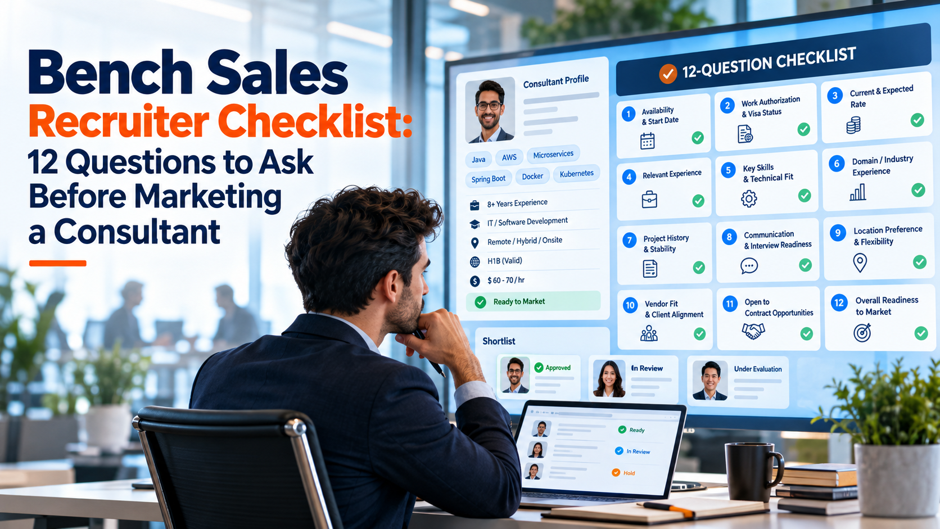
A consultant’s profile goes out to a vendor once, and the first impression it makes is hard to undo. Before that email or hotlist entry goes out, a short set of questions decides whether the submission has a real chance or wastes the recruiter’s time, the consultant’s patience and the vendor’s trust. Skipping any of them shows up later, usually at the worst moment, such as a client interview or a background check.
This checklist gathers 12 questions a bench sales recruiter should ask every consultant before marketing begins. They cover skills and experience, availability and logistics, compliance and representation, and rate and profile readiness, grouped so the intake conversation flows in a natural order. Each question includes what a good answer looks like and what a weak answer should prompt the recruiter to do next.
TL;DR
- Skills and logistics come first. A consultant’s technology depth, project history, location and start date decide which requirements are worth chasing at all. Getting these answers early prevents the recruiter from spending time on a requirement the consultant can’t actually fill, and it gives the recruiter the specific details a vendor screener checks in the first minute of reading a resume.
- Compliance protects every submission. Work authorization status, exclusivity with other recruiters and willingness to sign a right to represent all affect whether a vendor can accept the consultant at all. Missing any of these 3 risks: a rejected bid, a duplicate submission conflict or a placement that falls apart during onboarding, after the recruiter has already invested time building the relationship with that vendor.
- Rate and readiness decide whether it closes. A consultant’s minimum rate, contract type, an accurate resume and readiness for a background check determine whether an interview turns into an offer. These questions belong at the end of intake, once the recruiter already knows the consultant is a technical and logistical fit for the kind of work being marketed.
Why a Pre-Marketing Checklist Matters
A checklist turns a loose conversation into a repeatable process, and repeatable processes are what let a bench sales recruiter run 20 or more consultants at once without losing track of who can start when or who needs a visa question answered first. Without a fixed set of questions, 2 recruiters on the same team ask different things, collect different details and submit consultants with gaps that only surface once a vendor calls to schedule an interview.
The cost of skipping a question rarely shows up right away. A consultant who wasn’t asked about planned time off accepts an interview and then discloses a 2-week trip the day before it. A consultant who wasn’t asked about exclusivity turns out to already be marketed by another vendor, and the submission gets rejected as a duplicate. Each of these problems traces back to a question that should have been asked during intake, before the resume ever left the recruiter’s inbox.
The 12 Questions at a Glance
The table below lists all 12 questions in the order they belong in an intake conversation, along with what each one protects. Reading the table first gives the recruiter the full shape of the checklist before working through the detail in the sections that follow, and it also works as a quick reference to pin near the desk during a busy week of submissions.
| Question | What It Protects | |
| 1 | What is the core technology stack and depth of hands-on experience? | Whether the consultant genuinely fits the requirement |
| 2 | Can the consultant walk through 2 or 3 recent projects in detail? | Interview performance once a vendor schedules a call |
| 3 | What certifications or credentials support the resume claims? | Credibility with the vendor’s technical screener |
| 4 | What is the current location, and is relocation or onsite work possible? | Which requirements are geographically realistic |
| 5 | What is the earliest start date, and is time off planned? | Whether the timeline matches what the vendor needs |
| 6 | Is the consultant reachable during US business hours? | Interview scheduling and follow-up speed |
| 7 | What is the exact work authorization status and expiry? | Which vendors and clients can legally accept the submission |
| 8 | Is another recruiter currently marketing this consultant? | Duplicate submission conflicts and wasted vendor trust |
| 9 | Will the consultant sign a right to represent each posting? | Whether the submission is valid under vendor program rules |
| 10 | What is the minimum rate and preferred contract type? | Whether the deal can close at a rate everyone accepts |
| 11 | Does the resume match the LinkedIn or job board profile? | Whether the vendor’s fact-check turns up a mismatch |
| 12 | Is the consultant ready for a background check? | Whether onboarding proceeds without a last-minute surprise |
The order matters because each answer narrows the field before the recruiter invests more time. A consultant who fails the skills questions shouldn’t reach the compliance questions yet, because there’s no requirement to represent them for. Working top to bottom keeps the intake conversation efficient and avoids asking about rate before confirming the consultant is even a technical match.
Skills and Experience Questions
The first 3 questions establish whether a consultant genuinely fits the kind of requirement the recruiter plans to chase. Answers here come from the consultant directly, and vague answers are themselves useful information, because a consultant who struggles to describe their own work will struggle more in a live technical screen with a stranger on the other end of the call.
Question 1: What Is the Core Technology Stack, and How Deep Is the Hands-On Experience? Ask the consultant to name their top 3 tools or platforms and the number of years spent on each in a production environment, not in a course or a personal project. A vendor screener reads a resume in seconds and looks for exact keyword matches near the top, so the recruiter needs those 3 tools clearly identified before writing a single hotlist entry. A consultant who lists 10 skills with no clear depth in any of them is harder to market than one who lists 3 with real experience behind each.
Question 2: Can the Consultant Walk Through 2 or 3 Recent Projects in Technical Detail? Ask for a short, specific description of what the consultant actually built or fixed on their last 2 projects, including the scale of the work and their individual contribution on a team. This question previews how the consultant will perform in a live interview, since a vendor’s technical panel asks the same thing within the first few minutes. A consultant who answers in vague generalities needs coaching before any submission goes out, not after a vendor complains.
Question 3: What Certifications or Credentials Support the Resume Claims? Ask for the exact certification name, the issuing body and the date earned, then confirm the consultant can produce the certificate if a vendor asks. Some programs require candidates to confirm that their skills table reflects real experience and hasn’t been embellished, so a credential that can’t be verified is a liability rather than an asset on the resume. Certifications that have lapsed or were never completed should come off the resume before marketing starts.
A consultant who answers all 3 questions clearly and specifically is ready for the next stage of intake. A consultant who struggles with any of them needs either more preparation time before marketing begins or a narrower set of requirements that match what they can actually demonstrate under questioning. Recruiters who note the specific gap, rather than a general impression that the call went poorly, know exactly what to revisit before the next attempt.
Availability and Logistics Questions
Questions 4 through 6 confirm that the consultant can actually take the kind of role the recruiter plans to submit them for. A perfect technical match falls apart if the consultant can’t start on time, won’t relocate for an onsite requirement or is impossible to reach when a vendor calls to schedule an interview on short notice. These answers also shape which hotlist entries and targeted emails the recruiter sends out that same day.
- Location and relocation. Ask where the consultant currently lives, whether they’re open to relocating and whether they’ll accept fully onsite, hybrid or remote-only roles. A consultant open to relocation reaches requirements a location-only search would miss entirely, so this answer changes which job boards and vendor contacts are worth checking each morning. Write the answer down precisely, because “open to relocation” means different things to different consultants.
- Start date and planned time off. Ask for the earliest realistic start date and any vacations, family commitments or other obligations planned in the next 6 months. A consultant who can’t disclose a planned trip until after accepting an interview puts the recruiter in an awkward position with the vendor, so this question belongs in intake rather than after a submission is already in motion. Recording the date also lets the recruiter match consultants to requirements with a tight start window.
- Reachability during business hours. Ask how quickly the consultant typically responds to a call or message during US business hours, and confirm the best number and time zone to reach them. Vendors move fast once they decide to schedule an interview, and a consultant who takes a day to respond loses opportunities to consultants represented by recruiters who reach them within the hour. A clear answer here also tells the recruiter whether to warn the vendor about a response delay in advance.
Together these 3 answers tell the recruiter which requirements are realistic to chase and which aren’t worth the effort. A consultant who is available immediately, flexible on location and quick to respond opens up a wider set of postings than one who is tied to a single city and slow to reply, and that difference shows up directly in how many submissions turn into interviews.
Compliance and Authorization Questions
Questions 7 through 9 exist because a technically strong, logistically available consultant can still be unmarketable if the compliance basics aren’t in order. These questions protect the recruiter’s standing with vendors as much as they protect the consultant, since a rejected or disqualified submission reflects on the recruiter who sent it and can make that vendor slower to open the recruiter’s next email.
| Question | What to Ask For | Why It Matters |
| Work authorization status | The exact category, such as CPT, OPT, STEM OPT, H1B, H4 EAD, GC or TN, along with expiry dates and any pending transfer | Determines which vendors and clients can legally accept the consultant at all |
| Exclusivity with other recruiters | Whether the consultant’s resume is currently active with another agency for similar roles | Prevents duplicate submissions that get rejected or disqualify the consultant |
| Willingness to sign a right to represent | Confirmation that the consultant will approve a posting-specific right to represent when asked | Many vendor programs reject submissions that arrive without a valid one |
Work authorization deserves the most careful handling of the 3, since the consultant’s status affects which requirements are even worth pursuing and the recruiter’s employer carries legal responsibility for representing it accurately. Exclusivity matters because vendor programs treat a duplicate submission as a conflict, and some contracts disqualify a candidate submitted by more than 1 vendor for the same posting. A consultant who hesitates on the right to represent a question needs a short explanation of what it is and why it protects them, not a submission sent without one.
A recruiter who confirms all 3 before marketing avoids the most common reasons a strong candidate gets rejected before a vendor even reaches the technical screen. These questions take a few extra minutes during intake, and they save hours of back-and-forth later when a program’s compliance team flags an incomplete submission, which usually happens days after the recruiter has already moved on to other requirements.
Rate and Profile Readiness Questions
The final 3 questions come last in intake because they matter most once a requirement has already been identified and the consultant has passed the skills, logistics and compliance checks. These are the details that decide whether an interview turns into an accepted offer, and asking them too early wastes time on consultants who never make it past the first checks.
Question 10: What Is the Minimum Acceptable Rate, and Which Contract Type Does the Consultant Prefer? Ask for a target rate and a firm minimum, along with whether the consultant wants W2, corporate contract (C2C) or 1099 terms. Agreeing these numbers before any vendor call means the recruiter can negotiate on the spot instead of pausing to call the consultant back for approval, which can cost the deal to a faster-moving competitor. The contract type also determines which vendors and client programs can even accept the submission, since some require W2 status for every contractor on a project.
Question 11: Does the Resume Match the Consultant’s LinkedIn or Job Board Profile, Fact for Fact? Ask the consultant to review their LinkedIn and any job board listings for consistency with the resume being submitted, including job titles, dates and the technologies listed. A vendor recruiter who checks LinkedIn after reading the resume and finds a mismatch in dates or titles loses confidence in the whole submission, even when the underlying experience is genuine. Fixing small inconsistencies during intake is far easier than explaining them after a vendor has already noticed.
Question 12: Is the Consultant Prepared for a Background Check, and Are There Employment Gaps to Explain? Ask directly about any gaps in the employment history and whether the consultant expects a background check or reference verification to raise anything unusual. Background checks typically add about 2 weeks to onboarding, and a consultant who is caught off guard by a question about a gap can stumble in a way that raises unnecessary doubt. A short, honest explanation prepared in advance turns a potential red flag into a non-issue.
These last 3 questions close the loop between a strong technical match and an actual placement. A consultant who clears questions 1 through 9 but stumbles on rate expectations or resume consistency can still lose a placement that looked certain a day earlier, which is why the recruiter confirms all 3 before treating any submission as settled and ready to send.
Red Flags That Signal You’re Not Ready to Market Yet
Some answers during intake are clear signals to pause marketing rather than push ahead and hope the gap doesn’t surface later. Recognizing these patterns early saves the recruiter from a rejected submission, a damaged vendor relationship or a consultant who accepts an interview they can’t actually attend, and each pattern below is worth watching for on every intake call.
- Vague or rehearsed-sounding project descriptions. A consultant who can’t explain their own recent work in specific terms, or who repeats the same generic phrases for every project, is likely to struggle in a live technical interview. This is worth addressing with coaching before any resume goes out, because the gap will surface at the worst possible moment, in front of the vendor’s own technical panel.
- Shifting availability or rate expectations. A consultant whose start date, minimum rate or contract type preference changes each time the recruiter asks isn’t ready to be marketed with confidence. Submitting a profile with numbers that might change wastes a vendor’s time and damages the recruiter’s credibility when the terms shift again after an interview has already been scheduled.
- Reluctance to discuss work authorization clearly. A consultant who deflects questions about visa status, expiry dates or pending transfers usually has a complication that needs to be resolved before marketing, not during it. Recruiters should route unclear cases to immigration counsel rather than guess, since an inaccurate representation affects the recruiter’s employer as much as the consultant, and the mistake is hard to undo once a vendor has already seen the submission.
- No clear answer on other active submissions. A consultant who can’t say whether another recruiter is currently marketing them creates real risk of a duplicate submission conflict. This question deserves a direct answer before any resume leaves the recruiter’s hands, because the alternative is a rejected bid discovered only after a vendor’s compliance team catches the overlap, which wastes both the recruiter’s effort and the vendor’s screening time.
- Resume details that don’t match verbally. When a consultant describes their experience differently than the resume states, the mismatch needs to be resolved before submission, not explained away afterward. Either the resume needs correcting or the consultant’s account needs correcting, and leaving the gap unresolved risks a rejected candidacy at the worst point in the process, usually right after a vendor has already scheduled the interview.
None of these red flags mean the consultant can’t eventually be marketed successfully. They mean the recruiter has more intake work to do before the profile is ready, and that extra work is far cheaper than an interview that falls apart or a vendor relationship damaged by a poorly prepared submission that never should have gone out in the first place.
Documenting the Answers You Collect
Asking the 12 questions accomplishes little if the answers aren’t written down somewhere the recruiter can find them again quickly. A consultant’s rate, availability and visa status all change over time, so the record needs a clear date attached and a simple way to flag when it’s due for an update, otherwise the checklist becomes a one-time exercise instead of a living record.
Most recruiters keep this information in a tracking sheet or an internal database alongside submission history, following the same daily reporting habits that already track hotlist activity and vendor responses. Recording the answer to each of the 12 questions in a consistent format, rather than as scattered notes from different calls, means any recruiter on the team can pick up a consultant’s file and market them accurately without calling the consultant to re-ask basic questions. A monthly check-in, which some bench sales teams already run to confirm submission status, is also the natural point to refresh answers that tend to shift, particularly availability and rate.
Good documentation also protects the recruiter when a dispute arises. If a vendor later questions whether a consultant disclosed a work authorization detail or agreed to a specific rate, a dated record of the intake conversation settles the question quickly. Without that record, the recruiter is relying on memory against a vendor’s own paperwork, which is a weak position to argue from.
How to Use the Checklist During Intake
The 12 questions work best as a structured conversation rather than a form the consultant fills out alone, since follow-up questions catch details a written form would miss. Breaking the conversation into 3 stages keeps it efficient without skipping anything that matters, and each stage has a clear purpose that carries into the next, so nothing important gets rushed at the end of a long call.
Before the call, send the consultant a short list of what to have ready, such as certification names, current resume and a rough sense of their target rate, so the call itself moves faster. Reviewing the consultant’s existing resume and LinkedIn profile beforehand lets the recruiter spot inconsistencies to raise directly rather than discovering them later from a vendor. A few minutes of preparation on both sides turns a 45-minute intake call into a focused 20-minute conversation.
During the Call Work through the 12 questions roughly in the order they appear in this checklist, starting with skills and ending with rate and readiness, since each answer builds context for the next. Ask follow-up questions whenever an answer feels vague, especially on the project-detail and work-authorization questions, because a rushed answer there is the one most likely to cause a problem later. Take notes in real time rather than trying to reconstruct the conversation afterward from memory.
After the Call, Write the answers into the consultant’s record the same day, while the details are still fresh, and flag anything that needs a follow-up before marketing begins. If any red flag surfaced during the call, resolve it before the first submission goes out rather than marketing the consultant and hoping the gap doesn’t matter. A consultant who clears every question cleanly is ready to move straight into hotlist entries and targeted vendor outreach.
When to Revisit the Checklist
A consultant’s answers don’t stay accurate forever, and a checklist run once at the start of a bench period can go stale within weeks. Certain events should trigger a full or partial re-check rather than waiting for the next scheduled update, since a stale answer can send a submission out on outdated information that the vendor later catches before the recruiter does.
- A visa status changes or nears expiry. Any update to work authorization, including an approved transfer, a pending extension or an approaching expiry date, needs to reach the recruiter immediately, since it can change which requirements are still valid to pursue. Marketing a consultant on an outdated authorization record risks a submission that falls apart during onboarding, after both the recruiter and the vendor have already invested time in it.
- A significant amount of time passes on the bench. A consultant who has been on the bench for several weeks may have adjusted their minimum rate, widened their location flexibility or accepted an offer elsewhere that needs to be confirmed. Revisiting the core questions at this point often reopens requirements that looked closed earlier, simply because the consultant’s own situation has shifted since the first conversation.
- A vendor raises a question the intake didn’t cover. When a vendor’s screening process asks something the original checklist missed, that gap should be added to the standard set of questions going forward, so the same surprise never repeats with the next consultant. Treating each surprise as a chance to improve the checklist keeps future intake conversations more complete.
- The consultant’s rate or contract preference shifts. A change in target rate, minimum acceptable rate or preferred contract type changes which requirements are still a fit and should update every active hotlist entry and vendor conversation immediately. Marketing at an outdated rate wastes time on both sides once the real number surfaces during negotiation, and it can cost the recruiter credibility with a vendor who already quoted the old figure to a client.
Building these triggers into the daily routine keeps the checklist accurate without turning every update into a full re-interview. A short, targeted question about the specific thing that changed is usually enough, and it shows the consultant that the recruiter is actively managing their bench time rather than treating the intake conversation as a one-time formality that gets filed away and forgotten.
Common Mistakes When Skipping Questions
Most problems that surface after a submission trace back to 1 of these 12 questions being skipped or answered too quickly during intake. The table below maps the mistake to its usual consequence and the fix that prevents it from recurring, so the same error doesn’t repeat across the next consultant’s file, once the recruiter has seen the pattern once.
| Mistake | Usual Consequence | Fix |
| Skipping the depth-of-experience question | Consultant struggles in the technical interview | Ask for specific years and production examples on the top 3 skills |
| Not confirming planned time off | Consultant discloses a trip after accepting an interview | Ask about the next 6 months directly during intake |
| Accepting a vague work authorization answer | Submission gets rejected or the placement falls apart later | Get the exact category, expiry date and any pending transfer in writing |
| Not asking about other active submissions | Duplicate submission conflict with another vendor | Ask directly and record the answer before any resume goes out |
| Skipping the resume-to-profile comparison | Vendor notices a mismatch and loses confidence in the submission | Review LinkedIn and job board listings against the resume together |
Each of these mistakes is easy to avoid and expensive to fix after the fact. A recruiter who works through all 12 questions every time, even with consultants who seem straightforward, catches the rare mismatch before it costs a placement rather than after, and that habit is what separates a consistent bench sales desk from an inconsistent one.
FAQs
Why does a bench sales recruiter need a checklist before marketing a consultant?
A checklist turns intake into a repeatable process instead of a loose conversation that varies by recruiter. Missing a single question, such as work authorization status or an existing submission with another vendor, can cost a placement or damage a vendor relationship. The 12 questions catch these gaps before a resume ever leaves the recruiter’s inbox.
Which of the 12 questions matters most?
Work authorization status carries the most legal and practical weight, since it determines which vendors and clients can even accept the consultant. Skills depth and exclusivity with other recruiters follow closely, because a technical mismatch or a duplicate submission both end a placement before it starts. All 12 matter, but these 3 cause the most damage when skipped.
How long should an intake conversation using this checklist take?
A focused conversation covering all 12 questions usually runs 20 to 30 minutes once the consultant has prepared their resume and certification details in advance. Vague or inconsistent answers extend the call, since those are exactly the points that need follow-up questions. A consultant who answers everything clearly moves through the checklist quickly, and that speed itself is a good sign the profile is ready to market.
How often should the checklist be repeated for the same consultant?
Core answers such as skills and certifications rarely change, but rate, availability and work authorization status should be reconfirmed on a regular basis, such as monthly, and immediately after any event that could affect them. A visa expiry approaching or a rate expectation shifting are both reasons to revisit the relevant questions right away rather than waiting for the next scheduled check.
What should a recruiter do if a consultant can’t answer a compliance question clearly? Route the question to the company’s immigration counsel or compliance team rather than guessing at an answer. Marketing a consultant with an unclear work authorization status risks a submission that gets rejected or a placement that falls apart during onboarding. It’s better to pause marketing for a few days than to represent an unclear status as settled.
Does every question need to be asked in person or by phone?
A phone or video call works best for questions where tone and hesitation reveal useful information, particularly the project-detail and compliance questions. Simpler logistical details, such as location or certification dates, can be confirmed by email or an intake form. Mixing the methods keeps the conversation efficient without losing the value of a live discussion for the harder questions.
How does this checklist reduce duplicate submissions?
Question 8 asks directly whether another recruiter is currently marketing the consultant for similar roles, and question 9 confirms the consultant understands that a right to represent applies to 1 specific posting at a time. Answering both clearly during intake, before any submission goes out, is the most reliable way to avoid a conflict that a vendor’s compliance team would otherwise catch later.
Should the checklist change for different types of consultants?
The core 12 questions apply to any consultant being marketed for a US IT contract role, regardless of technology or experience level. Some questions carry more weight for certain consultants, such as work authorization for a visa holder nearing a transfer deadline or rate flexibility for a highly specialized skill set. The order and depth of follow-up can adjust, but none of the 12 questions should be skipped entirely.