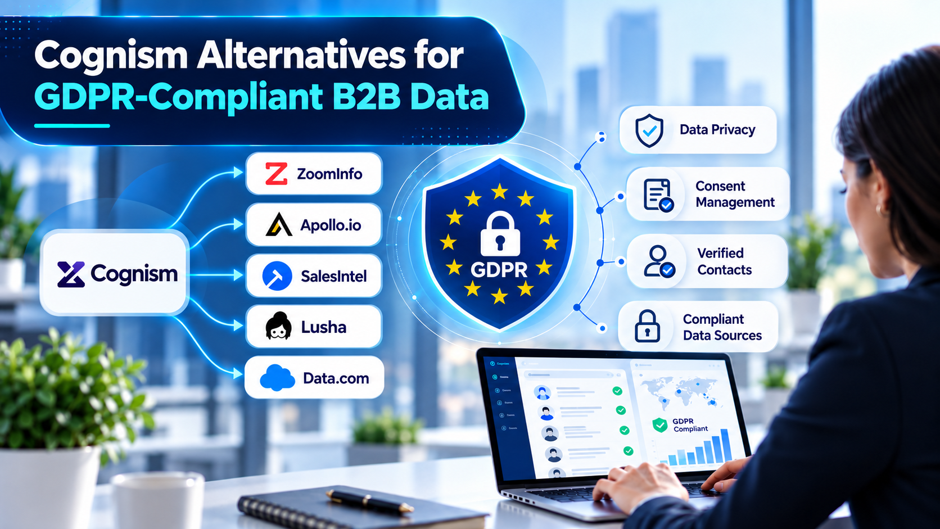
Cognism Alternatives for GDPR-Compliant B2B Data
Cognism built its reputation on a specific promise: business contact data for Europe that a legal team can sign off on without a long argument about where the numbers came from. That promise matters, because a B2B database sourced the wrong way can turn a prospecting list into a regulatory problem, and the cost of that mistake lands on the buyer as much as the vendor. A single complaint from a data subject can trigger a regulator’s questions about where a company’s outbound list originated, and the answer to that question depends entirely on which provider supplied the data in the first place.
Cognism isn’t the only option built around that promise, though, and it isn’t the right fit for every team. Some buyers need deeper North American coverage, some want self-serve pricing instead of an annual contract, and some are evaluating a second provider to fill gaps in a specific country that Cognism doesn’t cover as deeply. This post looks at how Cognism handles GDPR today, what to check before switching to another provider, and how 6 commonly evaluated alternatives compare on the compliance details that actually matter to a legal or revenue operations team, from the lawful basis each vendor relies on to how many countries their Do Not Call screening actually covers.
TL;DR
- Cognism’s compliance model rests on 3 pillars. It sources data only from public sources, processes it under the legitimate interest lawful basis with formal assessments on file, and operates a notified database that tells data subjects it holds their information under Article 14 of the GDPR. It also screens phone numbers against Do Not Call registries in roughly 15 countries and holds ISO 27001, ISO 27701 and SOC 2 Type II certifications.
- Alternatives split into 3 groups. Global platforms such as ZoomInfo and Apollo.io offer broader worldwide coverage but thinner European compliance tooling. European-native providers such as Dealfront source from public trade registers and host data inside the EU. Lean prospecting tools such as Lusha, Kaspr and UpLead compete on price and simplicity, with compliance depth that varies by vendor and deserves its own check.
- The right choice depends on where you sell. A team selling mostly into North America rarely needs Cognism’s depth of European Do Not Call screening, while a team running outbound calls into the UK, France and DACH usually does. Checking each provider’s lawful basis, DNC country list and certifications against your own target markets, rather than trusting a marketing page alone, is the step that actually protects you.
Why Teams Look Beyond Cognism
Cognism’s pricing runs on annual contracts, and public reporting on deal sizes places most agreements somewhere between $15,000 and $50,000 a year depending on seats and data access. That structure suits a revenue team with a defined European motion and a budget approved in advance, but it’s a mismatch for a smaller team that wants to start with a self-serve monthly plan and scale up only once the data proves out. Several of the alternatives in this post solve exactly that mismatch with credit-based or per-seat pricing that starts far lower, letting a small team test data quality against a real pipeline before committing to a 12-month agreement they haven’t yet validated.
Geography is the second common reason teams look elsewhere, and it comes up in nearly every vendor evaluation call once budget has been discussed. Cognism’s own comparisons describe its strength as concentrated in the UK, DACH, Benelux, Nordics, France and Spain, which is exactly where a Europe-first team wants that strength to sit. A team whose pipeline runs mostly through North America, or one that needs deep coverage in a market outside Cognism’s strongest regions, often finds a platform built around a larger global database fits the go-to-market motion better, even if it means building a separate compliance process for the European portion of that pipeline.
A third reason shows up less often in marketing comparisons but matters in practice: some buying committees want a second, independent data source to validate contact accuracy against, and picking a provider with a genuinely different sourcing model from Cognism’s notified-database approach gives that cross-check more value than picking a near-identical competitor would.
How Cognism Handles GDPR Today
Cognism’s own compliance documentation lays out a specific, checkable process rather than a general promise. The company states that it obtains business contact data only from publicly available sources and validates the dataset on an ongoing basis, rather than buying bulk lists from unnamed third parties. It processes personal data under the lawful basis of legitimate interest as defined in Article 6(1)(f) of the GDPR, and it backs that basis with a legitimate interest assessment, a data protection impact assessment and a transfer impact assessment, each completed with external legal counsel.
The notification piece is where Cognism’s approach differs most visibly from a scraped or unverified database. Where Article 14 of the GDPR requires it, Cognism notifies the individuals in its database that it holds their information, explains how that data is used and gives them a way to opt out, which is what the company refers to as a notified database. On the calling side, Cognism screens its telephone data against Do Not Call and similar registries in around 15 countries, including the UK’s TPS and CTPS lists, along with registries in the US, Germany, France, Ireland, Canada, Spain, Portugal, Croatia, Sweden and Belgium.
Cognism also documents the parts of a compliance program that a legal team typically asks about directly. It holds ISO 27001 and ISO 27701 certifications alongside SOC 2 Type II compliance, keeps most collected data inside the European Economic Area, and applies standard contractual clauses when data does move outside it. The company is registered with the UK’s Information Commissioner’s Office and, in the US, registered as a data broker under the California Consumer Privacy Act. A dedicated internal team handles data subject access requests within the required timeframes, which is the operational detail that turns a privacy policy into a working process rather than a document that sits unused until a regulator asks for it. Cognism also runs annual security and GDPR training for staff and puts contractual safeguards in place with the third parties it works with, so the compliance program covers its own supply chain as well as the customer-facing product.
What Changes When You Switch Providers
Moving from Cognism to another vendor changes more than the login screen, since the new provider’s sourcing model, lawful basis and screening coverage become part of your own compliance story the moment their data lands in your CRM. The table below lists the areas worth checking before signing, since each one affects how defensible your outbound program is if a data subject or a regulator asks how their information reached your CRM.
| Area to Check | Question to Ask | Why It Matters |
| Lawful basis | Does the provider rely on legitimate interest, consent or another basis, and is that documented? | Determines whether your own outreach has a defensible legal foundation |
| Notification model | Are data subjects informed that their data is held, as Article 14 requires? | An unnotified database creates a compliance gap the buyer inherits |
| DNC and TPS screening | Which countries does the provider screen against Do Not Call registries? | Cold calling into an unscreened country risks fines and complaints |
| Certifications | Does the provider hold ISO 27001, ISO 27701 or SOC 2, and are they current? | Certifications give a legal team an independent basis to trust the vendor |
| Data hosting location | Where is the data stored, and does it leave the EEA? | Cross-border transfers need their own safeguards under GDPR |
| DSAR and deletion handling | How quickly does the provider process access and deletion requests? | Slow handling reflects on your own compliance if a data subject complains to you first |
Reading a vendor’s compliance page is a start, but it’s worth asking for the actual certificates and the country list for DNC screening rather than accepting a general claim of being GDPR compliant. Several providers in this space describe themselves that way while covering very different ground underneath the label, and the gap between the marketing claim and the operational detail is exactly where risk sits. A short call with the vendor’s compliance or legal contact, rather than a sales representative alone, usually surfaces the operational detail faster than reading through marketing pages on your own.
Cognism Alternatives at a Glance
The table below summarizes 6 commonly evaluated alternatives before the sections that follow go into more detail on each one, covering the audience each provider fits best and the lawful basis it relies on for GDPR. Pricing figures are directional, since providers in this space change plans and packaging often, and should be confirmed directly before any purchase decision rather than assumed from a comparison page written months earlier.
| Provider | Best For | Compliance Basis |
| ZoomInfo | Global teams with a North American core and a European tail | Legitimate interest, privacy notices to addressable contacts, DNC screening in 8 countries |
| Apollo.io | Budget-conscious self-serve teams that need data plus a built-in sequencer | GDPR and CCPA compliance stated, DNC checking limited to the UK and US |
| Lusha | Lean outbound teams that want a lower entry price with solid certifications | Legitimate interest with a signed Data Processing Agreement, ISO 27701, ISO 27001, ISO 27018 and SOC 2 Type II |
| Kaspr | Teams prioritizing French and wider European direct-dial data | GDPR and CCPA compliance stated by the vendor, though sourcing practices have drawn regulatory scrutiny |
| UpLead | Teams that want a real-time accuracy guarantee on a smaller list | GDPR compliance stated, verification centered on email accuracy rather than phone DNC screening |
| Dealfront | DACH and Nordics-focused teams that want EU-hosted, registry-sourced data | Built on public trade register data, hosted and processed entirely within the EU |
ZoomInfo for Global Coverage With EU Support
ZoomInfo is the largest and most established platform on this list, and its core strength is depth in North America rather than Europe specifically. The company reports well over 300 million contact profiles worldwide and positions itself around go-to-market intelligence broadly, not compliance as the primary differentiator, which shows in how it talks about its own product compared to how Cognism talks about its own. ZoomInfo has also invested in privacy leadership at an executive level, bringing in a former UK Information Commissioner’s Office policy director to advise on how the company and its customers navigate GDPR and similar regulations as they evolve.
On the compliance side, ZoomInfo processes personal data under legitimate interest and sends privacy notifications to addressable data subjects regardless of their location, a practice similar in spirit to Cognism’s notified database. Its Do Not Call suppression currently covers 8 countries, a narrower net than Cognism’s roughly 15, and several comparison sources note that European data quality and coverage in ZoomInfo can be inconsistent outside the core North American dataset. A team with a genuinely global pipeline, where Europe is 1 region among several rather than the primary focus, often finds ZoomInfo’s breadth outweighs that narrower compliance footprint, while a Europe-first team usually doesn’t. Buyers evaluating ZoomInfo specifically for European outbound should ask which of the 8 DNC-covered countries match their own target list, since a mismatch there is easy to miss until a campaign is already underway.
Apollo.io for Budget-Conscious Self-Serve Teams
- Pricing and access. Apollo runs on tiered, self-serve pricing starting at a fraction of Cognism’s typical annual contract, with a free tier for small-volume testing and paid plans priced per user rather than per seat on a long commitment. That structure suits a founder-led sales team or a small SDR pod that wants to start immediately rather than negotiate an annual deal.
- Compliance coverage. Apollo states GDPR and CCPA compliance and holds ISO 27001 and SOC 2 certification, but its Do Not Call list checking is limited to the UK and US according to comparison sources that track this specifically. Several independent reviews describe Apollo’s compliance tooling as lighter than dedicated European-first providers, which is a reasonable trade-off for a team focused on North America but a real gap for one calling into wider EMEA markets.
- Where it fits best. Apollo’s combination of a large global database, a built-in sequencer and low-friction pricing makes it a strong fit for teams that want 1 tool for both data and outreach, provided the European compliance gap is either acceptable for the target market or covered by a second, more compliance-focused source for that specific region. Founder-led teams and early-stage SDR functions in particular tend to value the single-tool convenience more than a specialist European data provider’s deeper certification stack, at least until the pipeline grows enough to justify a second subscription.
Lusha for Lean European Outbound
Lusha built its product around a Chrome extension that surfaces contact details on LinkedIn profiles, with a contributor model where users browsing the platform add data back into the shared database. That architecture gives Lusha strength in markets where its user base is active, particularly parts of Northern Europe, while leaving thinner coverage in regions where fewer contributors browse.
On compliance, Lusha holds a genuinely strong certification stack for a tool in its price range: ISO 27701 for privacy management, ISO 27001, ISO 27018 and SOC 2 Type II, alongside a pre-signed Data Processing Agreement that includes EU and UK standard contractual clauses. The company states it processes data under legitimate interest, sends personal information notices to EU data subjects with an opt-out option and runs a self-service privacy center for data subject requests. For a team that wants Cognism-level certification depth at a lower price point and is comfortable with a smaller, contributor-sourced database rather than Cognism’s larger notified one, Lusha is one of the more credible options on this list. Lusha also publishes subprocessor information and notifies customers when a data subject requests deletion of their record, which gives a compliance team a paper trail similar in spirit to what larger, more expensive platforms provide.
Kaspr for Direct-Dial Prospecting in France and Europe
Kaspr, born in France with additional hubs in the UK and Spain, built its reputation on direct-dial phone numbers for European contacts, drawing on more than 120 partner data sources and a Chrome extension similar in concept to Lusha’s. The company states that its data is collected in compliance with GDPR and CCPA, while also noting on its own site that users remain responsible for their own compliance with local marketing and consent rules, a more cautious framing than Cognism’s compliance page uses.
That caution is worth taking seriously given Kaspr’s regulatory history. France’s data protection authority, the CNIL, fined Kaspr 200,000 euros over its LinkedIn-based data collection practices, citing breaches including a missing lawful basis for some processing, a retention period not matched to the purpose of that processing, insufficient transparency to data subjects under Articles 12 and 14, and gaps in handling individual access requests under Article 15. The regulator also ordered Kaspr to stop collecting data from LinkedIn users who had limited the visibility of their own contact details.
This doesn’t mean Kaspr is unusable for a compliance-conscious team, since regulators can and do issue corrective orders that a company then implements, but it’s a concrete, documented example of the kind of scrutiny a scraping-based sourcing model can draw, and it’s the type of detail worth raising directly with any vendor’s compliance team before signing. A team still evaluating Kaspr for its French and direct-dial strength should ask specifically what changed in its data collection process after the CNIL decision, since that answer says more about current risk than the fine itself does.
UpLead for Verified Email-First Lists
Accuracy Model UpLead’s whole product is built around a single, testable claim: every email is verified in real time at the moment a user reveals a contact, and if that verification fails, the credit isn’t charged. The company backs this with a stated accuracy guarantee in the mid-90s percentage range, which is a meaningfully different promise than a database that verifies records on a periodic schedule and lets accuracy drift between refreshes.
Compliance Posture UpLead lists GDPR as part of its compliance profile, and third-party vendor tracking sites list the same tag, but public detail on its lawful basis, notification practices or Do Not Call screening by country is thinner than what Cognism, Lusha or Dealfront publish. For a team whose outreach is entirely email-based rather than phone-based, that gap matters less, since the specific compliance risk UpLead needs to manage is narrower than a platform that also sells verified mobile numbers for cold calling.
Pricing and Fit UpLead runs on tiered, credit-based pricing that starts well below Cognism’s typical annual contract and scales with usage, which makes it a natural fit for a smaller team or an individual rep who wants a verified list without committing to an enterprise data platform. Teams that need phone-based European outreach with documented DNC screening should treat UpLead as a complement to a more phone-focused provider rather than a full replacement for one.
Dealfront for Trade-Register-Sourced DACH and Nordics Data
- Data sourcing model. Dealfront, formed from the merger of the German firm Echobot and the Finnish company Leadfeeder, builds its dataset on public trade and business registers rather than scraped social profiles, then enriches those records with public web data and cross-references them against directory sources. Each record in the platform can be traced back to a specific source, which gives a compliance team a clearer audit trail than a provider that can’t point to where an individual data point originated.
- Hosting and processing. All of Dealfront’s data processing and hosting happens inside the European Union, and the company markets this as a deliberate difference from competitors that process European data on servers outside the EEA. For a legal team specifically worried about cross-border transfer risk, EU-only hosting removes an entire category of question that comes up with most of the other providers on this list.
- Regional strength and gaps. Dealfront’s strongest coverage sits in DACH and the Nordics, reflecting its German and Finnish roots, and it holds ISO 27001 and ISO 27701 certification alongside its stated GDPR compliance. The trade-off is a narrower global footprint than ZoomInfo or Apollo, so a team that needs strong data outside Western and Northern Europe will likely need a second provider to fill those gaps. Teams selling primarily into Germany, Austria, Switzerland or the Nordic countries, where Dealfront’s trade-register sourcing runs deepest, often find the audit-trail advantage worth the narrower reach outside those specific regions.
Comparing Compliance Signals Across Providers
The table below lines up the compliance signals that came up across every provider in this post, so the comparison sits in 1 place rather than scattered across 7 separate write-ups, and a compliance or procurement team can use it as a starting checklist during vendor evaluation. Treat the DNC country counts and certification lists as a snapshot rather than a permanent fact, since providers update both regularly, and the numbers here should be reconfirmed directly with each vendor before a contract is signed.
| Provider | Lawful Basis | DNC or TPS Screening | Key Certifications |
| Cognism | Legitimate interest, notified database | Around 15 countries | ISO 27001, ISO 27701, SOC 2 Type II |
| ZoomInfo | Legitimate interest, privacy notices | 8 countries | Industry-standard security and privacy certifications |
| Apollo.io | GDPR and CCPA compliance stated | UK and US only | ISO 27001, SOC 2 |
| Lusha | Legitimate interest, signed DPA with SCCs | UK and US on higher plans | ISO 27701, ISO 27001, ISO 27018, SOC 2 Type II |
| Kaspr | GDPR and CCPA compliance stated | Not independently documented | Compliance framework under regulatory review after a 2026 CNIL fine |
| UpLead | GDPR compliance stated | Not a core feature; email-focused verification | Accuracy guarantee rather than security certification as the headline claim |
| Dealfront | GDPR compliance, EU-only processing | Not phone-focused; registry-sourced data | ISO 27001, ISO 27701 |
How Pricing Structures Differ Across the Field
Compliance depth and pricing model don’t always move together, and understanding the pricing shape of each provider helps set expectations before a sales call starts. The table below groups the 7 providers in this post by how they charge, since an annual enterprise contract and a monthly credit plan suit very different buying situations and involve very different internal approval processes before a contract gets signed.
| Pricing Model | Providers | Typical Starting Point |
| Annual enterprise contract | Cognism, ZoomInfo | Often $15,000 or more per year, scaling with seats and data access |
| Self-serve per-seat subscription | Apollo.io, Lusha | Free or low-cost entry tiers, scaling to team plans priced per user per month |
| Credit-based subscription | UpLead, Kaspr | Tiered monthly plans priced by contact volume, with credits refunded on failed verification in some cases |
| EU-hosted subscription with tiered access | Dealfront | Custom pricing scaled to company size, positioned closer to the enterprise tier than the self-serve tools |
A team’s budget approval process often decides as much about which provider fits as the compliance comparison does, and it’s worth mapping both before a vendor conversation goes too far. An annual enterprise contract needs procurement sign-off and usually a multi-stakeholder buying committee, while a self-serve monthly plan can start on a single rep’s company card and scale later once the data proves its worth. Neither model is inherently more compliant than the other, so the pricing decision and the compliance decision are worth treating as 2 separate evaluations rather than assuming the more expensive option is automatically the safer one.
Questions to Ask Any Provider Before You Buy
- Ask for the actual certificates, not the badge. A logo on a website proves nothing on its own, so request the current ISO or SOC 2 certificate and confirm the scope and expiry date match what the provider claims. A certification that lapsed a year ago and was never renewed is a common gap that a quick document request catches immediately.
- Ask which countries the Do Not Call screening actually covers. A provider that says it screens against Do Not Call lists without naming the countries is making a vaguer claim than one that lists them explicitly, and the difference between 8 countries and 15 can be the difference between a compliant campaign and a complaint.
- Ask how data subjects are notified. A notified database under Article 14 is a materially different model from one that never tells the people in it that their data is held, and the answer to this question tells you how exposed your own team is if someone in the database asks where you got their information. A provider that can show you a sample notification email and explain its opt-out mechanism has clearly built this into its process, rather than treating it as an afterthought.
- Ask about the provider’s own regulatory history. A provider that has faced a documented enforcement action, like Kaspr’s CNIL fine, isn’t automatically disqualified, but the specifics of what the regulator found and what the provider changed afterward belong in your due diligence notes before you sign. Most providers will discuss a past enforcement action directly if asked, and a vendor that deflects the question entirely is itself worth treating as a signal.
- Ask where the data is hosted and processed. Hosting inside the EEA removes a category of cross-border transfer risk that a US-hosted platform has to manage through standard contractual clauses instead, and knowing which model a provider uses shapes what your own legal team needs to review before signing. A provider that can’t answer this question clearly during a sales call is unlikely to have a clean answer ready for a regulator either.
FAQs
Is Cognism the only GDPR-compliant B2B data provider?
No. Several providers, including Dealfront, Lusha and UpLead, publish GDPR compliance claims backed by certifications such as ISO 27701 or ISO 27001. The depth of that compliance varies significantly between providers, so the certifications and the Do Not Call country list are worth checking individually rather than assuming every GDPR claim means the same thing, since 2 providers can both say they are compliant while covering very different ground underneath that label.
What makes Cognism’s approach to GDPR different from a typical data broker?
Cognism operates what it calls a notified database, meaning it tells data subjects it holds their information and gives them an opt-out, as Article 14 of the GDPR requires in certain circumstances. It pairs that with formal legitimate interest and data protection impact assessments completed with external legal counsel, rather than relying on a general compliance statement alone.
Which Cognism alternative has the strongest EU data hosting story?
Dealfront processes and hosts all of its data inside the European Union and builds its dataset from public trade registers rather than scraped social profiles. That combination gives a compliance team a clear, traceable answer to where the data comes from and where it lives, which is a stronger position than providers that host outside the EEA and rely on standard contractual clauses to bridge the gap.
Why did the CNIL fine Kaspr, and does that mean it should be avoided?
France’s data protection authority fined Kaspr 200,000 euros for GDPR breaches connected to how it collected contact data through a LinkedIn browser extension, including gaps in lawful basis, data retention and transparency to individuals. A documented enforcement action is a serious signal to raise directly with the vendor during due diligence, though it doesn’t automatically rule the provider out if the underlying issues have since been addressed.
Is Apollo.io GDPR compliant?
Apollo states that it complies with GDPR and CCPA and holds ISO 27001 and SOC 2 certification. Its Do Not Call list checking is limited to the UK and US according to independent comparisons, which is narrower than providers built specifically around European compliance, so a team calling into wider EMEA markets should confirm the current country coverage before relying on Apollo for that outreach.
How does ZoomInfo’s European compliance compare to Cognism’s?
ZoomInfo processes data under legitimate interest and sends privacy notifications to data subjects, similar in principle to Cognism’s notified database model. Its Do Not Call screening covers 8 countries against Cognism’s roughly 15, and several sources note that ZoomInfo’s European data depth is less consistent than its North American coverage, which fits its overall positioning as a global platform rather than a Europe-first one.
Do lower-cost alternatives like UpLead and Lusha sacrifice compliance for price?
Not necessarily. Lusha holds a certification stack, including ISO 27701, that rivals more expensive providers, while charging significantly less. UpLead’s compliance documentation is thinner on phone-specific screening, but its product is built around email verification rather than mobile calling, so the comparison depends on which channel your outbound program actually uses and how much weight your team places on phone-based Do Not Call coverage specifically.
Should a team use more than 1 provider for different regions?
Many teams do, since no single provider on this list covers every region with the same depth. A common pattern is pairing a strong North American platform such as ZoomInfo or Apollo with a European-focused provider such as Cognism or Dealfront for the markets where compliance and coverage matter most, then reconciling the resulting data in a CRM or enrichment workflow.