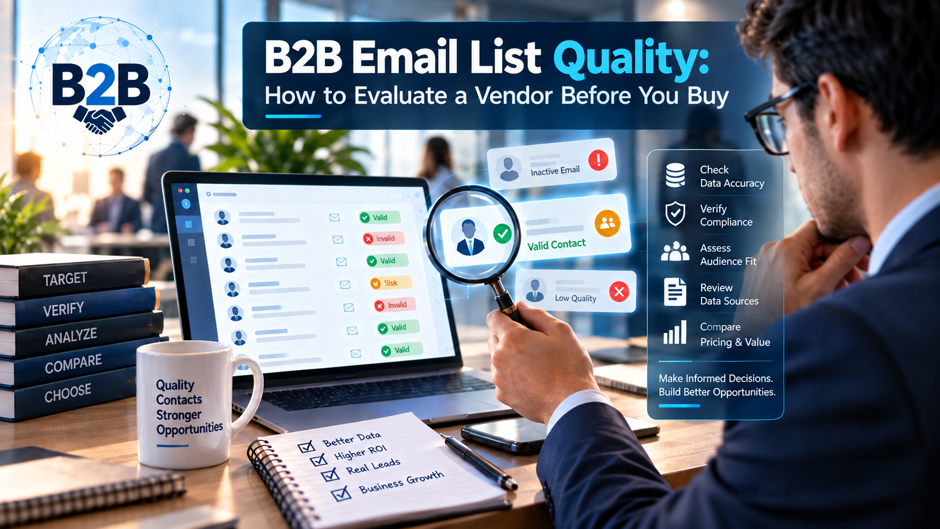
B2B Email List Quality: How to Evaluate a Vendor Before You Buy
Consider this illustrative cost example. A sales team buys 100,000 records at 3 cents each, feels good about the $3,000 price tag, and watches 35,000 of them bounce within the first send. What’s left is 65,000 non-bouncing contacts and a high-bounce campaign that can put sender reputation at risk. A different team buys 40,000 records at 15 cents each, spends $6,000, and ends up with 38,400 non-bouncing contacts. These figures aren’t a case study or a market benchmark. They’re simple arithmetic meant to show that the sticker price per record doesn’t tell a buyer how much usable data will remain after quality checks or what sending risk comes with the list. The lesson isn’t that expensive lists are automatically better. It’s that price, usable-record yield, and sending risk have to be evaluated together before the buyer decides what the list actually costs.
B2B email list quality doesn’t announce itself on a pricing page. It shows up in bounce rates discovered after the first send, in job titles that don’t match the seniority the list claimed, in a domain reputation that takes weeks to repair, and in a vendor who goes quiet the moment you ask where the data actually came from. This guide works through exactly what to check before committing budget: the specific fields a legitimate vendor discloses without hesitation, the red flags that show up consistently across unreliable providers, how to actually test a sample rather than trust a headline claim, and the contract protections that keep a bad purchase from turning into a multi-week deliverability crisis.
TL;DR
| What to check | Why it matters |
| Source disclosure | A vendor who can’t explain where the data came from, opt-in forms, public directories, partnerships, is the single most cited red flag among experienced buyers |
| Verification recency | Ask when records were last verified; a monthly refresh cycle gets a clear answer, a vendor who hedges in quarters is telling you something |
| Field completeness | Measure business-domain coverage when named business contacts are required. Personal domains are a targeting-fit question, not proof of bad sourcing or poor deliverability |
| Sample testing | Request 200-plus ICP-matched contacts, run them through independent verification, and manually spot-check 20 to 30 on LinkedIn |
| Compliance documentation | Confirm the vendor’s data-protection role, applicable lawful basis, notice duties, suppression and opt-out handling, recipient type, destination jurisdiction, and the contract that fits the relationship |
| Contract protections | An SLA clause allowing termination if bounce rates exceed an agreed threshold, and clarity on whether overage billing is one-way |
| ESP compatibility | Many major platforms explicitly prohibit purchased lists; check your own terms of service before a single contact gets uploaded |
None of these checks individually guarantees a good vendor, but a provider who passes all 7 without hesitation or vague answers is in a meaningfully different category than one who dodges even 2 or 3 of them, and that gap tends to show up directly in campaign performance.
Why Database Size Is the Wrong First Question
The first number most vendors lead with is total record count, and it’s consistently the least useful signal for actually predicting whether a purchased list will perform once it’s deployed against real prospects in a real campaign, with real budget and real sender reputation on the line from the very first send.
Volume Without Verification Is a Liability, Not an Asset
A database advertising an enormous headline number but unable to specify what portion is actually verified is quoting the wrong figure entirely. B2B contact data decays continuously, and the decay rate on any actively prospected list runs faster than a smoothed, database-wide average suggests, because the specific contacts sales teams target most frequently are also the ones most likely to have already changed roles, changed companies, or had their email address reassigned since the record was last confirmed. A smaller, consistently well-verified database outperforms a larger one carrying a high decay rate in essentially every measurable outcome that matters: deliverability, reply rate, and the health of the sending domain doing the outreach.
What the Cheap-List Math Actually Costs
The illustrative comparison at the top of this guide is a cost example, not evidence that one price tier always outperforms another. A larger volume at a lower per-record price can still leave the buyer with fewer usable records once invalid addresses are removed, while a smaller list may cost more even when its quality checks are stronger. The calculation buyers can make is straightforward: compare the total price with the number of records that pass the agreed quality criteria, then assess the sending risk separately. A high-bounce send can affect sender reputation beyond the immediate campaign, so the sample test and acceptance criteria matter before the full list is purchased.
The Field-Level Checklist Every Legitimate Vendor Should Pass
Beyond the headline pitch, a specific set of fields and disclosures separates a genuinely transparent, reliable vendor from one that’s simply hoping most buyers won’t push past the polished marketing copy with too many detailed follow-up questions before they end up signing on the dotted line.
What a vendor should disclose without hesitation:
- Source of the data, specifically whether contacts come from opt-in forms, licensed partnerships, public business directories, or a combination, with enough detail to actually evaluate the claim rather than a vague assurance that the data is “compliant”
- Collection and last-verification date, distinct from each other, since a record collected 2 years ago and verified last month is meaningfully different from one that’s simply old on both counts
- Enrichment methodology, explaining whether additional fields come from API lookups, third-party integrations, or internal proprietary databases, and how conflicts between sources get resolved
- Verification method and layers, clarifying whether the vendor uses SMTP-level checks, bounce testing, or dedicated validation tools, and whether verification is automated, human-reviewed, or both
- Segmentation transparency, showing exactly which filters, role, company size, industry, region, were applied so the buyer can confirm the list genuinely matches their ideal customer profile rather than a loosely adjacent audience
Why Work-Domain Emails Are a Fit-for-Purpose Check
If the campaign is meant to reach named business contacts, measure the share of records carrying a work-domain email address such as firstname@company.com rather than a personal Gmail or Yahoo address. That percentage helps test whether the list fits the targeting brief and whether the contact fields match the buyer’s intended use. A personal-domain address can still be valid, and its domain alone doesn’t prove how the record was sourced or whether a message will reach the inbox.
Why Email Verification Doesn’t Confirm the Whole Record
Email verification tools assess address-level signals such as syntax, domain status, mailbox responses, and other technical indicators. They don’t, by themselves, prove that the person still works at the stated company, holds the listed job title, matches the claimed seniority, or fits the buyer’s ICP. Manual business research answers those separate questions. Treat technical verification and record research as different checks rather than expecting automation alone to validate the entire contact record.
Red Flags That Show Up Consistently Across Unreliable Vendors
Beyond what a good vendor discloses proactively without being pushed for it, several specific warning signs recur consistently across providers that experienced buyers learn to recognise quickly, often within the very first few minutes of an initial sales conversation, well before any formal proposal document ever actually arrives in an inbox.
| Red flag | What it actually indicates |
| Vague or evasive answers about data source | The single most cited red flag among professional data buyers; if a vendor can’t or won’t explain sourcing clearly, walk away |
| Suspiciously identical record counts across many different segments | Often indicates the data was generated or padded rather than compiled from genuine, distinct records |
| Job titles that don’t match the segment’s claimed seniority | A “CEO” list padded with junior or mid-level titles suggests the title field was never actually confirmed against a real source |
| Compliance claims without role-appropriate documentation | The vendor can’t explain its data-protection role, lawful basis, notice or opt-out process, recipient scope, or the contract that applies to the relationship |
| Refusal to provide a targeted, ICP-matched sample | A legitimate provider can generate a relevant sample quickly; refusal or delay signals the underlying data may not hold up to scrutiny |
| No clear refresh cadence when asked directly | A provider who hedges with an answer measured in quarters, rather than weeks or months, is revealing how stale the working dataset likely is |
| Headline record count with no verified-portion breakdown | A database that can’t specify what share of its total count is actually verified is quoting a number that doesn’t reflect what a buyer would actually receive |
None of these red flags correlate with vendor size or list price specifically. A well-known, expensive provider can exhibit several of them just as easily as a small, cheap one, which is exactly why checking for them directly matters more than assuming a higher price automatically signals higher quality.
How to Actually Test a Sample Before Committing Budget
Claims on a vendor’s website are a reasonable starting point, but they’re not a sound basis for an actual purchasing decision on their own. The only genuinely reliable way to evaluate a specific vendor is testing a real, honest sample against independent tools you personally control.
The Sample Request Itself
Request at least 200 contacts specifically matched to your ideal customer profile, not a generic demo sample the vendor hands out to every prospective buyer. A provider who resists providing a genuinely targeted sample, offering only a pre-built generic list instead, is signalling something worth taking seriously before any money is spent.
Running the Sample Through Independent Verification
The specific checks that reveal whether a sample is actually usable:
- Run the full sample through an independent email verification tool such as ZeroBounce, NeverBounce, or Kickbox, and calculate the actual bounce rate rather than trusting whatever figure the vendor reports internally
- Manually cross-check 20 to 30 individual records on LinkedIn, confirming the person still holds the stated role at the stated company, since this catches exactly the kind of staleness that automated bounce testing alone can miss
- Check the sample against your existing CRM to see how many contacts you already have, which reveals whether the vendor’s targeting genuinely reaches new prospects or largely overlaps with contacts already in your system
- Ask the vendor to document data provenance, the lawful basis relevant to the planned outreach, notice requirements, suppression and opt-out handling, recipient type, and the destination jurisdictions involved
What the Results Actually Mean
There isn’t one bounce-rate cutoff that should decide every purchase. Set buyer-defined acceptance criteria before the sample arrives, based on the planned sending platform, list type, campaign method, and risk tolerance. Record those criteria before seeing the vendor’s sample so the threshold doesn’t move after results arrive. Track address-validity classifications, catch-all share, any permitted test-send hard bounces, and manual role and employer checks separately instead of collapsing them into one quality score. If the sample misses the agreed standard, pause the purchase or require replacement data. Where a specific email platform publishes sending restrictions associated with elevated bounce rates, use that platform’s current policy rather than an industry-wide number. Also distinguish a platform enforcement threshold from a commercial acceptance threshold written into the vendor contract, since they serve different purposes and don’t need to be the same number.
What Good Deliverability Actually Looks Like Once You’re Sending
Pre-purchase checks should separate address validity from inbox deliverability. A verification tool can estimate whether an address is valid, invalid, uncertain, or catch-all, while deliverability covers what happens after sending, including whether mail is accepted, filtered, or placed in the inbox. A valid address can still be filtered to spam, and a catch-all result may remain uncertain. Compare vendors with measurable address and campaign metrics rather than fixed performance tiers, and record the metric definitions so both parties review the same outcomes later.
Metrics Worth Measuring Before You Send
| Metric group | What to measure | Why it matters |
| Address quality | Valid-address rate and catch-all share | Shows how much of the sample appears usable and how much remains uncertain before sending |
| Sending quality | Hard-bounce rate and inbox placement, where tested | Separates failed delivery from inbox placement instead of treating both as one measure |
| Recipient response | Spam complaints and reply rate | Shows how recipients and mailbox providers react after the campaign begins |
Why These Metrics Need to Be Read Together
No single metric tells the whole story. A high valid-address rate can still sit beside a large catch-all share, while a low hard-bounce rate doesn’t prove that messages are reaching the inbox. Inbox placement can also vary by sender reputation, message content, authentication, sending pattern, and recipient behavior, so it isn’t a pure measure of list quality. Spam complaints and reply rate add a different view of recipient response. Track low, stable bounce rates alongside inbox-placement tests and response measures where those tests are available. Review the measures by sample or segment rather than only at the account level, because one weak source or audience can be hidden inside an acceptable overall average. Comparing the metrics together makes it easier to separate address quality from campaign performance and sender-reputation effects.
Using These Metrics to Evaluate a Specific Vendor’s Claims
When a vendor quotes a specific deliverability percentage, ask exactly what the number measures. A claim may refer to addresses classified as valid, messages accepted by receiving servers, or messages placed in the inbox, and those are different outcomes. If a vendor cites 98% deliverability, request the test method, sample period, population, and definition behind the figure. Compare that evidence with the vendor’s refresh cadence, catch-all share, and your own controlled results rather than treating one headline percentage as a complete quality measure.
Compliance Documentation That Actually Protects the Buyer
Beyond data quality in the narrow technical sense alone, compliance documentation determines whether using a given list creates genuine legal and reputational exposure that outlasts any single campaign by a wide margin, sometimes surfacing months or even years later, well after the original purchase itself was made and forgotten.
What a Genuinely Compliant Vendor Provides
The vendor should explain its data-protection role for the dataset and transaction. The applicable obligations depend on the buyer’s location, recipient type, campaign purpose, and relevant privacy or email regulations. The vendor should clarify lawful basis where applicable, notice duties, suppression and opt-out handling, recipient types, destination jurisdictions, and contract terms. These controls support compliance, but the buyer should assess the requirements that apply to its planned outreach and document its own decision.
Why This Matters Beyond the Immediate Purchase
Buying from a vendor with genuine compliance documentation doesn’t just protect against regulatory risk; it’s also a meaningful proxy for overall data quality, since organisations that invest in proper compliance infrastructure tend to invest similarly in sourcing and verification discipline. A vendor cutting corners on compliance documentation is statistically more likely to be cutting corners on data accuracy as well, even though the 2 aren’t mechanically linked in every individual case.
Contract Protections Worth Negotiating Before Signing
Even a vendor that passes every single quality and compliance check covered so far in this guide should still be locked into clear, specific contract terms that genuinely protect the buyer if the delivered list ultimately underperforms what the original evaluated sample had suggested it would.
The specific protections worth building into any vendor contract:
- A service-level clause permitting termination, replacement, or refund if delivered data misses an acceptance threshold agreed in the contract. Set the threshold for the planned use case, list type, and sending platform instead of treating one bounce percentage as a universal standard
- Explicit terms on refund scope, since some vendors offer refunds covering only the list cost itself, not the deliverability damage to a sending domain, which is frequently the larger and more expensive consequence of a bad list
- Clarity on usage reconciliation billing, specifically checking whether the vendor’s billing model charges for overages but never credits for underages, a one-way reconciliation structure flagged repeatedly as one of the more common traps buyers encounter during procurement
- A defined refresh or replacement policy, confirming what happens to records that decay or bounce after initial delivery, rather than treating the delivered list as a one-time, static asset with no ongoing accountability from the vendor. A broader data appending process can also matter when the buyer intends to maintain the database rather than replace it after every campaign.
Why These Terms Rarely Appear Unless the Buyer Asks
Vendors don’t typically volunteer generous bounce-rate guarantees or favourable reconciliation terms in a standard proposal, since these protections shift risk from the buyer back onto the vendor. Raising these specific points during negotiation, rather than assuming standard contract language already covers them, is frequently the difference between a purchase with real recourse if quality disappoints and one with none.
Checking Your Own ESP Terms Before a Single Contact Gets Uploaded
A vendor can technically pass every single quality and compliance check covered throughout this entire guide, and the resulting purchase can still create a genuinely serious problem for the buyer if it quietly violates their own email service provider’s terms of service somewhere along the way.
What this looks like across different platform categories:
- Newsletter and marketing automation platforms (Mailchimp, Klaviyo, HubSpot, Constant Contact) explicitly prohibit uploading purchased contact lists under their acceptable use policies, and violating these terms risks account suspension entirely independent of the list’s actual quality
- Cold outreach and prospecting-style sending tools generally operate under different terms than the platforms above, built around the assumption that contacts weren’t necessarily opted in through the sender’s own forms
- A platform may technically permit a particular outreach workflow while another platform prohibits it, but platform acceptance doesn’t establish lawful use. The sender still has to confirm the privacy, anti-spam, data-protection, suppression, and notice rules that apply to the recipients and destination jurisdictions
Check the acceptable use policy for the platform that will actually send the campaign, then separately check the legal and privacy requirements that apply to the outreach. Both checks have to pass before contacts are uploaded or messaged. Document which platform, audience, jurisdictions, and suppression lists apply. Recheck the terms if the sending tool, region, or campaign type changes. Platform rules can block a campaign even when the data is accurate, while platform permission alone doesn’t make a particular use lawful.
Matching the Vendor Type to the Actual Use Case
A significant share of buyer disappointment traces back not to a genuinely bad vendor at all, but instead to a fundamental mismatch between what kind of provider was actually purchased from and what the buyer genuinely needed that resulting data to accomplish once real campaigns started running.
Two Genuinely Different Categories of Provider
Contact data and enrichment platforms, such as tools like ZoomInfo or Apollo, are generally used for identifying named decision-makers at target accounts and supporting personalised outreach. Pre-built, “ready to mail” bulk list providers offer datasets intended for different campaign workflows. The appropriate evaluation criteria depend on the intended use case, verification needs, and outreach approach.
Why This Distinction Changes What “Good” Actually Looks Like
A research and enrichment platform evaluated against bulk-mail deliverability standards will look disappointing, because it was never built to be uploaded wholesale into a mass-sending tool in the first place. A bulk list provider evaluated purely on named-contact research depth will look thin, because depth of research per contact was never the product’s actual value proposition. Buyers who identify which category of provider actually matches their intended use case before evaluating specific vendors within that category avoid a significant share of the disappointment that comes from judging a provider against a standard it was never designed to meet.
Questions to Ask During the Vendor’s Sales Call
Use the same short question script with every shortlisted vendor, ask each question in the same order, and record the answer in the procurement notes before comparing providers. The goal is consistency: every vendor gets the same prompts, and the buyer can follow up on missing evidence without repeating the earlier red-flag analysis here.
| Copy-ready question script |
| “Where specifically does this data come from?” |
| “When was this specific segment last verified?” |
| “Can I get a sample matched to my actual ICP?” |
| “What happens if delivered data misses the acceptance criteria in our contract?” |
| “What data-protection role do you take for this dataset, which jurisdictions and recipient types does it cover, and what contract and opt-out process apply?” |
A Practical Evaluation Framework Before Committing Budget
Pulling every single check covered throughout this guide into one unified, repeatable sequence makes vendor evaluation something a team can apply consistently going forward, rather than reinventing the entire process from scratch for every single new purchasing decision that inevitably comes up further down the line.
The sequence to work through before signing with any new vendor:
| Step | Action |
| 1 | Confirm which category of provider you’re actually evaluating, research and enrichment platform versus bulk-mail-ready list, since this determines which quality standards are even the right ones to apply |
| 2 | Request a genuinely ICP-matched sample of at least 200 contacts and refuse to proceed if the vendor only offers a generic demo list instead |
| 3 | Run the sample through independent email verification and manually spot-check a meaningful subset on LinkedIn for role and employment accuracy |
| 4 | Ask every question on the field-level disclosure checklist directly, treating vague or evasive answers as seriously as an outright red flag |
| 5 | Request compliance documentation that matches the vendor’s data-protection role, and confirm the lawful basis, notice duties, suppression and opt-out handling, recipient type, destination jurisdictions, and applicable contract terms |
| 6 | Negotiate specific contract protections, a buyer-defined data acceptance threshold, clear refund or replacement scope, and transparent reconciliation billing, rather than accepting standard terms |
| 7 | Confirm the intended sending platform’s acceptable use policy permits the planned workflow, then separately confirm the privacy, anti-spam, data-protection, suppression, and notice rules that apply |
Working through all 7 steps in order takes longer than trusting a vendor’s pitch at face value, but each step catches a genuinely different failure mode the others miss, which is exactly why skipping any single one reopens the specific risk that step was designed to close.
FAQs
Is there a database size or record count that should automatically disqualify a vendor? No, and treating size alone as a disqualifying or qualifying factor misses the point entirely. A smaller, genuinely well-verified database consistently outperforms a larger one with a high decay rate, which means the right question is never simply how many records a vendor holds, but what portion is verified, how recently, and through what method. A vendor citing an enormous headline number without being able to specify the verified portion is giving you a number that doesn’t actually describe what you’d receive.
What bounce rate on a sample should trigger walking away from a vendor entirely?
There isn’t one universal cutoff. Set an acceptance threshold before testing based on the list type, intended platform, outreach method, and your own risk tolerance. Compare independent verification results with any permitted test-send hard bounces and manual checks of role and employer accuracy. If the sample misses the agreed criteria, pause the purchase or require replacement data. Where a specific sending platform publishes limits or enforcement guidance, use its current policy instead of assuming one percentage applies across all providers.
How often should a vendor be re-evaluated after an initial purchase, rather than treated as a one-time decision?
Given how continuously B2B contact data decays, a vendor relationship intended for repeat or ongoing purchases benefits from periodic re-verification rather than assuming the quality established at initial evaluation holds indefinitely. Re-running the sample verification process on a representative subset of any new delivery, particularly for vendors providing data on a recurring subscription basis, catches quality drift before it compounds across multiple campaigns.
Do research and enrichment platforms like ZoomInfo or Apollo count as “buying an email list” in the traditional sense?
Not exactly, and this distinction matters for how the resulting data should actually be used. These platforms are generally built for identifying named decision-makers at specific target accounts, intended to support personalised, lower-volume outreach from dedicated sending infrastructure, rather than functioning as a bulk-mail-ready dataset meant for wholesale upload into a mass email tool. Treating research-platform data as though it were a bulk list, or vice versa, is a common source of disappointment that traces back to a category mismatch rather than genuine data quality problems.
What’s the single most important question to ask a vendor before requesting a sample? Asking directly where the data actually comes from, and pushing past a vague or generic answer to get specifics about opt-in forms, partnerships, public directories, or a combination, is the single test experienced buyers consistently point to first. A vendor’s response to this one question, whether it’s specific and confident or evasive and general, tends to predict how the rest of the evaluation will go more reliably than almost any other single check.
Can a vendor with excellent data still create problems if the contract terms are weak? Yes, and this is a genuinely underappreciated risk. Even accurate, well-verified data delivered under a contract with no enforceable bounce-rate threshold, unclear refund scope, or a one-way usage reconciliation structure leaves the buyer with limited recourse if something changes between the sample evaluation and the actual delivered list, or if the vendor’s quality degrades on a future recurring order. Strong data and strong contract protections are separate things worth negotiating independently, not one guaranteeing the other.
How should a small team with limited budget approach this evaluation process without a dedicated procurement function?
The core sequence, requesting a genuine sample, running independent verification, and asking the field-level disclosure questions directly, scales down perfectly well without requiring a formal procurement process or specialised tooling. A small team can run the sample through a free or low-cost verification tool, manually spot-check a smaller but still meaningful subset of 10 to 15 records on LinkedIn instead of 20 to 30, and simply ask every vendor the same direct questions about sourcing and compliance before comparing answers across a shortlist. The discipline of actually asking and verifying matters considerably more than the sophistication of the process used to do it.