Why One Orthopedic Label Loses You Money Before a Campaign Starts
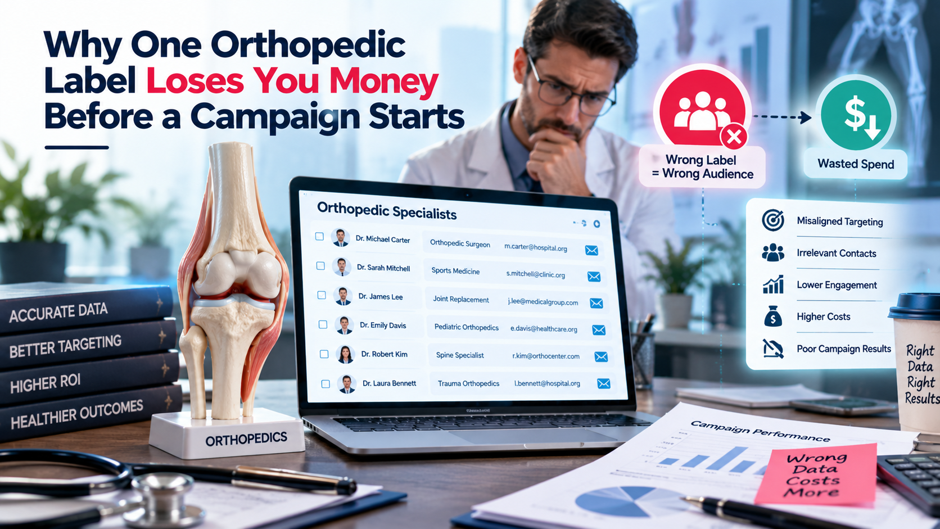
A marketing team builds a target list tagged “Orthopedic Surgeon,” pulls records, and launches a campaign for a specific orthopedic product. The campaign underperforms, and the review focuses on creative, messaging, and timing. The underlying issue may be that the audience definition used a broad specialty label instead of a more detailed subspecialty structure.
This is the most consistently underestimated cost in orthopedic marketing and sales: the money isn’t lost in execution. It’s lost at the definition stage, when “orthopedic surgeon” gets treated as one audience instead of what it actually is, a loose umbrella term covering at least 7 genuinely distinct surgical practices with different case volumes, different purchasing cycles, different price points, and, critically, different sales representatives on the vendor side entirely dedicated to each one. A campaign built on the generic label is misaligned with reality before the first creative asset is even drafted, and no amount of downstream optimisation fixes a targeting foundation that was wrong from the start.
TL;DR
| Problem with the generic label | What it actually costs |
| No subspecialty differentiation | Messages built for one practice type reach surgeons who have no clinical or commercial reason to care |
| Misalignment with vendor sales structure | Device and pharma companies organise their own reps by subspecialty; a generic list can’t route to the right internal owner |
| Wildly different case economics treated as one | A knee replacement and a spinal fusion have completely different price points, cycles, and decision-makers, collapsed into a single average |
| Decision timelines flattened | Spine decisions run months longer than sports medicine decisions; a single cadence serves neither well |
| Referral and site-of-care patterns ignored | ASC-based sports medicine and hospital-based joint reconstruction have different buying environments entirely |
| Wasted spend that shows up as “poor campaign performance” | The actual failure gets misdiagnosed as a creative or channel problem rather than a targeting problem |
The fix isn’t more budget or better creative. It’s rebuilding the underlying taxonomy before a single dollar gets spent, because every other marketing decision downstream, from creative to cadence to sales handoff, inherits whatever precision, or imprecision, exists in that foundational targeting structure from the very beginning.
Why “Orthopedic Surgeon” Was Never a Single Audience
Orthopedic surgery is one of the most internally fragmented specialties in medicine, not because of arbitrary industry convention but because the anatomy, procedures, technology, and patient populations involved are genuinely different across subspecialties. Treating this fragmented field as a single addressable market is a category error that happens to be extremely common, precisely because the licensing credential, “orthopedic surgeon,” is singular even though the practice underneath it is not.
The Core Subspecialties and Why Each Is a Distinct Buyer
Joint reconstruction and replacement covers hip, knee, and shoulder arthroplasty. It represents an important orthopedic segment with distinct procedures, clinical considerations, and purchasing requirements.
Spine surgery is frequently described within the medical device industry as the most demanding and highest-value segment, involving pedicle screws, interbody cages, cervical plates, artificial discs, and increasingly spinal cord stimulators. Spine cases are anatomically complex, carry meaningfully higher per-procedure revenue than general orthopedic hardware, often in the tens of thousands of dollars range, and involve decision cycles that run substantially longer than most other subspecialties, frequently spanning 2 to 6 months compared to days or weeks for simpler procedures.
Sports medicine covers arthroscopic procedures, ligament reconstruction, and soft-tissue repair, and skews toward a younger patient population with a different set of priorities, recovery timelines and return-to-activity outcomes weighing as heavily in the decision as the procedure itself. Sports medicine cases typically move through a faster decision cycle than joint reconstruction or spine, and increasingly happen in ambulatory surgical centres rather than hospital settings.
Trauma and extremities addresses fracture repair and reconstructive procedures following injury, using implants, screws, plates, and intramedullary nails, and operates on a fundamentally different timeline than the elective procedures above, since trauma cases are unscheduled by definition and the purchasing relationship that matters most is availability and immediate supply rather than a considered, multi-month evaluation process.
Foot and ankle surgery, hand surgery, and pediatric orthopedics each represent smaller but genuinely distinct practice areas with their own device categories, referral patterns, and in pediatric orthopedics specifically, an entirely different patient population and clinical consideration set than any adult-focused subspecialty on this list.
Why This Matters More in Orthopedics Than in Many Other Specialties
Some medical specialties tolerate broader targeting reasonably well because the underlying practice, while it has sub-focuses, doesn’t diverge as dramatically in procedure type, price point, and buying cycle as orthopedics does. Orthopedics is a genuine outlier in how far its subspecialties diverge from each other while still sharing a single licensing credential, which is exactly why the generic label causes more damage here than it might in a specialty with less internal fragmentation.
How Device and Pharma Companies Already Organise Around This Reality
The most direct evidence that “orthopedic surgeon” isn’t a coherent single audience comes from how the companies selling into this market structure their own sales organisations, since these structures reflect decades of commercial experience about what actually drives purchasing behaviour in this specific specialty, refined across an enormous volume of real deals.
Sales Force Structure at Major Orthopedic Device Companies
Orthopedic device companies often organize commercial teams around product areas and clinical specialties. This type of specialization reflects the need for focused product knowledge and customer engagement. A targeted surgeons email list should distinguish surgical focus rather than stop at the broader profession.
What this organisational reality means for a marketer targeting orthopedic surgeons:
- A territory manager selling joint reconstruction implants has no commercial reason to receive a lead generated from spine-focused content, and routing it to them wastes the lead entirely
- A marketing list built around the generic “orthopedic surgeon” label cannot be cleanly handed off to the correct internal sales division without additional manual sorting that the list itself should have already done
- Commission structures, quota assignments, and territory value calculations inside these companies are all built around subspecialty-specific device spend, meaning a lead without subspecialty context is functionally unusable for accurate territory and pipeline reporting
- Sales reps themselves develop deep, procedure-specific product knowledge and surgeon relationships within their subspecialty, and a generic outreach campaign that doesn’t reflect this specialisation reads as generic to the surgeon receiving it, undermining credibility before any actual conversation begins
The Compounding Effect of Misalignment
When a marketing organisation’s targeting taxonomy doesn’t match the subspecialty structure the actual sales organisation, whether internal or a device company’s own reps, is built around, every downstream process inherits the mismatch. Lead routing becomes manual and error-prone. Attribution becomes unreliable, because a lead tagged only as “orthopedic surgeon” can’t be cleanly connected back to the specific subspecialty campaign, content, or channel that actually influenced it. And sales teams, receiving leads that don’t match their actual territory or product focus, reasonably conclude that marketing-sourced leads are low quality, when the underlying problem was never lead quality at all, but a taxonomy that never should have been built around a single generic specialty label in the first place.
Where the Money Actually Leaks Before the Campaign Starts
Understanding the specific failure points helps make the abstract cost of a generic label concrete, since each of these represents a distinct, avoidable source of wasted spend that traces directly back to the targeting definition itself, not to campaign execution, creative quality, or any of the factors a typical post-campaign review actually examines.
The list purchase itself gets priced and sized incorrectly. A generic “orthopedic surgeon” universe in the United States runs into the tens of thousands of names, and purchasing or licensing contact data against that full universe when the actual addressable audience for a specific spine device is a meaningful fraction of that number means paying for reach that was never going to convert, while simultaneously diluting whatever budget exists for the depth of data, verification, and enrichment that the genuinely relevant subset actually deserves.
Creative and messaging get built for an audience that doesn’t exist. Content teams asked to write for “orthopedic surgeons” broadly tend to default toward generic, lowest-common-denominator messaging that avoids alienating any subspecialty, which in practice means the messaging fails to resonate strongly with any of them, since a spine surgeon evaluating a multi-month capital decision and a sports medicine surgeon making a faster procedural choice respond to fundamentally different value propositions, technical depth, and evidence types.
Send cadence and campaign timeline get set around the wrong buying cycle. A campaign paced for a 2-week decision cycle, appropriate for some sports medicine or trauma-adjacent purchases, will feel rushed and premature to a spine surgeon whose device evaluation genuinely takes several months, while a campaign paced for that longer spine cycle will have gone cold by the time a faster-moving subspecialty audience was actually ready to act.
Attribution and reporting become structurally unreliable. Without subspecialty tagging built into the list from the start, post-campaign analysis can only report at the generic “orthopedic surgeon” level, which means a marketing team genuinely cannot tell whether a campaign succeeded because the spine-focused content resonated or failed because the sports medicine segment within the same list was never going to respond to spine-specific messaging in the first place. The data needed to learn from the campaign and improve the next one simply doesn’t exist at the resolution required.
Sales handoff friction compounds the waste. Leads generated from a generically targeted campaign arrive at the sales organisation without the subspecialty context needed for accurate routing, forcing either a manual triage step that delays follow-up past the window when a lead is genuinely warm, or an incorrect handoff to a rep whose territory and product focus don’t actually match what the surgeon was responding to in the first place.
Case Economics by Subspecialty: Why Averaging Destroys the Signal
Collapsing every orthopedic subspecialty into a single average obscures exactly the variation that should be driving targeting and budget allocation decisions in the first place, and the table below makes that variation concrete rather than abstract by laying out how the major subspecialties actually differ across the dimensions that matter most to campaign planning.
| Subspecialty | Typical decision cycle | Relative per-procedure value | Dominant site of care |
| Joint reconstruction | Weeks to a few months | High volume, moderate-to-high per-unit value | Predominantly hospital, growing ASC shift |
| Spine | 2 to 6 months | Highest per-procedure value of any orthopedic subspecialty | Predominantly hospital |
| Sports medicine | Days to weeks | Lower per-procedure value, high volume | Increasingly ASC-based |
| Trauma and extremities | Immediate, unscheduled | Variable, driven by injury acuity | Hospital, emergency-driven |
| Foot and ankle | Weeks to a few months | Moderate, procedure-dependent | Mixed hospital and ASC |
| Hand surgery | Weeks to a few months | Lower per-procedure value, high volume | Predominantly ASC |
| Pediatric orthopedics | Variable, condition-dependent | Highly variable, distinct patient population considerations | Predominantly children’s hospitals |
A marketing budget allocated as though every name on an orthopedic list represents an equivalent opportunity is, by definition, misallocated, since a spine-focused campaign competing for a surgeon’s attention across a multi-month cycle requires a fundamentally different investment pattern, content depth, and touchpoint cadence than a sports medicine campaign competing for attention across a matter of days. Treating both under one generic plan means one of them, usually the longer, higher-value cycle, gets under-resourced relative to what it actually requires to convert.
What a Properly Segmented Targeting Structure Actually Requires
Fixing the generic label problem isn’t about abandoning the orthopedic surgeon audience entirely, and it isn’t about starting from scratch either. It’s about rebuilding the underlying taxonomy so that every subsequent marketing and sales decision inherits the precision the broader strategy actually needs to succeed, rather than repeating the same generic-label mistake at every stage that follows.
The minimum segmentation layer any orthopedic targeting effort should include:
- Subspecialty designation as a structured, verified field, not inferred loosely from a job title or practice name that may not accurately reflect actual clinical focus
- Site of care, distinguishing hospital-based practice from ambulatory surgical centre-based practice, since this affects both purchasing process and the channels most likely to actually reach the surgeon
- Procedure volume or case mix data where available, since a surgeon performing high volumes in a specific subspecialty represents a meaningfully different opportunity than one for whom that subspecialty is a minor part of a broader general orthopedic practice
- Practice setting type, distinguishing an independent, physician-owned group from a hospital-employed position from an academic medical centre appointment, since purchasing authority and decision process differ substantially across these settings
- Geographic and territory alignment data structured to match how the actual sales organisation, whether internal or a device company’s own reps, divides its coverage
What this segmentation enables that a flat list cannot:
Content and messaging can be built specifically for each subspecialty’s actual clinical priorities and decision timeline, rather than diluted into something generic enough to avoid contradicting any of them. Campaign cadence and channel selection can be calibrated to the genuinely different buying cycles each subspecialty follows, rather than forcing every segment through an identical, one-size-fits-all timeline. Lead routing to the correct internal or partner sales representative becomes automatic rather than a manual triage step that introduces delay and error into exactly the moment when a lead is most likely to be genuinely warm. And attribution becomes granular enough to actually inform the next campaign, distinguishing what worked for spine from what worked for sports medicine rather than averaging both into a single, uninformative blended result.
Who Feels This Cost Most Acutely
The generic label problem doesn’t affect every organisation targeting orthopedic surgeons in exactly the same way or to the same degree, and understanding where the cost actually lands hardest helps prioritise which organisations should treat this as an urgent, near-term fix versus a lower-priority improvement worth addressing more gradually over time.
| Organisation type | How the generic label hurts them specifically | Urgency of fixing it |
| Medical device manufacturers | Leads can’t route to the correct subspecialty-dedicated sales rep without manual triage, delaying follow-up on warm leads | High, since sales routing friction directly delays revenue |
| Pharmaceutical companies with orthopedic-adjacent products | Messaging and clinical evidence get diluted to avoid contradicting any subspecialty, reducing relevance across all of them | Moderate to high, depending on how subspecialty-specific the product actually is |
| Continuing education and certification providers | Course relevance gets misjudged, since a spine-focused CE offering promoted to the full generic list wastes invitations on surgeons with no genuine interest | Moderate, since the cost shows up mainly as lower registration rates rather than lost revenue directly |
| Healthcare staffing and recruitment firms | Placement matching suffers when a facility’s specific subspecialty need gets matched against a generically labelled candidate pool | High, since a poor subspecialty match can derail an entire placement process |
| Professional associations and membership organisations | Broad outreach may tolerate the generic label reasonably well, but targeted programme promotion within the association still suffers the same relevance problem | Lower for general communications, higher for programme-specific outreach |
| Practice management and EHR software vendors | Product relevance claims (procedure-specific workflows, subspecialty-specific documentation templates) land poorly against an undifferentiated audience | Moderate to high, depending on how subspecialty-tailored the actual product is |
Medical device manufacturers and healthcare staffing firms sit at the highest-urgency end of this table because their core operating model depends directly on accurate subspecialty matching, whether that’s routing a lead to the correct territory manager or placing a candidate against a facility’s genuine clinical need. For these organisations, the generic label problem isn’t a marketing efficiency issue at the margins. It’s a structural gap sitting directly between the campaign and the revenue or placement outcome the campaign was actually built to produce.
Organisations lower on this urgency scale shouldn’t assume the problem doesn’t apply to them at all, since even broad professional communications benefit from subspecialty awareness whenever a specific programme, event track, or content series is being promoted rather than a genuinely universal message relevant to every orthopedic surgeon regardless of subspecialty focus.
A Practical Framework for Auditing an Existing Orthopedic Targeting List
Organisations that suspect their existing orthopedic targeting is built around the generic label problem can apply a structured audit before committing further budget to campaigns built on that same flawed foundation, and the checklist below is designed to surface the problem quickly rather than requiring a lengthy formal review.
The audit checklist to apply before the next campaign launches:
- Pull a representative sample of the existing list and confirm what percentage of records carry a genuine, verified subspecialty designation versus a generic “orthopedic surgeon” or “orthopedics” tag with no further detail
- Cross-reference a sample of records against a subspecialty’s actual procedure or case data where available, to confirm the subspecialty tag reflects genuine clinical focus rather than a loosely inferred label based only on job title text
- Review the past 2 to 3 campaigns run against this list and assess whether performance data can be broken down by subspecialty at all, or whether the reporting is structurally limited to the generic specialty level
- Interview the sales team receiving leads from this list and ask directly whether the leads they’ve received have matched their actual territory and product focus, or whether manual re-routing has been a recurring, unaddressed friction point
- Calculate what share of total list spend has gone toward subspecialties that don’t actually align with the specific products or services being marketed, to quantify the concrete waste the generic label has produced
Running this audit consistently surfaces a pattern that’s easy to underestimate in the abstract but becomes difficult to ignore once quantified directly: a meaningful share of total marketing spend against a generically labelled orthopedic list has typically gone toward surgeons whose actual subspecialty focus made them structurally unlikely to respond to the specific campaign being run, regardless of how well that individual campaign was otherwise executed.
The Site-of-Care Shift and Why It Adds Another Layer
Subspecialty alone doesn’t fully capture the targeting complexity in orthopedics today, because a parallel shift in where procedures actually happen has been reshaping the buying environment independently of subspecialty, and a targeting taxonomy that ignores this second dimension is still leaving real precision on the table.
Why Site of Care Has Become a Second Critical Variable
Orthopedic procedures have increasingly been performed across different care settings, including hospitals and ambulatory surgical centres. The relevance of site of care depends on the procedure, organization, and market conditions.
What changes when a surgeon’s practice is predominantly ASC-based versus hospital-based:
- Purchasing authority concentrates differently, since an ASC often involves the operating surgeons directly in capital and supply purchasing decisions in a way that a large hospital system, with its centralised value analysis committees and procurement departments, typically does not
- Decision speed changes, since an ASC’s smaller, more direct decision-making structure can move faster on a device or supplier evaluation than a hospital system’s multi-layered committee process, independent of whatever the underlying subspecialty’s typical cycle length happens to be
- The relevant messaging shifts, since ASC-based surgeons and administrators care intensely about throughput, cost-efficiency, and the specific economics of outpatient care in a way that isn’t always the primary consideration inside a large hospital system evaluating the same device category
- Competitive dynamics differ, since certain device categories and vendors have built specific commercial strategies and product configurations around the ASC environment that simply don’t apply the same way inside a traditional hospital operating room
Combining Subspecialty and Site of Care Into a Genuinely Useful Taxonomy
A targeting structure that captures subspecialty but ignores site of care still risks treating a hospital-based joint reconstruction surgeon and an ASC-based joint reconstruction surgeon as functionally identical, when in practice these 2 surgeons may respond to meaningfully different messaging, move through different decision processes, and require different sales or marketing motions entirely, despite sharing the same subspecialty label. The most effective orthopedic targeting frameworks treat subspecialty and site of care as 2 independent dimensions that combine to define a genuinely distinct segment, rather than defaulting to subspecialty alone and assuming site of care is a secondary detail that can be addressed later or ignored entirely.
This is precisely the kind of layered precision that a generic “orthopedic surgeon” label makes structurally impossible to capture, since a taxonomy that starts from a single undifferentiated category has no natural place to add this second dimension without a substantial rebuild, whereas a taxonomy that started with genuine subspecialty segmentation from the outset can extend naturally to incorporate site of care, practice ownership structure, and any other dimension that later proves commercially relevant to a specific campaign. A surgeon working inside a large hospital system can sit inside a very different account structure from an otherwise similar surgeon working primarily through an independent ASC.
FAQs
Is it ever appropriate to target orthopedic surgeons as a single, undifferentiated group? For a narrow set of genuinely cross-cutting use cases, such as general practice management software, broad continuing education content relevant across all orthopedic subspecialties, or professional association communications, a less segmented approach can work reasonably well. The moment a campaign involves a specific device, procedure type, or subspecialty-relevant clinical content, which describes the overwhelming majority of orthopedic marketing and sales activity, the generic label becomes a genuine liability rather than a reasonable simplification.
How many orthopedic subspecialties actually need to be tracked as distinct segments? Most orthopedic targeting frameworks benefit from distinguishing at least joint reconstruction, spine, sports medicine, trauma and extremities, foot and ankle, hand surgery, and pediatric orthopedics as separate segments, since each of these reflects genuinely distinct procedure types, decision cycles, and in many cases distinct sales organisation structures on the vendor side. Some organisations further subdivide joint reconstruction into hip, knee, and shoulder specifically, or separate general spine practice from more specialised deformity or minimally invasive spine focus, depending on how granular the specific product or campaign requires.
Does fixing this problem require purchasing an entirely new contact database?
Not necessarily, though it often requires meaningfully enriching an existing one. Many organisations already hold a reasonably accurate universe of orthopedic surgeon contacts, and the actual gap is subspecialty-level enrichment rather than the base contact data itself. This can involve appending subspecialty data from a specialised healthcare data provider, cross-referencing existing records against procedure or claims data where available, or in smaller-scale efforts, a manual research pass against a prioritised subset of the highest-value accounts before a major campaign launch.
How does this problem show up differently for a pharmaceutical company versus a medical device company targeting orthopedic surgeons?
Medical device and pharmaceutical companies may experience different challenges when targeting orthopedic surgeons. Device companies often focus on routing and product relevance, while pharmaceutical campaigns may require subspecialty-specific messaging.
What’s the single biggest warning sign that an organisation’s orthopedic targeting has this problem?
The clearest warning sign is campaign performance reporting that can only be analysed at the generic “orthopedic surgeon” level, with no ability to break results down by subspecialty. If a marketing team cannot answer the specific question of how a spine-focused campaign performed among spine surgeons specifically, as distinct from the broader orthopedic list it was sent against, that reporting gap is itself strong evidence that the underlying targeting taxonomy never captured subspecialty in the first place, and the resulting inability to learn from campaign results compounds the original targeting problem indefinitely, since each subsequent campaign gets planned with the same incomplete picture the previous one produced.
How long does it typically take to rebuild an orthopedic targeting taxonomy around subspecialty segmentation?
For an organisation with an existing contact database that simply needs subspecialty enrichment appended, this can often be completed within several weeks, particularly when working with a data provider that already maintains subspecialty-level classification. For an organisation building genuinely new targeting infrastructure from scratch, including establishing the segmentation logic, sourcing or verifying subspecialty data, and rebuilding campaign and reporting structures around the new taxonomy, a more realistic timeline runs 2 to 3 months, though the investment consistently pays for itself across the following campaigns once every subsequent decision, from creative to cadence to sales routing, inherits accurate segmentation rather than compounding the original generic-label problem further with each new campaign that launches.
Can subspecialty segmentation be inferred reliably from publicly available data, or does it require a specialised source?
Some signal can be inferred from publicly available sources such as hospital department listings, professional society membership in subspecialty-specific organisations, or published case series and research focus, but this inference carries real limitations, particularly for surgeons whose public profile doesn’t fully reflect their actual current case mix. Specialised healthcare data providers that maintain subspecialty classification systematically, often cross-referenced against procedure-level claims or case volume data, generally produce more reliable and more complete segmentation than an internally built inference process alone, particularly at the scale most orthopedic marketing and sales organisations need to operate at, where manually researching subspecialty focus for thousands of individual surgeons simply isn’t a practical or sustainable approach.