Salesforce vs. HubSpot vs. Pipedrive: Which CRM Is Right for Your Business?
iinfotanks September 1, 2026 0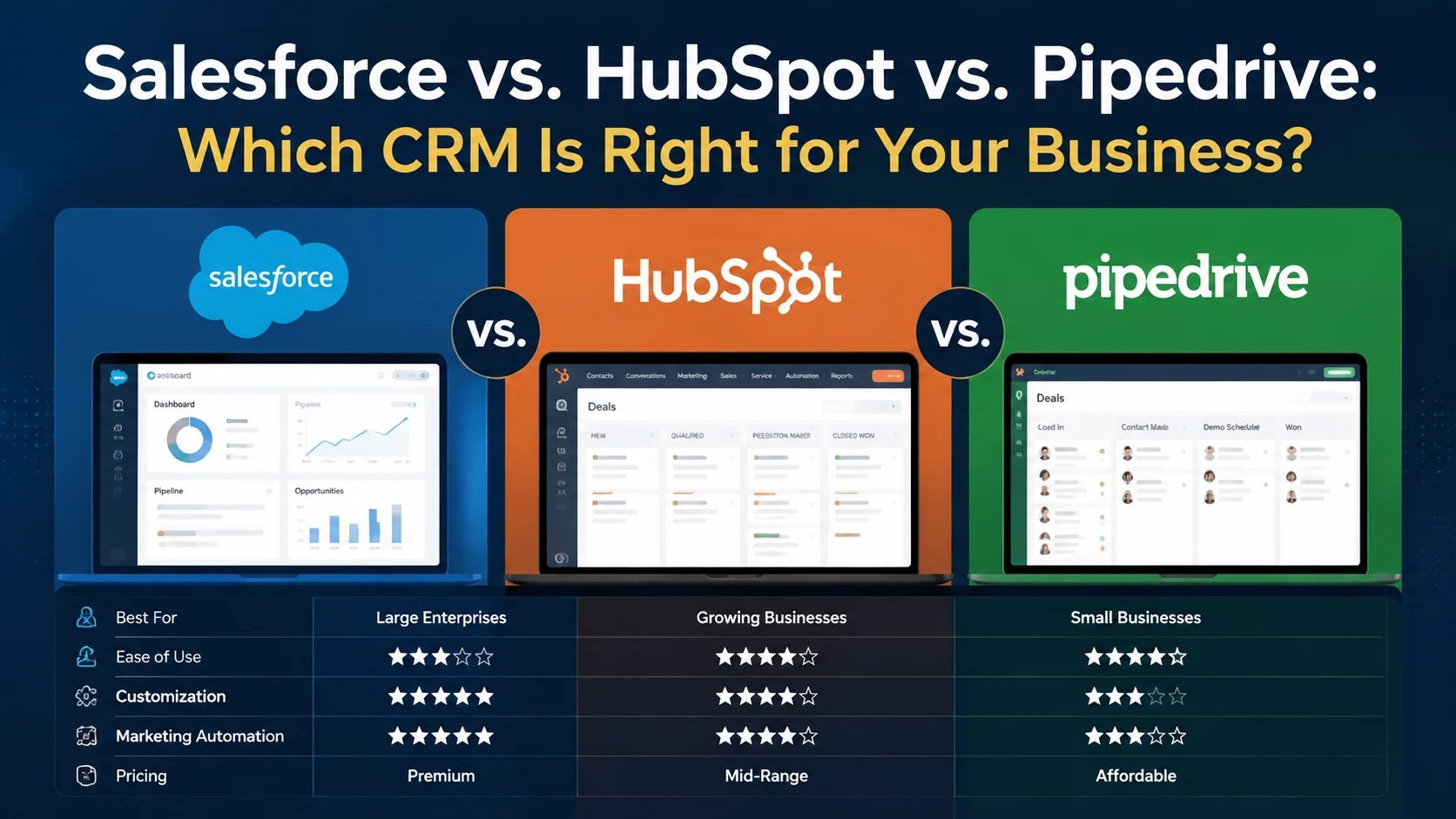
Choosing a CRM becomes difficult when the shortlist contains 3 products that can all manage contacts, deals, pipelines, email activity, reporting, and automation. The real differences appear when a company asks harder questions about data structure, permissions, AI usage, integrations, sales forecasting, administration, and what the system may need to support 2 years from now. That is the useful frame for Salesforce vs HubSpot 2026, because a low entry price or a long feature list can hide the cost of running the CRM after launch.
This guide compares the products as operating systems for revenue teams rather than treating them as interchangeable contact databases. Salesforce vs HubSpot vs Pipedrive becomes much clearer once the buyer separates sales usability from platform depth and calculates ownership beyond licenses. The CRM comparison 2026 also needs current evidence because pricing and AI packaging have changed during 2026, while Pipedrive has moved to Lite, Growth, Premium, and Ultimate plans.
For companies that reach the point where Salesforce is the likely fit,HyphenX Solutions’ Salesforce consulting services cover implementation planning, configuration, migration, integrations, Agentforce work, and continued administration. That role matters later in the decision process. First, the CRM itself has to fit the business.
TL;DR
Salesforce is the strongest fit when the CRM has to model complex business processes, support deeper permissions, connect with several business systems, and handle reporting or forecasting across larger teams. HubSpot is strongest when sales needs to sit close to marketing and service inside one customer platform, with easier day-to-day ownership than a heavily configured Salesforce environment. Pipedrive remains the clearest sales-first option when the main requirement is pipeline execution, rep adoption, email follow-up, and lower software cost.
For Salesforce vs HubSpot 2026, the choice usually changes when custom data relationships, governance, or multi-team requirements become serious. Salesforce vs Pipedrive 2026 is more strongly divided by platform depth: Pipedrive keeps sales work direct, while Salesforce can carry much more business logic. HubSpot vs Pipedrive 2026 is closer for smaller teams, but HubSpot pulls ahead when marketing, service, content, and CRM information need to operate in the same system.
Decision Area | Salesforce | HubSpot | Pipedrive |
|---|---|---|---|
Best Starting Fit | Complex mid-market and enterprise use | Connected sales and marketing teams | Sales-first SMB and mid-market teams |
Administration | Usually highest | Moderate | Usually lowest |
Custom Data Depth | Deep object and permission model | Stronger at Enterprise | Field and pipeline centered |
AI Direction | Agentforce inside Salesforce | Breeze agents with credits | Native AI plus MCP connections |
Pricing Pattern | Highest representative license cost | Mid-range, with onboarding on higher tiers | Lowest of the 3 examples used here |
Main Buying Risk | Paying for depth you don’t need | Cost jumps as advanced needs grow | Outgrowing the sales-centered model |
A good CRM comparison 2026 therefore starts with business complexity. Salesforce vs HubSpot vs Pipedrive should be decided by the processes the CRM must carry, the information it must govern, and the changes expected after go-live. Price matters, but the cheapest license can become the expensive choice if a second migration arrives 18 months later.
Why these CRMs feel similar but work differently
All 3 platforms cover the basic sales record set, yet they organize the problem differently. Salesforce is a platform-first CRM. Its current Sales editions span lead and opportunity management, forecasting, roles and permissions, approval processes, Flow Builder, sandboxes, APIs, AI add-ons, and a large extension ecosystem. That breadth is why Salesforce vs HubSpot 2026 often becomes a discussion about process complexity rather than screens or ease of setup.
HubSpot takes a customer-platform approach. Sales Hub shares the wider HubSpot information model with marketing, service, content, revenue, and data products. That design is attractive when marketing activity and sales execution need to stay close. HubSpot vs Pipedrive 2026 becomes especially relevant for companies deciding whether they need a broader go-to-market platform or a more focused sales workspace.
Pipedrive starts from the seller’s pipeline. Its current plans still center on leads, deals, activities, email, automation, forecasting, and visual pipeline work, even as newer tiers add AI reporting, lead routing, scoring, enrichment, stronger permissions, and sandbox testing. Salesforce vs Pipedrive 2026 therefore has a clear architectural divide: one is built to carry a wider range of business rules, while the other keeps more attention on sales execution.
That architectural difference should guide the CRM comparison 2026. Salesforce vs HubSpot vs Pipedrive is less about whether a feature exists and more about how far that feature can be extended, governed, tested, and maintained when requirements grow.
Core sales and CRM features
The basic checklist can make the 3 systems look almost equal, so the useful comparison is the depth behind each feature. Salesforce providesSales Cloud services and capabilities around leads, opportunities, forecasting, products, quotes, territories, reports, automation, and permission structures. Pipedrive’s current pricing page shows that Growth adds email sync, workflow automation, sequences, and forecasting, while Premium adds lead routing, scoring, enrichment, contracts, stronger fields, and more detailed permissions.Pipedrive’s current pricing lists Lite at $14, Growth at $24, Premium at $49, and Ultimate at $69 per seat per month when billed annually.
Capability | Salesforce | HubSpot | Pipedrive |
|---|---|---|---|
Pipeline Management | Deep opportunity and pipeline controls | Strong deal pipeline tools | Core product strength |
Lead Routing | Strong, edition dependent | Strong in paid sales tiers | Premium adds lead routing |
Forecasting | Advanced forecasting and pipeline inspection | Forecasting in higher sales tiers | Built-in forecast reporting |
Email And Sequences | Sales engagement varies by edition | Strong native sales sequence model | Growth adds email sync and sequences |
Reporting | Deep reports, dashboards, territories | Strong CRM and GTM reporting | Sales-focused insights and custom reports |
Quotes And Contracts | Products, quotes, orders, related products | Available across HubSpot sales stack | Premium includes contracts and e-signatures |
Mobile Sales Work | Mature mobile CRM | Mobile CRM and sales tools | Mobile sales pipeline focus |
Salesforce vs HubSpot 2026 is strongest in this section when the buyer asks how many teams and processes must share the CRM. HubSpot can cover a broad go-to-market motion without demanding the same level of administration as a heavily configured Salesforce org. Salesforce becomes more attractive when permission models, approvals, sales territories, multi-object processes, or deeper reporting become requirements rather than future ideas.
Salesforce vs Pipedrive 2026 is easier to call when sales complexity is low. Pipedrive keeps pipeline activity direct and now offers more advanced functions than its older reputation suggests. HubSpot vs Pipedrive 2026 is a closer contest for a growing sales team, especially if both products can support the current pipeline, which is why buyers should test their marketing, service, reporting, and future data requirements before choosing.
The right Salesforce vs HubSpot vs Pipedrive decision therefore comes from the business process beneath the feature. A CRM comparison 2026 that marks every box with a checkmark misses the practical question: what happens when the company needs another approval step, another business unit, another information relationship, or another reporting layer?
Pricing and the 24-month cost of ownership
Public prices create an easy comparison, but they do not create an equal comparison. Salesforce currently lists Starter Suite at $25, Pro Suite at $100, Enterprise at $175, Unlimited at $350, and Agentforce 1 Sales at $550 per user per month, with annual billing on the higher plans.Salesforce’s current Sales pricing also shows that Web Services API access costs an additional $25 per user per month on Pro Suite, while Enterprise includes web API access.
HubSpot’s live Sales Hub page currently shows Free for up to 2 users, Starter from $7 per seat per month on its displayed annual offer, Professional from $90, and Enterprise from $150. Professional carries a required $1,500 onboarding fee and Enterprise a $3,500 onboarding fee. The same page also displays standard prices beside some promotional prices, soHubSpot Sales Hub pricing should be checked on the publication date rather than copied from an older comparison.
Example Cost | Salesforce Enterprise | HubSpot Professional | Pipedrive Premium |
|---|---|---|---|
Current Representative Seat Price | $175/month | $90/month displayed offer | $49/month annual billing |
10 Users, Annual Licenses | $21,000 | $10,800 | $5,880 |
Required Public Onboarding Used Here | Not included | $1,500 | None used |
10 Users, First Year | $21,000 | $12,300 | $5,880 |
50 Users, Annual Licenses | $105,000 | $54,000 | $29,400 |
10 Users, 24 Months | $42,000 | $23,100 | $11,760 |
These examples clarify Salesforce vs HubSpot 2026, but they are not feature-equivalent totals. Salesforce vs Pipedrive 2026 can show a large license gap while ignoring the business capability that caused the company to evaluate Salesforce in the first place. HubSpot vs Pipedrive 2026 can also change once HubSpot onboarding, AI credits, additional Hubs, or Pipedrive add-ons enter the budget.
A better CRM comparison 2026 uses a 24-month ownership model: licenses + required onboarding + implementation + migration + integrations + AI usage + internal administration + support + later change work. Salesforce vs HubSpot vs Pipedrive should be modeled against the real operating design. A company that expects several integrations, stricter permissions, or complex data relationships needs to price those requirements before choosing a cheaper tier. Pricing checked: September 1, 2026. Vendor prices, offers, plan names, and packaging can change.
AI and automation: Agentforce, Breeze, and Pipedrive MCP
AI is now part of the operating model of each CRM, yet the 3 approaches differ. Salesforce places Agentforce inside its platform and current Sales pricing lists agent functions around lead nurture, sales coaching, pipeline management, sales actions, and related intelligence at higher tiers or as purchases. HyphenX’sSalesforce Agentforce services focus on agent setup, use cases, governance, and Salesforce information access, which becomes relevant when AI actions are expected to change records or trigger business processes.
HubSpot uses Breeze agents alongside HubSpot Credits. Its current Sales pricing includes 500 credits on Starter, 3,000 on Professional, and 5,000 on Enterprise, with additional credits shown at $9 per 1,000 when paid annually. That means Salesforce vs HubSpot 2026 should compare AI consumption as well as AI features. A buyer needs to know how frequently agents will research prospects, create information, or run other credit-consuming work before estimating cost.
Pipedrive’s 2026 MCP work adds another model.Pipedrive MCP for ChatGPT lets a connected assistant work with authorized Pipedrive information and inherit the user’s existing role and visibility permissions. Pipedrive’s MCP tools can retrieve, create, search, and update records such as activities, deals, persons, organizations, leads, pipelines, and notes.
What buyers should test before comparing AI
- Action scope: Can the AI only suggest work, or can it create and update CRM records?
- Information access: Which records, fields, connected sources, and histories can it read?
- Human control: Which actions require review, approval, or an administrator’s permission?
- Usage cost: Is AI included, sold as an add-on, or metered through credits and consumption?
For Salesforce vs Pipedrive 2026, the AI question is therefore partly about where intelligence lives and how deeply it participates in the CRM. HubSpot vs Pipedrive 2026 also differs because HubSpot increasingly meters agent work through credits, while Pipedrive is exposing CRM actions through MCP-compatible assistants. Salesforce vs HubSpot vs Pipedrive should compare agent permissions, action types, usage cost, audit requirements, and human review. That gives the CRM comparison 2026 a decision framework that an AI checkmark cannot provide.
Customization, data models, APIs, and integrations
Customization is where the long-term limits of a CRM become visible. Salesforce supports a broad object model with custom objects, fields, record types, relationships, roles, permission sets, page layouts, Flow, approvals, Lightning applications, APIs, and multiple sandbox options by edition. Teams that need customer information from several sources can also evaluateSalesforce Data Cloud services when unified customer information, activation, or AI grounding becomes part of the architecture.
HubSpot supports a shared object model across contacts, companies, deals, activities, payments, subscriptions, and other records. Custom objects can represent business-specific entities, but HubSpot currently places custom-object creation in Enterprise subscriptions. That threshold matters in Salesforce vs HubSpot 2026 because a buyer can begin with a simpler HubSpot setup and later discover that a new data model changes the required subscription.
Pipedrive extends its sales-centered model through custom fields, pipelines, linked sales records, integrations, and APIs. Current usage limits show 30 custom fields on Lite, 100 on Growth, 300 on Premium, and 500 on Ultimate, while lead-and-deal and API limits also increase by plan. Salesforce vs Pipedrive 2026 should therefore examine whether the buyer is adding detail to sales records or modeling new business entities and relationships. Those are different requirements.
Integration design can change the answer again. HyphenX’sSalesforce API integration services cover CRM connections with ERP, finance, marketing, and other applications. HubSpot vs Pipedrive 2026 may favor HubSpot when the broader HubSpot platform already contains much of the go-to-market stack, while Pipedrive can be attractive when the company prefers separate specialist tools. Salesforce vs HubSpot vs Pipedrive becomes a stronger CRM comparison 2026 when the buyer maps the systems that must exchange information before selecting a license.
Reporting, security, and governance
Reporting requirements should be written as management questions rather than feature names. Salesforce supports customizable reports, dashboards, forecasting, opportunity splits, territories, pipeline inspection, and advanced reporting functions by edition. HubSpot connects sales reporting to its wider customer platform. Pipedrive focuses reporting around deals, activities, forecasts, and sales performance, with more report and customization capacity as plans rise.
Governance is another dividing line. HubSpot documents SAML SSO, SCIM provisioning, object and property controls, sensitive-information handling, and centralized audit logs. Buyers can reviewHubSpot’s security and compliance material when Salesforce vs HubSpot 2026 reaches security requirements. Salesforce provides a deeper role, object, field, and sharing model that suits organizations with more complicated access rules, though the quality of any setup still depends on how those controls are configured.
Pipedrive has also expanded plan-based controls. Ultimate includes stronger security rules and sandbox testing, while currentPipedrive usage limits show higher tiers adding more teams, visibility groups, permission sets, and API capacity. That makes Salesforce vs Pipedrive 2026 a governance decision when users must be divided by regions, teams, or record visibility.
HubSpot vs Pipedrive 2026 often stays simpler until the company adds more teams or sensitive information. The useful question is how much control administrators need over who can see records, change fields, test workflows, connect applications, and review activity history. Security belongs in the buying model from the start, especially when CRM data includes regulated, financial, or commercially sensitive information.
Implementation, administration, and user adoption
Implementation cost starts before configuration. A serious CRM project includes process discovery, information mapping, permission design, migration planning, integration decisions, testing, training, and launch support. Salesforce usually creates more design work because buyers can change more of the platform. That is also whyHyphenX Salesforce implementation services cover requirements, architecture, migration, configuration, API work, testing, user training, and go-live activities instead of treating implementation as account setup.
Salesforce vs HubSpot 2026 therefore needs to separate implementation effort from software price. HubSpot can often reach a usable sales state with less technical ownership, but complex workflows, custom objects, several Hubs, or advanced governance still require design discipline. Pipedrive generally asks less from administrators for a straightforward sales motion, which is a major advantage when a small team has no dedicated CRM owner.
Adoption is where architecture meets daily work. A CRM with more capability can still fail if sales representatives avoid it, while a simpler CRM can become restrictive if leaders need information the system was never designed to hold. The implementation team should test real scenarios such as creating an opportunity, changing ownership, approving a discount, forecasting a quarter, fixing duplicate data, and adding a new reporting requirement.
That makes administration part of the purchase decision. Salesforce requires a clearer ownership model as configuration depth rises. HubSpot still needs governance as automation and data volume expand. Pipedrive keeps day-to-day ownership lighter for many sales teams, but its plan limits and data model need to be checked against expected growth before the initial rollout.
Which CRM fits your business model?
Company size is useful, but process complexity is a better predictor. A 20-person company selling regulated services through several approval steps can have a harder CRM requirement than a much larger company with a simple pipeline. Salesforce vs HubSpot 2026 should therefore start with sales motion, information model, governance, and connected systems before employee count.
Business Situation | First CRM To Evaluate | Reason |
|---|---|---|
Small Sales Team With A Straight Pipeline | Pipedrive | Low operating burden and clear pipeline work |
Inbound-Led Growth Team | HubSpot | Sales works closely with marketing information |
Mid-Market Team With Growing GTM Functions | HubSpot or Salesforce | Choice depends on process and data complexity |
Complex B2B Sales With Approvals | Salesforce | Deeper workflow and permission model |
Multi-Team Or Multi-Region Sales Operation | Salesforce | Stronger hierarchy, reporting, and governance options |
Company With Heavy ERP Or Custom Integration Needs | Salesforce | Broader platform and API architecture |
Team With No CRM Administrator | Pipedrive or HubSpot | Lower ownership burden can matter more than maximum depth |
For Salesforce vs Pipedrive 2026, Pipedrive deserves the first look when the sales process itself is the main system requirement. For HubSpot vs Pipedrive 2026, HubSpot moves ahead when marketing information, lead nurturing, service, or a wider customer-platform model matters. Salesforce becomes more compelling when the CRM is expected to carry more complicated permissions, automation, reporting, information relationships, or integrations.
The practical Salesforce vs HubSpot vs Pipedrive decision should also include expected change. A buyer should write down what the CRM must support now and what is likely within 24 months. That exercise prevents a common CRM comparison 2026 mistake: selecting for today’s smallest requirement and paying for another migration when the operating model changes.
Salesforce vs HubSpot 2026 is therefore rarely decided by a single feature. It is decided by the point at which extra platform depth begins to create more value than extra administration costs. When that point never arrives, HubSpot or Pipedrive can be the better decision.
Migration paths and the cost of changing your mind
Migration is part of CRM selection because every platform choice creates an exit path. Moving from HubSpot to Salesforce may require mapping standard and custom objects, recreating workflows, validating associations, checking activity history, and rebuilding integrations. Moving from Pipedrive to Salesforce can look simpler at first, yet fields, stages, products, email history, owners, activities, and reporting definitions still need a clear target model.
Teams moving into Salesforce can useHyphenX Salesforce data migration services for assessment, mapping, transformation, controlled loading, validation, and reconciliation. The important point for Salesforce vs HubSpot 2026 is that migration quality depends on what the old system contains and what the new system needs to mean. Copying every old field into a new CRM often carries old mistakes forward instead of fixing them.
Moving in the other direction also has tradeoffs. Salesforce to HubSpot may require simplifying a richer object model or rebuilding automation around HubSpot’s objects and subscription limits. Salesforce to Pipedrive can require a larger reduction in data-model depth.HubSpot custom-object documentation is especially relevant when a Salesforce migration relies on business-specific entities because custom objects currently require an Enterprise subscription.
The Salesforce-Pipedrive decision and the HubSpot-Pipedrive decision should therefore include exit cost before purchase. A migration plan should cover record mapping, activities, files, ownership, automation, connected applications, user acceptance testing, reconciliation, and rollback decisions. The CRM that is cheapest today may still be the wrong choice if the company can already see a requirement that it will struggle to support later.
When Salesforce wins, the partner decision matters
Salesforce becomes the stronger candidate when flexibility, governance, connected systems, and deeper process design justify the extra ownership work. At that point the buying decision changes from software selection to delivery quality. Salesforce’s FY27 Consulting Partner Program now uses Summit and Select tiers, with Provisional status for qualifying newer partners. Competencies replace the old Navigator framework and are measured through certifications, completed projects, and customer satisfaction. Buyers should verify current status through Salesforce rather than relying on an old partner badge.Salesforce’s FY27 partner program explains that framework.
HyphenX Solutions fits this article after Salesforce has earned its place in the evaluation. Its public Salesforce pages cover consulting, implementation, migration, integrations, Agentforce, Data Cloud, custom development, and continued support. Buyers that want one team to stay involved after go-live can also reviewHyphenX Salesforce support, which describes support models covering configuration, development, integrations, architecture, sandbox-first changes, peer review, runbooks, and service reviews.
A fair Salesforce partner comparison should focus on project fit rather than company size alone. Large integrators can bring global delivery capacity and wider transformation programs. Smaller Salesforce-focused firms can offer closer access to delivery teams and a narrower scope. The useful test is whether the named team has recent experience with the exact clouds, data model, integration pattern, AI work, and support requirements in the project.
Firm | Typical Position In The Market | What Buyers Should Check |
|---|---|---|
HyphenX Solutions | Salesforce-focused consulting and delivery | Named team, relevant project evidence, current partner status |
Accenture / NeuraFlash | Large global programs | Delivery structure, regional team, total program scope |
Deloitte Digital | Enterprise advisory and delivery | Industry team, governance scope, delivery ownership |
IBM Consulting | Enterprise integration and AI programs | Architecture fit, existing IBM estate, staffing model |
Slalom | Regional consulting with Salesforce depth | Local delivery team and current competencies |
Capgemini | Global systems integration | Country team, workshare model, post-launch ownership |
Perficient | Large digital and Salesforce consultancy | Relevant cloud depth, industry proof, support model |
Salesforce vs HubSpot 2026 does not require a partner when HubSpot is the better product fit, and the same principle applies to Pipedrive. The partner discussion belongs after the product decision. Once Salesforce wins, partner quality can materially affect architecture, migration quality, user adoption, release discipline, and the cost of changes after launch.
Final verdict: choose for the CRM you will need, not the demo you saw
Salesforce vs HubSpot 2026 has no universal winner. Salesforce makes the most sense when a company can use its deeper process, information, governance, integration, and reporting capabilities. HubSpot is often the stronger choice when sales should stay close to marketing and service without carrying a large Salesforce administration model. Pipedrive remains a strong choice when seller usability and pipeline execution matter more than broad platform depth.
A practical evaluation should run the same real scenarios in each product. Ask a rep to manage a deal, ask a manager to forecast the quarter, ask an administrator to change a workflow, ask IT to connect a core system, and ask leadership to define who can see sensitive records. The Salesforce-Pipedrive decision becomes clear when those tasks require deeper platform rules. The HubSpot-Pipedrive decision becomes clearer when the wider customer journey enters the CRM requirement.
Use this three-way CRM decision as a 24-month planning exercise rather than a trial-screen contest. This CRM comparison should account for licensing, implementation, AI usage, migration, integrations, administration, and future changes. Salesforce vs HubSpot 2026 is the strongest frame when Salesforce’s extra depth is weighed against the real work required to own it.
Frequently asked questions
Is Salesforce better than HubSpot for growing companies?
Salesforce can be the better fit when growth creates more complex data relationships, permission rules, approval processes, integrations, or reporting requirements. HubSpot can remain the better choice when the company values a connected sales and marketing environment and its processes fit comfortably inside HubSpot’s product model. Growth alone does not force a move to Salesforce. The type of complexity created by that growth matters more than headcount.
Is Pipedrive better than HubSpot for a sales-only team?
Pipedrive is often easier to justify when the team mainly needs pipeline management, activities, email, automation, forecasting, and clear rep workflows. HubSpot becomes more attractive when marketing information, lead nurturing, service records, or a wider customer-platform requirement enters the picture. Teams should compare the paid tiers they would actually use because both products move important functions into higher plans.
Which CRM is cheapest for a 10-user sales team?
Using the representative plans in this guide, Pipedrive Premium has the lowest annual license total, followed by HubSpot Professional and Salesforce Enterprise. That does not prove it has the lowest 24-month cost for every company. Required features, onboarding, integrations, AI consumption, migration work, administration, and future changes can alter the result. Buyers should model the system they will actually operate.
Which CRM is easiest to implement?
A straightforward Pipedrive sales setup generally has the lowest design burden because the product remains centered on pipeline execution. HubSpot can also reach a usable state quickly when the company stays close to standard objects and processes. Salesforce can require more architecture work because there are more decisions around objects, automation, permissions, integrations, testing, and deployment. A simple Salesforce implementation can still be small when the requirements are small.
Which CRM has the strongest AI capabilities in 2026?
The answer depends on what the AI needs to do. Salesforce is building Agentforce deeply into Salesforce records, workflows, sales actions, data, and higher-tier products. HubSpot uses Breeze agents with HubSpot Credits and increasingly connects agent work to customer-platform information. Pipedrive now supports AI work inside the product and through MCP connections such as ChatGPT. Buyers should compare actions, permissions, human review, audit needs, and consumption cost.
When should a company move from HubSpot to Salesforce?
A move becomes worth evaluating when the business starts forcing awkward workarounds around data relationships, permissions, approvals, integration architecture, reporting, or several distinct operating units. The correct trigger is a documented business limitation rather than the assumption that a larger company should automatically use Salesforce. The migration case should show what Salesforce will support that the current HubSpot design cannot support cleanly.
When should a company move from Pipedrive to Salesforce?
A Pipedrive-to-Salesforce move often becomes relevant when the CRM has to become more than a sales pipeline. Examples include richer business entities, multi-step approvals, advanced permission hierarchies, enterprise integrations, complex territory structures, or wider service and customer processes. Before migrating, the team should document which requirements are exceeding Pipedrive’s model and confirm that Salesforce will solve those problems without introducing unnecessary administration.
Can HubSpot replace Salesforce completely?
For some companies, yes. HubSpot can support sales, marketing, service, reporting, automation, custom objects at Enterprise levels, and a large application ecosystem. It may still be a poor replacement when the existing Salesforce environment depends on a deeply custom object model, complex sharing rules, Apex logic, several enterprise integrations, or specialized Salesforce products. A replacement assessment should map the current architecture before comparing subscription prices.
Does Salesforce require a consulting partner?
Salesforce does not require a consulting partner for every implementation. A small team using standard Salesforce functions may be able to configure and administer the system internally. External help becomes more valuable when the project includes migration, complex permissions, custom development, several integrations, Agentforce, Data Cloud, regulated information, or a larger rollout. The delivery model should match the project risk rather than the Salesforce brand name.
What is the safest way to choose among Salesforce, HubSpot, and Pipedrive?
Write down the workflows, reports, integrations, permission rules, information relationships, AI use cases, and expected changes the CRM must support over the next 24 months. Test those scenarios in the actual editions under consideration, then calculate license and ownership cost. The best choice is the product that meets those requirements with acceptable administration and the fewest forced workarounds. That method is more reliable than choosing from a feature checklist alone.