How to Segment a B2B Database for Multi-Channel Campaigns
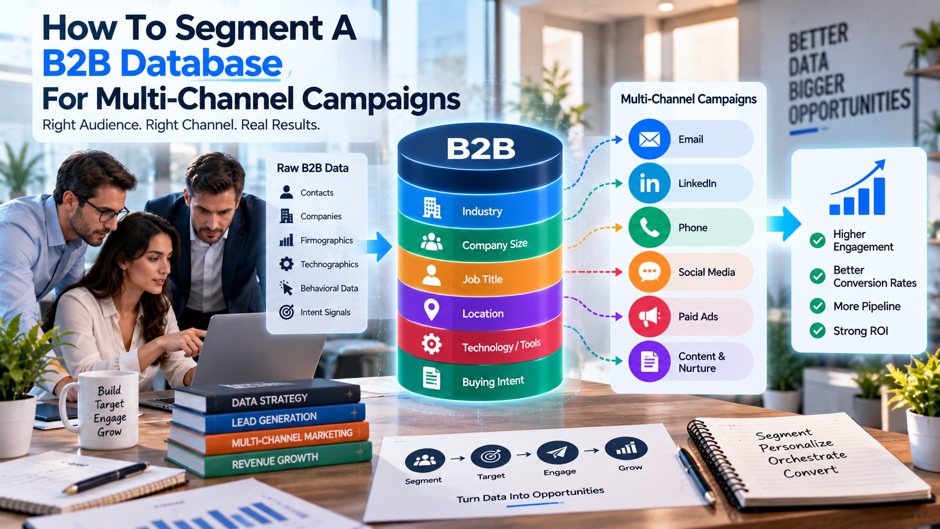
Most B2B teams segment their database once and reuse that same segmentation across every channel. The problem is that each channel depends on different data requirements, response patterns, and costs per touch. A segmentation model built for one channel may not support another channel effectively.
Genuine multi-channel segmentation requires 2 things most single-purpose lists don’t have: a set of underlying dimensions rich enough to slice the database multiple useful ways, and a clear mapping between each resulting segment and the specific channels that segment’s data quality, buying stage, and value actually justify. A high-intent, high-fit account with a verified direct-dial number and an active decision-maker on LinkedIn deserves a fundamentally different channel mix than a low-fit account whose only usable field is a general company email. Treating both the same way, which is exactly what happens when segmentation logic and channel logic are built separately, wastes budget on the low-fit account and under-invests in the high-fit one.
This guide walks through the core dimensions a B2B database needs to be segmented along, how those dimensions translate into practical channel-ready groupings, and how to build the operational structure for coordinated campaigns.
TL;DR
| Step | What it covers |
| Establish the core segmentation dimensions | Firmographic, demographic, technographic, behavioral, intent, and lifecycle stage, layered rather than used in isolation |
| Audit field coverage before designing segments | Confirm which fields are actually populated at scale, since segmentation logic is worthless against data that doesn’t exist |
| Map each channel’s specific data requirements | Email, LinkedIn, phone, direct mail, and ABM display each depend on different fields being present and verified |
| Build a segment-to-channel matrix | Assign each resulting segment to the channel mix its data quality and value actually justify, not a uniform mix applied everywhere |
| Sequence channels rather than running them in parallel | Coordinated, ordered touches across channels consistently outperform simultaneous, uncoordinated ones |
| Set a re-segmentation cadence | Segments decay as behavior, intent, and firmographic details change; a static segmentation model degrades quickly |
The underlying principle connecting every step: segmentation isn’t a one-time list-building exercise. It’s an ongoing operational layer that has to stay aligned with both the data actually available and the specific channels a campaign intends to run, and every step below builds on that same core principle.
The 6 Dimensions That Make Up Real B2B Segmentation
Most databases get segmented along a single dimension, typically firmographic, and stop there. Effective multi-channel segmentation layers multiple dimensions together, because each one answers a genuinely different question about a given account or contact, and no single dimension answers all of them on its own, regardless of how well it’s applied.
Firmographic: Who the Company Is
Firmographic data covers company-level attributes: industry vertical, employee headcount band, annual revenue range, headquarters location, and growth stage or funding status. This is the B2B equivalent of demographic data and functions as the baseline fit filter most segmentation models start from, since it answers the most fundamental question of whether a company even resembles the kind of customer that’s historically converted and stayed.
Demographic: Who the Person Is
Within a firmographically qualified company, demographic data covers the individual: job title, seniority level, department, and functional role. A VP of Engineering and a procurement manager at the same qualified account need fundamentally different messaging, and in many cases different channels entirely, which is exactly why firmographic fit alone never produces a usable segment on its own.
Technographic: What Tools the Company Runs
Technographic data captures the technology stack a company actually uses: CRM platform, cloud provider, marketing automation tool, and other relevant software. For companies selling a product that integrates with or replaces a specific tool, technographic segmentation identifies exactly which accounts represent a genuine integration opportunity or a genuine displacement opportunity, distinct from firmographic fit alone.
Behavioral: What the Record Has Actually Done
Behavioral data tracks observed actions: pages visited, emails opened, content downloaded, demo requested, product feature used, or trial started. Behavior is widely considered the single strongest buying signal available precisely because it’s revealed through actual action rather than simply stated or loosely inferred, and a contact who has taken several meaningful actions represents a categorically different opportunity than one who matches the same firmographic and demographic profile but has taken none.
Intent: What They’re Researching Right Now
Intent data, whether first-party (activity happening on your own site and owned assets) or third-party (research activity happening across the broader web, tracked through content consumption and comparison-site activity), answers a question firmographic and demographic data structurally cannot: is this account actively in a buying motion right now, or simply a theoretical fit that happens to match the target profile on paper.
Lifecycle Stage: Where They Sit in the Journey
Lifecycle stage, spanning new lead, marketing qualified lead, sales qualified lead, active opportunity, and existing customer being evaluated for expansion, determines both the appropriate message and the appropriate channel intensity. A brand-new lead with no prior engagement history at all justifies a fundamentally lighter-touch approach than an active opportunity already deep in a live sales conversation, regardless of how identical the two might look on firmographic and demographic criteria alone.
Why Firmographic Fit Alone Never Produces a Usable Segment
Firmographic data answers “who fits the target market,” but a segment built purely on that single dimension tends to be too large, too undifferentiated, and too disconnected from actual buying readiness to drive an efficient multi-channel campaign on its own, no matter how carefully the initial criteria were chosen.
What gets lost when firmographic data stands alone as the entire segmentation model:
- No distinction between a company that fits the profile and has shown zero engagement versus one actively researching the exact problem your product solves
- No indication of which specific individual within a qualified company actually holds purchasing influence or decision authority
- No signal for timing, meaning outreach gets triggered by list membership alone rather than by any actual readiness indicator
- No differentiation in channel appropriateness, since a firmographic-only segment treats a 5,000-employee enterprise account and a 50-employee account identically despite needing entirely different sales motions and channel investment levels
Why layering additional dimensions fixes this:
Combining firmographic fit with intent data answers whether a given account is genuinely in motion right now. Combining firmographic fit with technographic data reveals whether the specific integration or displacement opportunity your product actually addresses genuinely exists at that particular account. Combining firmographic fit with behavioral data clearly distinguishes a passive, theoretical match from an actively engaged, real prospect. Layering all of these together, rather than treating any single dimension as sufficient on its own, is what separates a genuinely actionable segment from a list that merely looks organized.
Auditing Field Coverage Before Designing Any Segment
Segmentation logic built against fields that don’t actually exist in the database at meaningful scale isn’t a segmentation strategy. It’s an aspiration that will fail the moment it’s put into practice, and this audit step is the one most frequently skipped under timeline pressure, precisely because it feels like a delay rather than progress.
The core fields to check coverage on before finalising any segmentation model:
| Field category | Specific fields to audit | Why coverage matters |
| Company identity | Company name, domain, industry, headcount band, HQ country | The baseline every firmographic segment depends on |
| Contact identity | Full name, verified work email, job title, seniority, department | Determines whether demographic and persona-based segmentation is even possible |
| Behavioral data | Last activity date, engagement score, specific product or content events | Without this, behavioral segmentation defaults to guesswork |
| Firmographic depth | Revenue band, funding status, headcount growth trend | Adds precision beyond the basic firmographic baseline |
| Channel-specific fields | Direct-dial phone, LinkedIn profile URL, verified mailing address | Each missing field disqualifies an entire channel for that record |
A database where half the contact records have no populated job title cannot support seniority-based segmentation, no matter how sophisticated the intended segmentation model looks on a whiteboard. Most teams discover, once they actually run this audit, that contact data quality, not segmentation logic, is the real limiting factor holding back an otherwise well-designed multi-channel strategy.
Mapping Data Requirements to Each Channel
This is the step most single-purpose segmentation models skip entirely, and it’s the one that determines whether a “multi-channel campaign” is genuinely coordinated or simply several single-channel campaigns sharing a spreadsheet and calling themselves one strategy without ever actually functioning as one coherent, connected effort that any of the teams involved would recognise as coordinated if asked directly.
What Each Channel Actually Requires to Function
Email requires, at minimum, a verified, deliverable work email address, and ideally a confirmed engagement history if the segment is meant to support ongoing nurture rather than a single cold touch. Email scales further than any other B2B channel and typically makes up the largest share of a coordinated outreach mix, but its effectiveness depends entirely on deliverability, meaning a segment built on unverified or stale email addresses undermines the entire channel regardless of how carefully-targeted the underlying list otherwise is, since even a perfectly segmented, well-targeted audience produces no meaningful results at all if the emails sent to reach them never actually land in an inbox in the first place.
LinkedIn outreach and advertising require an accurate, current profile match, either through a direct profile URL or through name-and-company data precise enough to produce a reliable platform match. LinkedIn works particularly well for building familiarity ahead of a direct outreach touch and for reaching contacts whose email deliverability is uncertain, since a LinkedIn connection doesn’t depend on email infrastructure at all.
Phone and direct outreach require a verified direct-dial number, not just a general company switchboard line, since the effort-to-connect ratio on a cold call to an unverified number makes this channel prohibitively inefficient at scale without that specific data point. Phone is typically reserved for higher-value segments specifically because the cost per attempted touch is meaningfully higher than email or LinkedIn.
Direct mail requires a verified, current physical mailing address tied to the individual, not simply the company’s general office address, and works best for higher-value accounts where a tangible, harder-to-ignore touch justifies its materially higher cost per contact compared to digital channels.
ABM display advertising requires either a confirmed company domain for account-based IP targeting or a matched contact list clean enough to produce a meaningful match rate against the advertising platform’s targeting system, since a low match rate means a large share of the intended budget simply never reaches its target audience at all, effectively burning spend on impressions nobody in the actual target account ever sees.
Why a Segment Missing One Field Doesn’t Disqualify the Whole Record
A contact missing a verified phone number isn’t disqualified from every channel, only from the channels that specifically depend on that field. The practical implication is that segmentation for multi-channel campaigns shouldn’t produce a single binary “in the campaign or not” classification, but rather a channel-by-channel eligibility profile for each record, where a given contact might qualify for email and LinkedIn while being excluded from the phone and direct mail tracks simply because the underlying data those channels require isn’t present or verified for that specific record.
Building the Segment-to-Channel Matrix
Once the underlying dimensions are established and field coverage has been audited, the practical output is a matrix connecting each resulting segment to the specific channel mix its data quality and account value actually justify, rather than a uniform channel mix applied indiscriminately across every account regardless of how different their underlying profiles actually are.
| Segment profile | Recommended channel mix | Why this mix fits |
| High firmographic fit + active intent signal + verified contact data across all channels | Coordinated email, LinkedIn, phone, and potentially direct mail | Highest-value opportunity; the full multi-touch investment is justified by both fit and timing |
| High firmographic fit + no intent signal yet + strong contact data | Email nurture plus LinkedIn familiarity-building, phone held in reserve | Good fit but no urgency signal yet; lighter-touch channels build awareness ahead of a heavier investment later |
| Moderate fit + strong behavioral engagement | Email plus targeted ABM display reinforcing recent engagement | Behavior indicates genuine interest even without a perfect firmographic match; digital channels are cost-efficient here |
| High fit + incomplete contact data (email only, no phone or LinkedIn match) | Email-only sequence with a data enrichment task queued before expanding channels | The channel mix is constrained by data availability, not by strategic choice |
| Low fit or unqualified | Excluded from active outreach entirely, or routed to a low-cost automated nurture track only | Protects budget from being spent on accounts unlikely to convert regardless of channel investment |
This matrix isn’t static. A segment sitting in the “no intent signal yet” row today can move into the top-priority row the moment a genuine intent signal appears, which is exactly why the underlying segmentation model needs to refresh regularly, on a cadence matched to how quickly the relevant signal decays, rather than being built once and treated as a permanent, unchanging structure that no longer reflects the accounts it was originally built to describe.
Sequencing Channels Rather Than Running Them in Parallel
Building the right segment-to-channel matrix solves only half the problem. The other half is sequencing channels so each touch builds from the previous interaction.
A common, well-tested sequencing pattern for a high-priority segment:
| Step | Channel | Timing | Purpose |
| 1 | Personalized email | Day 1 | References a specific, relevant trigger event rather than a generic opener |
| 2 | LinkedIn connection or engagement | 2 to 3 days later | Reinforces the sender’s name and offers a lower-friction way to respond than a cold email reply |
| 3 | Phone touch | Shortly after the LinkedIn step | Lands with genuine context since the prospect has already seen the name at least twice |
| 4 | Follow-up email | Closes the initial sequence | References the earlier touches directly rather than restarting the conversation from nothing |
This 4-step pattern is a starting template, not a rigid formula. Some teams add a second LinkedIn touch between steps 3 and 4, and higher-value segments sometimes insert a direct mail step ahead of the phone call specifically to give the phone conversation a physical artifact to reference. What matters more than the exact step count is the underlying principle: each touch should build on what the prior one already established, rather than treating every channel as an isolated, disconnected attempt to reach the same prospect.
Why sequencing outperforms parallel, uncoordinated channel firing:
Coordinated, deliberately ordered sequences consistently produce meaningfully more responses than the same channels run independently and simultaneously on the same list, because each touch builds contextual trust rather than arriving as an isolated, unexplained interruption. It typically takes several touchpoints, commonly cited in the range of 6 to 8 distinct touches, to generate a meaningful response from a genuinely cold B2B contact, and a sequence spreading those touches across multiple channels, rather than repeating the same channel 6 to 8 times, both increases the odds of actually reaching the prospect in a context where they’re receptive and reduces the fatigue any single channel accumulates from repeated, undifferentiated contact directed at the same prospect over a short window of time.
What breaks sequencing in practice:
The most common operational failure is running email, LinkedIn, and phone from 3 separate tools or 3 separate team owners with no shared visibility into what the others have already sent. This produces exactly the disjointed experience sequencing is designed to prevent: a prospect receiving a cold call referencing nothing from the email they received 2 days earlier, or a LinkedIn message landing the same day as an unrelated cold email, both arriving as though the sender has no memory of their own prior outreach.
Who Owns Segmentation Across Marketing, Sales, and RevOps
Segmentation that lives entirely inside a marketing automation platform, disconnected from what sales reps actually see and act on, tends to drift out of alignment with reality quickly, regardless of how well it was designed initially. Clarifying ownership across functions is what keeps the model current and genuinely used rather than becoming a one-time artifact nobody maintains.
How ownership typically divides across a well-functioning multi-channel operation:
- Marketing or demand generation typically owns the underlying segmentation logic itself: which dimensions to layer, how thresholds for each tier are defined, and how the segment-to-channel matrix gets structured and updated over time
- RevOps or marketing operations typically owns the data infrastructure that makes segmentation possible at all: field coverage audits, data enrichment vendor relationships, deduplication, and the technical plumbing connecting the database to every channel-specific tool in the stack
- Sales development or outbound teams typically own execution within the higher-touch channels, phone and personalized outreach specifically, and are often the first to notice when a segment’s data quality doesn’t match what the segmentation model assumed
- Sales leadership typically owns the feedback loop confirming whether segments the model identified as high-value are actually converting into real pipeline and revenue, closing the loop between segmentation theory and commercial outcome
Why unclear ownership is a common, quiet cause of segmentation decay:
When no single function is clearly accountable for keeping the segmentation model current, it tends to freeze at whatever state it was in when it was first built, even as the underlying data, market conditions, and product positioning continue evolving around it. Sales reps working from a segment they’ve learned not to trust, because it hasn’t reflected reality in months, quietly stop using it and revert to their own informal prioritization methods, which defeats the entire purpose of building a shared, data-driven segmentation model in the first place. Establishing explicit ownership, and a regular cross-functional review cadence where marketing, RevOps, and sales leadership actually look at segment performance together, is what prevents this quiet erosion from happening unnoticed over successive quarters.
Common Segmentation Mistakes That Undermine Multi-Channel Campaigns
Beyond the structural issues already covered, several recurring mistakes show up consistently across teams attempting to run genuinely coordinated multi-channel campaigns, regardless of company size, industry, or how sophisticated their underlying tooling happens to be at the time these mistakes typically get made and, more often than not, repeated.
- Building segmentation logic before auditing actual field coverage. Designing an elaborate, multi-dimensional segmentation model on a whiteboard, then discovering the database can’t actually support most of the intended criteria because the relevant fields are sparsely populated, wastes significant planning effort that a field audit at the start would have avoided entirely.
- Treating every segment as eligible for every channel regardless of data quality. Running a phone campaign against a segment where only a fraction of records have a verified direct-dial number produces poor connect rates that get misdiagnosed as a messaging or targeting problem, when the actual issue is simply a channel being applied to a segment whose underlying data never supported that channel choice in the first place.
- Letting segments go stale without a re-evaluation cadence. A segment built around an intent signal detected 3 months ago, still being actively worked as though that signal remains current, wastes outreach on accounts whose buying motion may have already resolved, either toward a competitor who moved faster or toward no purchase decision being made at all during that window.
- Applying identical channel intensity regardless of account value. Investing the same phone and direct mail effort in a small, low-ACV account as in a large enterprise account ignores the fundamentally different economics each channel carries, since the higher cost-per-touch channels only make financial sense when the underlying account value justifies that investment.
- Failing to exclude low-fit accounts explicitly. Without a clear, enforced exclusion rule, low-fit accounts tend to accumulate in active campaigns simply because nobody actively removed them, consuming channel budget and rep attention that would be far better directed toward genuinely qualified accounts sitting further up the priority list.
Each of these 5 patterns is individually easy to fix once named, but they tend to compound when left unaddressed together: stale segments applied to the wrong channels while low-fit accounts sit uncleaned in the active list is a combination that quietly consumes a disproportionate share of campaign budget without any single failure being dramatic enough on its own to trigger a review.
Measuring Whether the Segmentation Model Is Actually Working
Building a well-designed segment-to-channel matrix and a coordinated sequencing plan is necessary but not sufficient. Without a deliberate measurement layer sitting on top of it, there’s no reliable way to tell whether the segmentation logic is actually producing better outcomes than the single-purpose list it replaced.
The Metrics That Reveal Whether Segmentation Is Adding Value
| Metric | What it reveals | Why it matters specifically for segmentation |
| Response rate by segment, not just by campaign | Whether specific segments outperform others meaningfully | A blended campaign-level response rate hides which segments are actually driving results and which are dragging the average down |
| Channel performance by segment | Whether a given channel is actually justified for a given segment | Confirms or disproves the assumptions built into the segment-to-channel matrix |
| Cost per meeting or opportunity by segment | Whether higher-cost channels are producing proportionally higher-value outcomes | Validates whether phone and direct mail investment in top-tier segments is actually paying off |
| Data coverage decay over time | Whether field quality is degrading as the database ages | Segmentation quality is only as good as the underlying data feeding it, and that data decays continuously |
| Segment migration rate | How often accounts move between segments as new signals arrive | A healthy, responsive segmentation model shows regular movement; a static one suggests the underlying signals aren’t being refreshed |
Why Blended Reporting Hides the Real Picture
A campaign dashboard reporting a single overall response rate across the entire contact list obscures exactly the variation a segmentation strategy is supposed to reveal and act on. A high-fit, high-intent segment converting at a strong rate can be masked by a low-fit segment dragging the blended average down, leading a team to conclude the overall campaign underperformed when in reality the top segment performed excellently and simply needed more budget, while the bottom segment should have been excluded from active outreach entirely rather than included in the blended report at all.
Breaking every core metric out by segment, rather than reporting only at the campaign or channel level, is what actually validates or disproves the assumptions built into the original segmentation model, and it’s the feedback loop that should inform how the segment-to-channel matrix gets adjusted in each subsequent planning cycle rather than being built once and left unchanged indefinitely.
FAQs
How many segmentation dimensions does a database actually need before running a multi-channel campaign?
There’s no universal minimum, but most effective B2B motions blend at least 2 or 3 dimensions rather than relying on a single one. A reasonable default sequence for teams building this capability for the first time is starting with firmographic fit, adding demographic or persona-level detail to determine messaging, and layering behavioral or intent data once there’s enough volume of that signal to act on meaningfully. Technographic segmentation becomes a worthwhile addition specifically when the product being sold has a clear integration or displacement relationship with a specific, identifiable tool.
What should a team do if most of the database lacks the fields needed for sophisticated segmentation?
Prioritise a data enrichment effort before attempting to build an elaborate segmentation model on top of insufficient underlying data. Appending missing firmographic details, verifying existing email addresses, and confirming job titles and seniority levels for the highest-value accounts first, rather than the entire database indiscriminately, typically produces a better return than attempting sophisticated multi-dimensional segmentation against a dataset where half the required fields are simply empty, since no amount of clever segmentation logic can compensate for data that was never there to begin with.
Should every segment run through every available channel?
No, and attempting this is one of the most common and costly mistakes in multi-channel campaign design. Channel assignment should follow directly from the segment-to-channel matrix logic covered earlier in this guide, where both data availability and account value determine which channels a given segment justifies, rather than defaulting to a uniform channel mix applied indiscriminately across every segment regardless of fit or value.
How often should segments be refreshed or re-evaluated?
Behavioral and intent-based segments benefit from frequent refresh, often weekly or even more often for high-velocity sales motions, since these signals are inherently time-sensitive and decay quickly. Firmographic and technographic segments, which change more slowly, can reasonably be refreshed on a monthly or quarterly cadence. The specific cadence matters less than having one explicitly defined and consistently followed, since the most common failure mode is simply never revisiting a segmentation model after its initial build.
What’s the difference between multi-channel and omnichannel in this context? Multi-channel refers to running outreach across 2 or more channels, which can happen with or without coordination between them. Omnichannel specifically implies coordination, where activity on one channel informs and adjusts what happens on the others, creating a single adaptive sequence rather than several parallel, independently operating efforts. The segmentation and sequencing approach covered throughout this guide is specifically designed to produce genuine omnichannel coordination rather than merely multi-channel activity running in an uncoordinated, parallel fashion.
How does intent data specifically change channel prioritisation?
A strong intent signal, particularly one indicating active, current research into a problem the product solves, typically justifies accelerating a segment into higher-cost, higher-touch channels like phone outreach or direct mail sooner than firmographic and demographic fit alone would support. Without an intent signal, a firmographically qualified account might reasonably sit in a lighter-touch email and LinkedIn nurture track for an extended period before justifying the additional investment that phone or direct mail outreach represents.
Can this segmentation approach work for a smaller B2B team without a dedicated RevOps function?
Yes, though the sophistication of tooling will necessarily differ. Smaller teams can still apply the same underlying logic manually or with lighter-weight tools: auditing field coverage honestly, layering at minimum firmographic and behavioral data rather than relying on firmographic fit alone, and building even a simple, manually maintained segment-to-channel matrix rather than treating every account identically. The core discipline of matching channel investment to genuine data quality and account value matters more than the sophistication of the underlying technology stack used to apply it, and a spreadsheet-based version of this discipline consistently outperforms a sophisticated tool applied without it.