What Is Data Licensing and How It Differs From Buying a List
A marketing director signs a purchase order for “50,000 B2B contacts,” receives a CSV file, and assumes the transaction is finished: money changed hands, a file arrived, ownership transferred, end of story. Nine months later, a compliance review turns up a clause buried in the original terms of sale restricting use to a single campaign, prohibiting the file from being uploaded into a CRM for ongoing use, and reserving the vendor’s right to audit how the data was actually deployed. The director didn’t buy a list in the way the word “buy” usually implies. They licensed one, under terms they never read closely enough to notice, and the gap between what they thought they purchased and what they were legally entitled to do with it is exactly the confusion this guide exists to clear up.
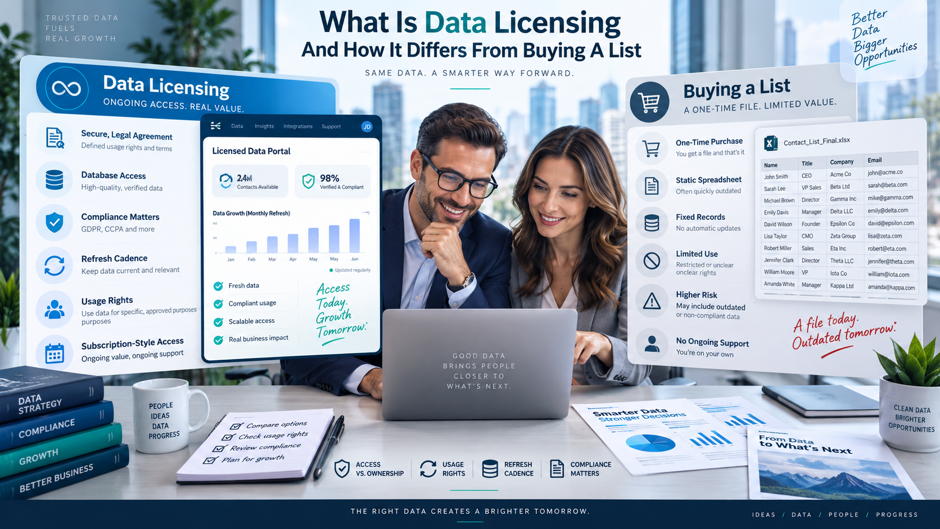
Data licensing and buying a list are often used interchangeably in casual conversation. In practice, the difference depends on the contract terms. A license generally grants specific rights to use data while the provider retains ownership of the dataset. Buyers need to review the agreement carefully to understand the rights granted and restrictions that apply.
TL;DR
| Dimension | Buying a list (as commonly understood) | Data licensing |
| What transfers | A file, delivered once, with the buyer assuming full ownership | Defined, bounded rights to access and use data the licensor continues to own |
| Duration | Assumed to be permanent and unrestricted | Explicitly scoped: term-limited, perpetual, or subscription-based, stated in the contract |
| Usage scope | Assumed unlimited unless the buyer reads the fine print | Explicitly defined: internal use only, single campaign, specific users, specific systems |
| Refresh and accuracy | A static snapshot that decays from the moment of delivery | Often includes ongoing refresh, updates, or access to a live feed as part of the terms |
| Redistribution rights | Frequently assumed to be allowed, rarely actually granted | Explicitly addressed through sublicensing clauses, almost always restrictive by default |
| Legal warranties | Often minimal or absent | Typically includes warranties on lawful sourcing and indemnification if those warranties are false |
| What underlies the legal reality | Raw facts and data are not copyrightable in the US under Feist v. Rural Telephone, which limits what “ownership” of a contact list can even mean | The license itself, not the data’s IP status, is what actually defines and protects the buyer’s rights |
The core takeaway: almost every “list purchase” in this market is legally a license, whether or not either party actually uses that word, and the terms buried inside that license are what determine what a business can actually, lawfully do with the data it paid for.
Why “Buying a List” Rarely Means What Buyers Assume
The word “buy” carries an implicit promise of full, unrestricted ownership that the underlying legal and commercial reality of contact data almost never actually delivers, no matter how confidently or repeatedly a vendor’s sales page happens to use that specific word throughout its marketing copy and pricing tables.
The Legal Foundation: Facts Aren’t Copyrightable
In the United States, the Supreme Court’s ruling in Feist Publications, Inc. v. Rural Telephone Service Co. established that raw facts and data are not protected by copyright, only the original, creative selection and arrangement of those facts can be. This matters enormously for contact data specifically, because a name, a job title, and a business email address are facts, not creative expression, which means the intellectual property protections available to a data seller are inherently more limited than the protections available to, say, a software company selling licensed code. A vendor “selling” a list isn’t transferring ownership of facts that were never ownable as facts in the first place; they’re granting permission to access and use a compiled dataset, which is precisely the structure of a license, not a sale.
What This Means for the Transaction Itself
Because the underlying facts aren’t independently protectable, the terms attached to the transaction, not the nature of the data itself, are what actually define what a buyer can lawfully do. A vendor’s terms of sale, however that document is labelled, typically restrict use to specific campaigns, specific internal teams, or a specific time window, and these restrictions exist and bind the buyer regardless of whether the invoice used the word “purchase” or “license.” A buyer who assumes the word “buy” on an invoice grants unrestricted, permanent rights is working from an assumption the underlying contract almost never actually supports.
What a Data Licensing Agreement Actually Contains
A genuine data licensing agreement, the kind long used across financial data and market research and now increasingly applied to contact and prospecting data as well, is explicit about exactly what it grants rather than leaving the actual scope open to buyer assumption, hope, or simple guesswork after the fact.
The Core Components Every Licensing Agreement Addresses
| Component | What it actually defines |
| Scope of license and exclusivity | Precisely what the licensee is permitted to do: view the data, use it for internal marketing, integrate it into a product, or redistribute it to third parties, each representing a separately priced grant of rights |
| Duration | Whether the license is perpetual, granting indefinite use, or term-limited, expiring unless renewed; subscription-based licensing with automatic renewal is by far the most common structure, since genuinely perpetual licenses are rare and command a significantly higher price |
| Sublicensing rights | Whether the licensee can extend access to subsidiaries, affiliated companies, agencies, or their own customers; the default position, unless explicitly negotiated otherwise, is that sublicensing is prohibited |
| Derivative works | Whether the licensee can build new products or enriched datasets using the licensed data as an input, and who owns the resulting derivative; frequently one of the most heavily negotiated points in a commercial deal |
| Number of users and systems | The actual scope of access, distinguishing per-named-user pricing from enterprise-wide access, and clarifying whether production, staging, and development environments each require separate licensing |
Each of these 5 components is independently negotiable, and a licensing agreement that leaves any one of them vague or unaddressed effectively hands the licensor discretion to interpret it however suits them later, which is exactly the ambiguity a well-drafted agreement is meant to close off from the start.
Warranties, Indemnification, and Who Bears the Risk
A properly structured licensing agreement includes warranties from the licensor confirming the data was collected lawfully and that the licensor genuinely holds the rights being granted, paired with indemnification protecting the licensee if those warranties later prove false. This detail matters enormously in practice, since regulators in several jurisdictions have pursued the buyer of unlawfully sourced data, not only the original seller, when that data gets used for marketing without a valid legal basis. A licensing agreement with genuine warranties and indemnification shifts at least some of that risk back onto the party that actually controlled how the data was originally collected.
How “Buying a List” Typically Compares Field by Field
Laying the 2 models side by side against a set of specific, concrete contractual terms makes the practical gap between them considerably clearer than any abstract legal description alone could ever really manage to convey on its own, no matter how carefully or thoroughly that description happened to be written out.
| Term | Typical “buy a list” transaction | Typical data licensing agreement |
| Ownership of underlying data | Assumed by the buyer, rarely explicitly addressed in the contract | Explicitly retained by the licensor; the contract states this directly |
| Permitted use | Loosely implied, often just “marketing use” | Specifically defined: which campaigns, which teams, which systems |
| Redistribution | Not addressed, creating ambiguity the buyer may wrongly resolve in their own favour | Explicitly restricted through a sublicensing clause |
| Data freshness | A single, static delivery with no ongoing obligation from the seller | Frequently includes refresh cycles or live access as part of the ongoing terms |
| Audit rights | Rarely present | Common; the licensor retains the right to confirm the licensee is complying with usage terms |
| Termination | Rarely defined, since the transaction is treated as complete at delivery | Explicitly defined: what happens to the data and the licensee’s rights when the agreement ends |
| Price structure | One-time payment | Often subscription-based, tied to ongoing access or periodic refresh |
Why This Gap Creates Real Operational Risk
A buyer operating under the informal “I bought this, I own it” assumption while the actual governing contract imposes campaign-specific restrictions, no redistribution rights, and an audit clause is operating with a materially different risk profile than they believe they are. This gap rarely surfaces until an audit, a compliance review, or a dispute forces someone to actually read the contract’s fine print, at which point the mismatch between assumption and reality has often already shaped months or years of how the data was used across the organisation.
Why Buyers Confuse the Distinction Between Purchase and Licensing
The ambiguity between “buying” and “licensing” often comes from how these terms are presented in the market. Buyers should review the actual agreement rather than relying only on product descriptions or labels.
“Buy” sells more easily than “license.” A one-time purchase framed as complete, final ownership feels simpler and more attractive to a buyer than a licensing relationship that implies ongoing obligations, restrictions, and the possibility of an audit, even when the underlying legal reality is closer to the latter than the former.
Vague terms reduce friction at the point of sale. A vendor whose terms of sale don’t clearly spell out usage restrictions, redistribution limits, or audit rights faces fewer objections during the sales process than one who states these terms explicitly upfront, even though the restrictions typically exist in the contract either way.
Some vendors genuinely do offer broader rights, and market them as such. Providers offering what they explicitly describe as one-time licensing with unlimited internal usage rights, allowing reuse across teams and campaigns without additional fees, are offering something closer to what buyers assume “buying a list” means by default. This kind of broad, internally unrestricted grant exists on the market, but it’s the exception clearly negotiated and stated, not the default that applies whenever a transaction happens to be labelled a purchase.
The distinction matters most when something goes wrong. As long as a buyer’s actual use of the data stays well within whatever restrictions the contract happens to impose, the gap between assumption and reality may never surface at all. It becomes consequential specifically when a buyer wants to do something the underlying terms don’t actually permit: share the data with an agency partner, upload it into a system the license didn’t anticipate, or continue using it past a term limit nobody at the buying organisation tracked.
The Compliance Dimension: Who Bears Risk If the Data Was Sourced Unlawfully
Beyond usage rights alone, the licensing-versus-buying distinction carries direct, genuinely real, and often expensive consequences for who ends up legally exposed if the underlying data later turns out to have been collected in a way that violates applicable privacy or marketing law somewhere along its original journey.
Why This Isn’t a Purely Theoretical Concern
Regulators enforcing GDPR and similar frameworks have, on multiple documented occasions, pursued the buyer of data for using it unlawfully, not only the original vendor who compiled and sold it. The reasoning is straightforward once stated plainly: a broker cannot transfer a lawful basis for processing personal data that the broker never actually held in the first place, and a buyer deploying that data for marketing inherits responsibility for having a valid basis of their own, regardless of what assurances the seller offered informally during the sales process.
How a Genuine Licensing Agreement Addresses This
A properly structured data licensing agreement includes specific warranties that the licensor collected the underlying data lawfully, and indemnification provisions that shift financial responsibility back onto the licensor if those warranties turn out to be false. This is a meaningfully different risk position than a casual list purchase with no such warranties, where the buyer has little contractual recourse if the data turns out to have been scraped, sourced without a valid legal basis, or compiled in a way that creates downstream liability for the buyer using it.
What to Actually Look for in the Contract
The specific documentation a genuinely protective agreement should include:
- A clear statement of the legal basis under which the underlying data was originally collected, not a vague assurance that the vendor is “compliant”
- An explicit warranty that the licensor holds the rights being granted and hasn’t exceeded what it’s actually entitled to license to a third party
- Indemnification language specifying what happens, financially and legally, if the warranty above later proves inaccurate
- A defined process for handling data subject requests and opt-outs that flow through to the licensee’s own use of the data, not just the licensor’s original database
A licensing agreement that’s missing all 4 of these specific elements offers little more genuine legal protection than an entirely informal, undocumented purchase would, regardless of how confidently and persuasively the vendor markets their own compliance posture during the original sales conversation that ultimately led to the deal.
Practical Differences in Day-to-Day Use
Beyond the legal structure covered above, licensing and outright purchase behave quite differently in the actual, lived operational experience of a team using the underlying data week after week, over an extended period of genuinely ongoing, real-world outreach, prospecting, and campaign activity that never really stops.
Data Freshness and the Decay Problem
A traditional list purchase delivers a single, static file at one point in time, and from that moment forward, the data begins decaying with no further obligation on the seller’s part to refresh or correct it. B2B contact data decays continuously as people change roles, companies merge, and email addresses get reassigned, which means a static purchased file that looked accurate on delivery day can be meaningfully stale within months, with the full cost of that decay falling entirely on the buyer.
A genuine data licensing arrangement, by contrast, frequently includes ongoing access to a refreshed dataset or a live feed as an explicit part of what’s being paid for, rather than a one-time snapshot. This is one of the most concrete, practical advantages of a licensing structure over a static purchase for any use case involving ongoing, rather than one-time, outreach.
Redistribution and Multi-Team Use
Organisations that need the same underlying data accessible across multiple teams, regions, or business units run into the sublicensing question directly and immediately. A static list purchase with no explicit redistribution terms leaves this genuinely ambiguous, while a properly negotiated licensing agreement addresses it directly, either granting broader internal use explicitly or making clear that separate licensing is required for each additional use case.
What Happens When the Relationship Ends
A one-time list purchase, treated informally as a completed transaction, rarely specifies what happens to the data after delivery, since the assumption is that the buyer now owns it indefinitely. A licensing agreement typically addresses this directly through a termination clause specifying whether the licensee must delete or return the data once the agreement ends, which matters considerably for any organisation relying on a term-limited or subscription-based arrangement rather than something explicitly perpetual.
When Licensing Makes More Sense Than a One-Time Purchase
Neither structure is universally suitable for every situation. The right choice depends on the intended use, required rights, contract terms, and how the data will be managed over time.
Licensing tends to fit better when:
- The use case involves ongoing, repeated outreach over an extended period rather than a single campaign, making the refresh and accuracy benefits of a licensing arrangement genuinely valuable rather than an unused feature being paid for
- Multiple teams or business units need access to the same underlying data, making the explicit multi-user and sublicensing terms a licensing agreement addresses directly more valuable than the ambiguity a simple purchase leaves unresolved
- The organisation needs contractual warranties and indemnification protecting against the risk that the underlying data was sourced unlawfully, particularly relevant for regulated industries or organisations with meaningful GDPR exposure
- The data itself needs to stay current over time, such as firmographic or technographic information that changes as companies grow, merge, or adopt new technology, rather than remaining static and accurate as delivered
A one-time purchase can reasonably fit better when:
- A single, time-boxed campaign is the entire intended use case, and the value of ongoing refresh or multi-user access genuinely doesn’t apply to how the data will actually be used
- Budget constraints make an ongoing subscription commitment impractical, and the buyer has clearly assessed and accepted the decay risk that comes with a static file
- The specific vendor offers unusually broad usage rights within what’s technically labelled a one-time purchase, effectively delivering licensing-equivalent flexibility without the subscription commitment, provided those broader rights are explicitly stated in writing rather than assumed
Neither list above is exhaustive, and a specific deal can reasonably satisfy criteria from both sides at once, in which case the decision usually comes down to whichever risk, decay on one side or unnecessary subscription cost on the other, the organisation is genuinely less willing to accept.
How the Distinction Shifts Across Different Data Types
The buying-versus-licensing question doesn’t play out identically across every single category of data an organisation might purchase, and understanding how the distinction genuinely shifts by data type helps calibrate realistic expectations before evaluating any specific vendor’s actual offering in real, genuinely meaningful detail rather than in the abstract.
Contact and Prospecting Data
Standard B2B contact lists, names, titles, emails, and company affiliations, sit at the lower-stakes end of this spectrum in most cases, since the individual facts involved carry limited independent commercial value and the underlying compilation, not any single fact, is what’s actually being licensed. Even here, though, the terms attached to the transaction still determine whether ongoing use, redistribution, or multi-team access is actually permitted, which is precisely the gap this guide has focused on throughout.
Market and Financial Data
Trading data, market research, and financial datasets typically involve considerably more formal, heavily negotiated licensing agreements, often including strict per-user or per-system access controls, explicit prohibitions on redistribution, and severe contractual penalties for unauthorised sharing. The stakes are higher because this data often feeds directly into commercial decision-making or products sold onward to the licensee’s own customers, which is exactly the kind of downstream, revenue-generating use a licensor has strong, obvious commercial reasons to control tightly and deliberately through the specific terms written into the agreement itself.
AI and Machine Learning Data Licensing
AI and machine learning data licensing introduces additional considerations when data is used beyond traditional B2B contact data applications. For contact data licensing, the primary focus remains on permitted use, access rights, and contractual terms.
Why This Matters for Evaluating Any Specific Vendor
Recognising which category a given data purchase actually falls into helps set realistic expectations for how detailed and restrictive the governing terms are likely to be. A buyer expecting the loosely defined, informally governed terms typical of a small contact-data purchase will be caught off guard by the considerably more detailed and restrictive terms standard in market data or AI training data licensing, and the reverse mismatch, expecting heavy restrictions on a simple contact list, can lead a buyer to over-negotiate a transaction that never needed that level of scrutiny in the first place.
Questions to Ask Before Signing Either Type of Agreement
Regardless of which structure a specific vendor calls their offering, whether they use the word purchase, license, subscription, or something else entirely different, a consistent set of prepared, direct questions clarifies what’s actually being granted well before any money ever actually changes hands between the 2 parties involved.
The questions that clarify actual scope, regardless of how the vendor labels the transaction:
- Does the contract explicitly state who retains ownership of the underlying data, and if the answer is ambiguous, what does that ambiguity imply about the buyer’s actual rights
- What specific uses are permitted, and are they defined narrowly, such as a single named campaign, or broadly, such as unrestricted internal marketing use across the organisation
- Can the data be shared with an external agency, a sister company, or another business unit without triggering a separate licensing requirement
- Is there a defined refresh cycle, or is this a one-time, static delivery with no ongoing obligation from the vendor
- What warranties exist regarding how the underlying data was originally collected, and what indemnification applies if those warranties later prove inaccurate
- What happens to the data, contractually, if the relationship ends, whether through a term limit expiring or a decision to switch vendors
- Does the vendor retain any audit rights, and if so, what would trigger an actual audit of the buyer’s usage
A vendor able to answer every one of these questions specifically and in writing is offering a transaction with real, enforceable terms, regardless of whether the word on the invoice is “purchase” or “license.” A vendor who deflects several of these questions is signalling that the actual terms may be considerably more restrictive, or considerably more ambiguous, than the simple word “buy” implies.
FAQs
If a company “buys” a list outright, does that mean they fully own the data afterward?
Not necessarily, and this is precisely the misconception this guide addresses directly. Because raw facts and data generally aren’t protected by copyright in the way creative works are, what a buyer typically receives isn’t ownership of the underlying facts but a bounded right to use a compiled dataset, governed by whatever terms of sale the vendor attached to the transaction, however that document happened to be labelled. The word “buy” printed on an invoice doesn’t override restrictive terms sitting elsewhere in the actual governing contract, regardless of how final and complete that single word might make the transaction feel to the person signing off on it.
Is a data licensing agreement always more expensive than buying a list outright?
Not always, though ongoing licensing arrangements involving continuous refresh or broad multi-user access frequently do carry a higher total cost than a single static file, reflecting the additional ongoing value being delivered. A term-limited or narrowly scoped license can sometimes cost less than a broad, unrestricted one-time purchase, since price generally tracks the actual scope of rights granted rather than whichever label, purchase or license, happens to be attached to the transaction itself on the final invoice or contract cover page.
How can a buyer tell whether a specific vendor’s “list purchase” actually functions more like a license?
Reading the actual terms of sale, not just the marketing page, reveals this directly. If the document specifies permitted uses, restricts redistribution, includes an audit clause, or defines what happens to the data after a certain period, it’s functioning as a license regardless of what word appears on the invoice. The absence of these terms doesn’t necessarily mean unrestricted rights either; it may simply mean the restrictions were never written down clearly, which creates its own separate, distinct risk that’s arguably harder to spot precisely because nothing was written down to raise a flag in the first place.
Does a licensing agreement protect a buyer from liability if the underlying data turns out to have been collected unlawfully?
It can, provided the agreement includes genuine warranties about lawful sourcing and indemnification if those warranties prove false. A licensing agreement without these specific provisions offers little more protection than an informal list purchase, which is why the presence of warranty and indemnification language matters considerably more than whether the transaction is formally labelled a license or a purchase.
Should a small business with a single, one-time campaign bother negotiating a formal licensing agreement?
Probably not in most cases, since the overhead of negotiating detailed licensing terms rarely makes sense for a genuinely limited, one-time use case with modest budget and low compliance exposure. What still matters, even for a small, one-time purchase, is reading whatever terms of sale the vendor does provide and confirming the intended use case, a single campaign from a specific sending platform, actually falls within what’s permitted, rather than simply assuming unrestricted, ownership-equivalent rights by default just because the word “purchase” appeared somewhere in the transaction.
What happens if a company uses licensed data in a way the original agreement didn’t permit?
This constitutes a breach of the licensing agreement and exposes the licensee to whatever remedies the contract specifies, which can range from a requirement to cease the unauthorised use, to financial penalties, to termination of the entire licensing relationship. This is precisely why the audit rights many licensing agreements include exist in the first place: they give the licensor a genuine, contractual mechanism to actually detect unauthorised use early, before it quietly becomes a much larger and considerably harder-to-unwind problem for both parties involved in the relationship.
Are subscription-based data feeds a form of licensing, or something different entirely? Subscription-based data feeds are one of the most common forms data licensing actually takes in practice, particularly for data that needs to stay current over time, such as firmographic, technographic, or intent data. The subscription structure, recurring payment in exchange for ongoing access and refresh, is functionally a term-limited license renewed automatically, which is precisely why treating a subscription data feed and a one-time list purchase as interchangeable, equivalent products leads directly to exactly the kind of scope confusion and mismatched expectations this entire guide has been designed to help buyers recognise and avoid going forward.